
To celebrate innovative campus research, the University of Maryland has been recognizing winners of the Inventions of the Year since 1987. In that time, more than 125 inventions have been awarded the high distinction, selected for their
- technical merit,
- improvements to existing technology,
- commercial potential, and
- overall benefit to society.
Beginning in 2016, the Innovate Maryland platform was established to form a series of programs, bringing together various departments at the University of Maryland, all supporting innovation and entrepreneurship. In that spirit, to celebrate inventions disclosed in 2025 and Maryland entrepreneurs, please join UM Ventures, College Park for

Learn more about the 2025 finalist inventions
171
12
43
Nominated in the Information Sciences category
Teaching Human Fine Motor Skills to Robots via the RAND Laser System
The RAND system captures human tool motions using a camera and laser grid, extracts key waypoints, and maps them to a robot’s workspace from single images. A robotic arm then reproduces the scaled motions, achieving 75% success in tasks as delicate as crab meat extraction— comparable to non-expert human performance. RAND enables rapid, low-cost training of robotic systems to replicate human skills across a wide range of applications, from food preparation to surgery. This represents a significant advance in robot learning, addressing a longstanding challenge in the field and offering broad potential across diverse technical domains.
Inventors:
- Yang Tao - A. James Clark School of Engineering, Fischell Department of Bioengineering
- Anjana Hevaganinge - A. James Clark School of Engineering, Fischell Department of Bioengineering
- Ravidu Hevaganinge - A. James Clark School of Engineering, Fischell Department of Bioengineering
- Joshua Ehizibolo - College of Computer, Mathematical, and Natural Sciences, Department of Physics
High-Resolution Soil Moisture Estimation Using Satellite Data
This invention can support precision irrigation and regional fire risk monitoring. It uses machine learning to augment public satellite data with a reading from a single field-collected sample to create soil moisture maps at 5-10 meter resolution for any crop or terrain worldwide. This approach solves past challenges of low resolution and signal noise caused by vegetation and soil roughness.
Inventors:
- Mehdi Hosseini - College of Behavior and Social Sciences, Department of Geographical Sciences
RACE: Real-time Adaptive Camera Calibration
RACE continuously and autonomously adjusts a camera’s internal parameters—such as focus and lens distortion—in real time using video alone. By adapting to changes over time, it maintains precise visual calibration without manual intervention, significantly improving reliability for robotic and augmented reality systems. This capability addresses a critical limitation for autonomous platforms deployed in environments such as space or deep-sea operations, where recalibration is impossible and extreme accuracy is required. RACE has strong dual-use potential across multiple high-value commercial and government markets.
Inventors:
- Hemant Kumar - A. James Clark School of Engineering, Department of Mechanical Engineering
- Nikhil Chopra - A. James Clark School of Engineering, Department of Mechanical Engineering
- Kaustubh Joshi - A. James Clark School of Engineering, Department of Mechanical Engineering
Nominated in the Life Sciences category
Early Detection of Alzheimer's Disease Using a Quantum Biosensor
The invention is a non-invasive approach to identify early Alzheimer’s Disease (AD) risk signatures both in vitro and in vivo using Quantum Biosensors. Unlike existing methods, this approach can detect elevated AD risk at very early, pre-symptomatic stages, potentially years before overt clinical decline. This enables prevention, stratification for clinical trials, and early intervention.
Inventors:
- Kan Cao - College of Computer, Mathematical, and Natural Sciences, Department of Cell Biology and Molecular Genetics
- Cheng Gong - A. James Clark School of Engineering, Department of Electrical and Computer Engineering
BreathAssist: Respiratory Bag Valve Mask Coach
This technology empowers first responders, families, and bystanders to deliver safe, effective breaths during emergencies, making it an essential tool for anyone working in overdose response or prehospital care. BreathAssist significantly increases efficacy and reduces the risk of lung injury in the use of adult bag valve masks (BVMs), common issues when untrained individuals attempt rescue breathing.
Inventors:
- Jason Rose - University of Maryland School of Medicine
- Kelly Yeung - A. James Clark School of Engineering, Robert E. Fischell Institute for Biomedical Devices, Maryland Technology Enterprise Institute
- Kevin Aroom - A. James Clark School of Engineering, Robert E. Fischell Institute for Biomedical Devices, Maryland Technology Enterprise Institute
- Martha Wang - A. James Clark School of Engineering, Fischell Department of Bioengineering
ASIT: Retraining the Immune System to Cure Autoimmune Disease
This technology offers a groundbreaking strategy to retrain the immune system to stop attacking the body, addressing the root cause of autoimmune diseases. Current practices only manage symptoms and are immunosuppressive. ASIT represents the first truly curative, disease‑specific approach in an immense and rapidly growing therapeutic market for diseases such as type 1 diabetes, multiple sclerosis, celiac, vitiligo, and transplant rejection.
Inventors:
- Christopher Jewell - A. James Clark School of Engineering, Robert E. Fischell Institute for Biomedical Devices, Maryland Technology Enterprise Institute
- Emily Gosselin - A. James Clark School of Engineering, Fischell Department of Bioengineering
- Sean Carey- A. James Clark School of Engineering, Fischell Department of Bioengineering
- Ryan McIlvaine - A. James Clark School of Engineering, Fischell Department of Bioengineering
- Senta Kapnick - A. James Clark School of Engineering, Robert E. Fischell Institute for Biomedical Devices, Maryland Technology Enterprise Institute
- Christopher Bridgeman - A. James Clark School of Engineering, Fischell Department of Bioengineering
- Robert Oakes - A. James Clark School of Engineering, Robert E. Fischell Institute for Biomedical Devices, Maryland Technology Enterprise Institute
- Jonathan Bromberg - University of Maryland School of Medicine
Nominated in the Physical Sciences category
Fabrication of Alum-modified Biochar for PFAS-binding
This technology modifies biochar using food-grade alum and acid to create a low-cost, eco-friendly material that efficiently removes hard-to-capture short-chain PFAS contaminants from water, making it suitable for decentralized water and soil remediation.
Inventors:
- Eguono Wayne Omagamre - University of Maryland Eastern Shore, Department of Natural Sciences
Rare-earth Metal Ion Recovery using a Self-assembling Ligand System
This technology uses a specially designed molecule that self-assembles with rare-earth metals to selectively bind and separate smaller ions from mixtures, enabling efficient, rapid, and recyclable recovery of high-purity rare-earth elements from electronic waste or ores.
Inventors:
- Mercedes Taylor - College of Computer, Mathematical, and Natural Sciences, Department of Chemistry and Biochemistry
- Michael Baptiste - College of Computer, Mathematical, and Natural Sciences, Department of Chemistry and Biochemistry
Broken Plasma Channel LWFA Injector
This technology enables precise, tunable electron injection in laser-driven particle accelerators, producing high-energy, tightly focused electron beams with exceptional control. By using an advanced laser technique to momentarily modify the plasma channel, the system delivers beam quality suitable for real-world deployment rather than laboratory demonstration. These capabilities directly support high-value applications including free-electron lasers, next-generation particle colliders, and advanced semiconductor lithography, where precise electron control is critical for achieving higher resolution, efficiency, and scalability.
Inventors:
- Jaron Shrock - A. James Clark School of Engineering & College of Computer Mathematical and Natural Sciences, Institute for Research in Electronics & Applied Physics
- Scott Hancock - A. James Clark School of Engineering & College of Computer Mathematical and Natural Sciences, Institute for Research in Electronics & Applied Physics
- Nishchal Tripathi - College of Computer Mathematical and Natural Sciences, Department of Physics
- Ari Sloss - College of Computer Mathematical and Natural Sciences, Institute for Research in Electronics & Applied Physics
- Bo Miao - A. James Clark School of Engineering & College of Computer Mathematical and Natural Sciences, Institute for Research in Electronics & Applied Physics
- Howard Milchberg - College of Computer Mathematical and Natural Sciences, Department of Physics & Institute for Research in Electronics & Applied Physics; A. James Clark School of Engineering, Department of Electrical & Computer Engineering
- Ela Rockafellow - College of Computer Mathematical and Natural Sciences, Institute for Research in Electronics & Applied Physics
Nominated in the Quantum category
Topological Photonics Architecture for Optical Computing and AI (TOPAI)
This invention introduces a novel topological photonics platform that enables robust, high speed, and energy efficient optical information processing for artificial intelligence (AI) and high-performance computing. By harnessing protected topological photonic states, TOPAI delivers fault tolerant light-based computation that overcomes the scalability, stability, and noise sensitivity challenges of traditional photonic and electronic processors. This technology provides a new foundation for next generation optical AI accelerators and quantum inspired computing systems, combining high bandwidth with intrinsic resilience to environmental noise and imperfections in fabrication.
Inventors:
- Mahmoud Mehrabad - College of Computer, Mathematical, and Natural Sciences, Department of Physics
- Lida Xu - College of Computer, Mathematical, and Natural Sciences, Department of Physics
- Supratik Sarkar - College of Computer, Mathematical, and Natural Sciences, Department of Physics
- Zhi-Yuan Wei - College of Computer, Mathematical, and Natural Sciences, Department of Physics
- Mohammad Hafezi - College of Computer, Mathematical, and Natural Sciences, Department of Physics & A. James Clark School of Engineering, Department of Electrical & Computer Engineering
Squeezed Quantum Light on a Chip for Device Integration
This technology is a chip-based, frequency-tunable squeezed light source that generates strong, multi-mode quantum light for enhanced sensing and spectroscopy, enabling more sensitive measurements at lower power and scalable quantum information processing on an integrated photonic microchip platform.
Inventors:
- Avik Dutt - A. James Clark School of Engineering, Department of Mechanical Engineering & College of Computer, Mathematical, and Natural Sciences, Institute for Physical Science and Technology
- Yichen Shen - A. James Clark School of Engineering, Department of Mechanical Engineering
- Ping-Yen Hsieh - College of Computer, Mathematical, and Natural Sciences, Institute for Physical Science and Technology
Fiber-Based Quantum Sensing Platforms
This technology delivers a fully integrated, fiber-based quantum sensing probe that enables remote, minimally invasive, and high-sensitivity measurements in environments where conventional quantum sensors cannot operate. It brings laboratory-grade quantum sensing into liquid, confined, and in vivo settings using a compact, deployable fiber architecture.
Inventors:
- Fahad Shaikh - College of Computer, Mathematical, and Natural Sciences, Department of Physics
- Wolfgang Losert - College of Computer, Mathematical, and Natural Sciences, Department of Physics & Institute for Physical Science and Technology
- Min Ouyang - College of Computer, Mathematical, and Natural Sciences, Department of Physics
Innovate Maryland
An annual celebration of UMD researchers’ creativity in translating cutting-edge research into practical, impactful solutions to address global challenges.

The Hall CP
4656 Hotel Dr., College Park, MD 20742
Tuesday, May 12, 2026
Doors Open: 3:00PM
Ceremony 3:30-6:00PM
Innovate Maryland Sponsors

Read the full recap of our 2026 event on MarylandToday

From left, UMD President Darryll J. Pines, UM Ventures Director Felicia Metz, Robert E. Fischell Institute Professor for Translational Engineering Christopher Jewell, Assistant Research Scientist Senta Kapnick, bioengineering doctoral students Christopher Bridgeman and Ryan Mcllvaine, UM Ventures Innovation Manager Andrea Deering and Vice President for Research Patrick O’Shea
2024 Inventions of the Year awarded May 13, 2025
Inventions of the Year Awardees:
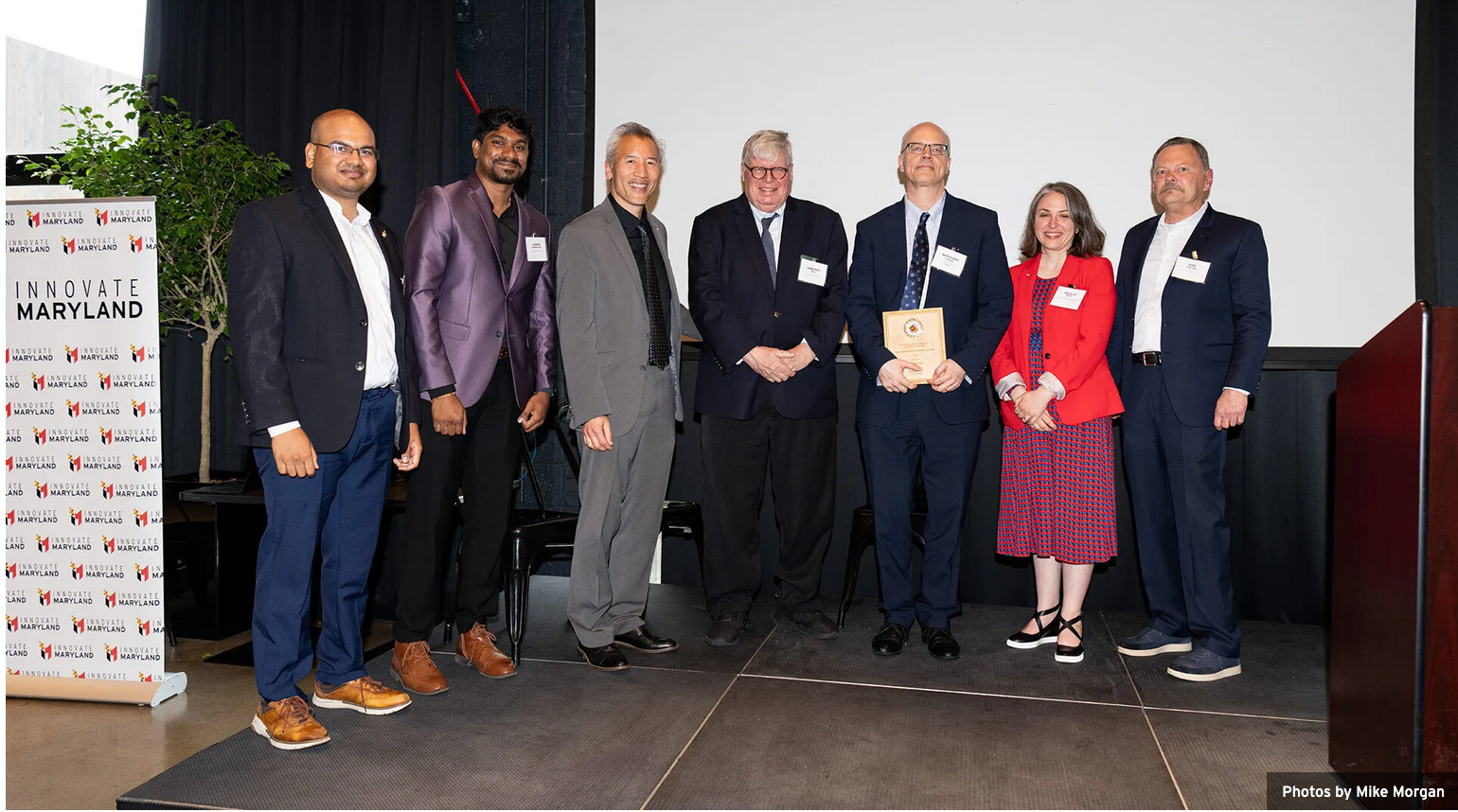
- In Information Sciences/Overall Winner: Brain-inspired Method of Machine Learning
Bridging the gap between neuroscience and artificial intelligence, Losert and Kang have developed a radical new way for machines to learn. Inspired by the human brain, their system mimics the rhythmic communication between neurons and glial cells, allowing machines to detect patterns and shifts in data with striking speed and accuracy. The result is an adaptable, efficient learning model that could one day predict financial crashes, natural disasters or cancer mutations, all with a fraction of the information that today’s AI systems require. - In Life Sciences: RNAnneal: Prediction of RNA Tertiary Structure and Thermodynamics With Generative AI
RNAnneal, developed by Millard and Lee Alexander Professor in chemical physics Pratyush Tiwary and doctoral student Lukas Herron, is a breakthrough in computational biology that could reshape how we design drugs targeting RNA—a fast-emerging frontier in medicine. This two-stage, AI-driven pipeline first generates thousands of potential RNA structures, then applies a novel thermodynamics-based model to identify the most stable configurations. It does so without relying on existing RNA data, setting a new bar with 100% prediction accuracy in benchmark tests. By dramatically improving the speed and precision of RNA-targeted drug development, RNAnneal offers new hope for treating cancer, neurological disorders, genetic conditions, infectious diseases and more. - In Physical Sciences: Efficient Microchannel Cooling for High-powered Electronics
As the race to build faster, smaller and more powerful electronics heats up—literally—Associate Professor of mechanical engineering Damena Agonafer and doctoral student Vivek Manepalli have cracked one of the industry’s most stubborn challenges. Their inventive cooling system, which blends tiny heat-absorbing capsules with specially designed microchannels, offers a smarter and more energy-efficient way to keep high-powered devices from frying themselves. The system has the potential to make the future of supercomputing possible by keeping it cool. - In Social Innovation: AI and Information Literacy Module
As artificial intelligence becomes a regular part of daily life, an interdisciplinary team of researchers, led by Mona Thompson of the Teaching and Learning Transformation Center and Benjamin Shaw of University Libraries, with researchers Hal Daumé III, Katie Shilton and Daria Yocco, want to make sure students aren’t just using AI—they’re thinking critically about it. Their new online module is a crash course on how to understand, evaluate and responsibly use AI tools, offering everything from bite-sized videos to hands-on exercises. The module aims to build digital citizens who can navigate misinformation, cite AI-generated content ethically and maintain academic integrity.
Read the full list of finalists in every category.
In addition to the Invention of the Year Awards, three special recognition awards were presented to honor recipients for their exceptional contributions to UMD’s innovation ecosystem and their lasting impact both in the region and beyond.
- Startup of the Year: ION Storage Systems, founded by Distinguished University Professor of materials science and engineering Eric Wachsman, was recognized as Startup of the Year for their pioneering work to develop safer, more powerful and fully recyclable solid-state batteries.
- Entrepreneur of the Year: Kan Cao, professor of cell biology and molecular genetics, was named Entrepreneur of the Year for launching Bluelene; the skin care line from her company, MBlue Labs, is the first to harness the anti-aging properties of the antioxidant methylene blue.
- Lifetime Inventor Award: Reinhard Radermacher (1952-2025), former director of the Center for Environmental Energy Engineering and Minta Martin Professor of Mechanical Engineering, was honored posthumously for his unparalleled career at UMD as an inventor. He holds the record for most inventions disclosed with a cumulative total of 150 since 1984, was himself an Invention of the Year winner in 2010 and finalist three other times. Six companies further developed and commercialized Radermacher’s technologies over his career at UMD, demonstrating his lasting, real-world impact.
Read more about 2025 Innovate Maryland in Maryland Today.
2023 Inventions of the Year awarded April 29, 2024
Groundbreaking Plasma Innovation Shines as Top Invention of the Year
Innovate Maryland Also Celebrates Research on AI Detection, Cancer Treatment, Quantum Computing
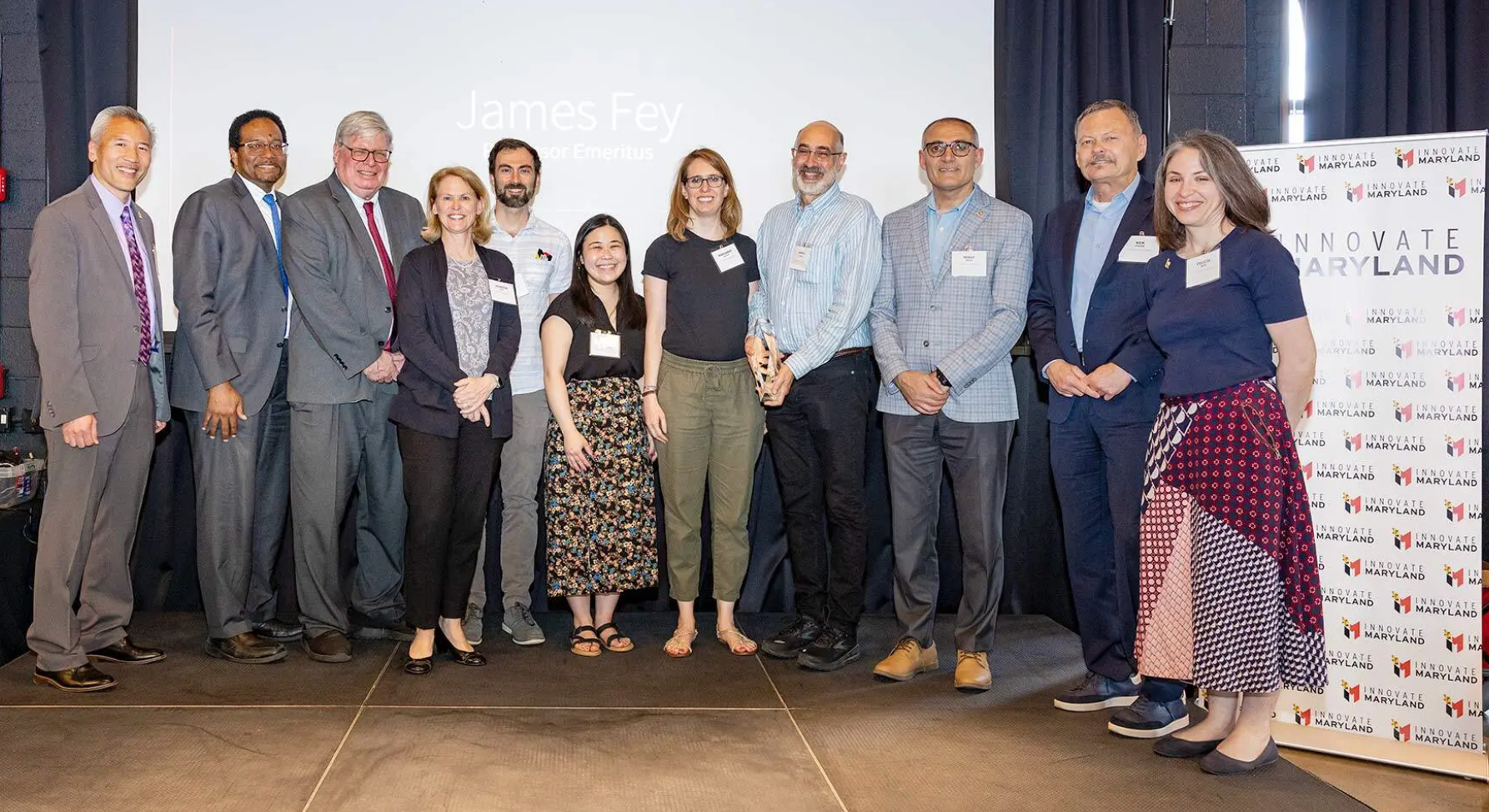
Here are the 2024 Invention of the Year Award winners across all categories:
Physical Sciences Invention of the Year/Overall Winner: Stable Plasma for Extreme Materials
Department of Materials Science and Engineering researchers Liangbing Hu, Hua Xie, Qian Zhang and Ji-Cheng Zhao and Princeton University researcher Yiguang Ju have developed a new method for creating stable plasma that can be used in extreme materials. The protocol works by applying a voltage between two blocks made of thin carbon fibers. The fibers act as a tip through which electrons can flow, resulting in all the gas between the blocks being turned into a highly stable and ultra high-temperature plasma. The process is simple, scalable and powered by renewable energy, allowing for reduced cost and a lower carbon footprint to make extreme materials.
Information Sciences Invention of the Year: Binoculars: A Method for Detecting Text Generated by Large Language Models
Two years ago, the launch of ChatGPT kicked off an AI boom that has been making headlines ever since. The growth of AI—specifically of large language models (LLMs) like ChatGPT—has been felt across all industries, but raises concerns about plagiarism, fraud and disinformation. Recent attempts to detect LLM-generated content have been consistently found unreliable, but College of Computer, Mathematical, and Natural Sciences researchers Tom Goldstein, a Volpi-Cupal Family Endowed Professor in the Department of Computer Science, and Abhimanyu Hans ’25, as well as Avi Schwarzschild Ph.D. ’23, now of Carnegie Mellon University, have developed an accurate method for distinguishing human-generated content.
The method, dubbed “Binoculars,” does not require any training data and does not need to modify the LLM to detect AI-generated text. It is also more reliable than many of its predecessors, with an accuracy rate of 90% and a false positive rate of 0.01%.
Life Sciences Invention of the Year: Combination Therapy and Diagnostic Tool for Aggressive Prostate Cancer
Each year, about 300,000 new cases of prostate cancer are diagnosed in the United States, affecting one in eight men during their lifetimes; one in 44 will eventually succumb to the disease. This grim reality is amplified among African American men, who experience an incidence rate 2.3 times higher and mortality rate 1.7 times higher than their white counterparts. Research has attributed this disparity to a blend of socioeconomic factors and biological vulnerabilities, underscoring the urgent need for targeted interventions.
Associate Professor Bi-Dar “Peter” Wang and Visiting Scientist Mohammad Waseem from the University of Maryland Eastern Shore have identified a precision prognostic biomarker and therapeutic tool, specifically for African American men. The novel treatment method combines gene therapy, introducing a tumor-suppressing mimic gene, with androgen receptor antagonists, drugs that stop the growth and spread of cancer cells. The method shows promise in treating prostate cancer that has become resistant to other types of therapy, and could potentially be used to treat all forms of advanced prostate cancer.
Quantum Invention of the Year: Quantum Non-Demolition Photon Counter
The rise of quantum computing presents unprecedented opportunities, leveraging the laws of quantum mechanics to tackle challenges beyond classical computers’ reach. Challenges to quantum computing have led researchers around the world to turn to the use of photons, or tiny particles of light, that can carry information from one place to another. With this development, photon counting has become a vital part of the field.
Traditional methods of photon counting destroy the particles’ quantum states, and existing attempts to circumvent this have a number of limitations. Researchers in the Department of Physics and the National Institute of Standards and Technology—NIST physicist and Adjunct Professor Alexey Gorshkov, NIST physicist and Adjunct Assistant Professor Michael Gullans, NIST Research Scientist James “Trey” V. Porto, graduate student Christopher Fechisin, current IBM Research Scientist Kunal Sharma, current Amazon Web Services Research Scientist Przemyslaw Bienias and Department of Physics Chair Steven Rolston have developed a new protocol that eliminates these limitations. Unlike previous methods, the researchers’ protocol has no fundamental limitation on the number of photons being counted and has the ability to count itinerant—or moving—photons. Their work has potential applications in light detection and ranging (LIDAR), fiber optic communication, quantum information processing, quantum encryption and cybersecurity, medical imaging, DNA sequencing and astrophysics.
Read the full list of finalists in every category.
In addition to the Invention of the Year awards, two faculty innovators received special recognition awards for their significant contributions to UMD’s innovation ecosystem and for making a lasting impact in the region and beyond:
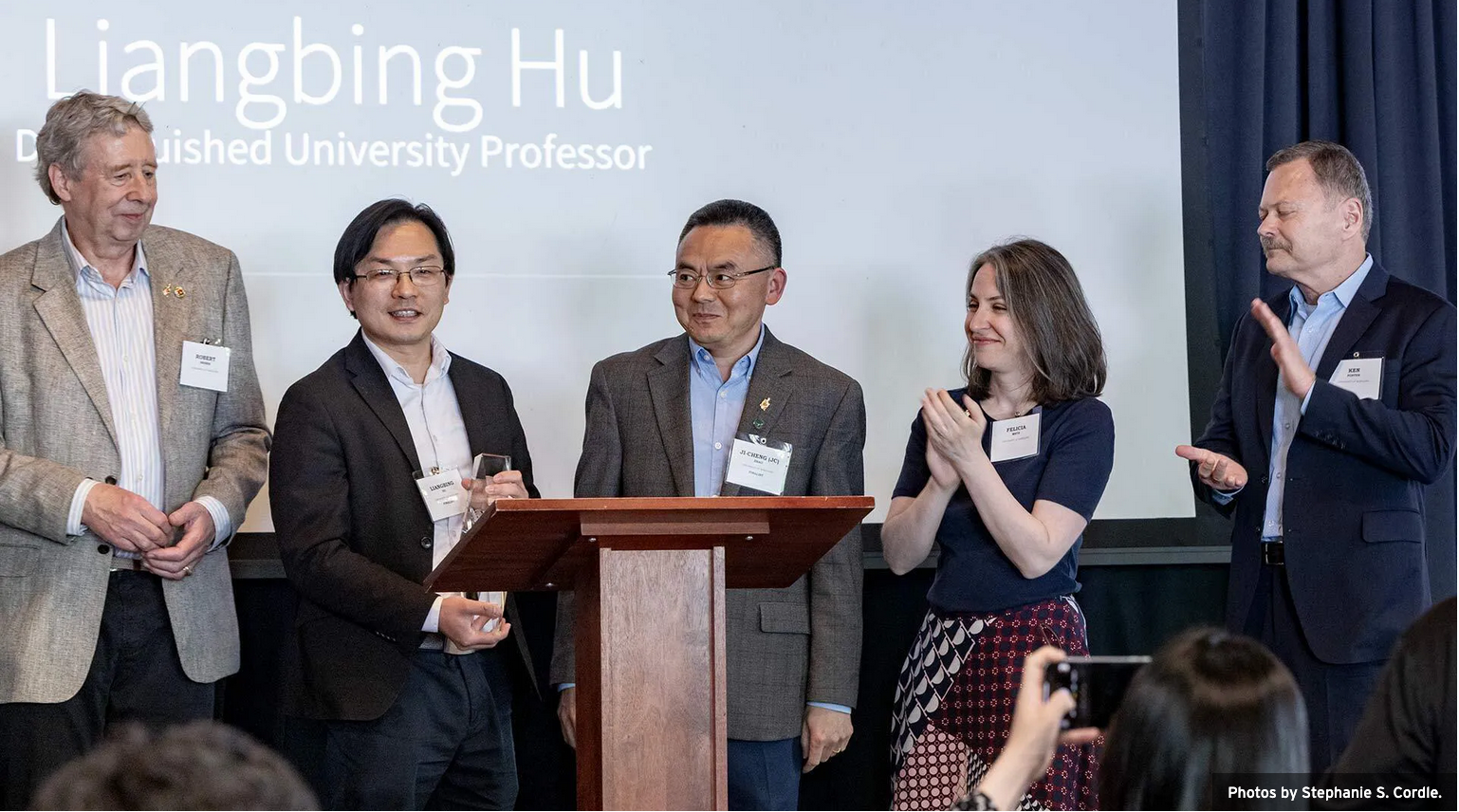
- President Darryll J. Pines presented a special recognition award to Hu, a professor in the Department of Materials Science and Engineering. Hu has submitted 134 invention disclosures, making him the second-most prolific inventor in the university’s history—a feat he accomplished in only 11 years. He also co-founded the highest number of university IP-based startups, with a record four this fiscal year alone.
- Senior Vice President and Provost Jennifer King Rice presented a special recognition award to James Fey, a professor emeritus in the College of Education’s Center for Math Education. Fey co-authored a series of children’s mathematics workbooks and curricula that have generated $4.1 million in revenue for UMD since 1991. Fey donated his share of the royalties back to the department to fund over a dozen PhD students in the Fey-Graeber Fellowship program.
Read more about Innovate Maryland 2024 in Maryland Today.