
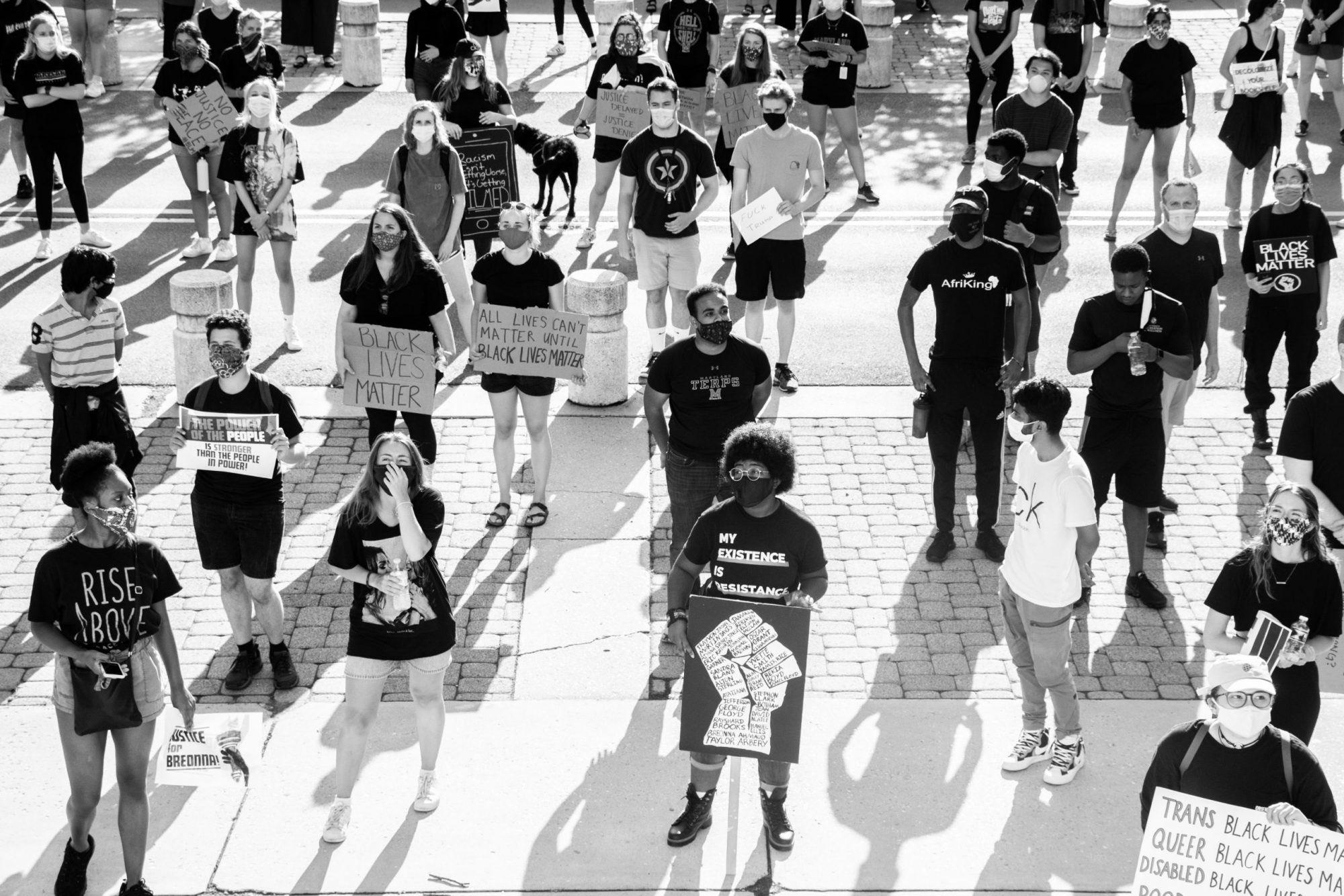
The University of Maryland's innovation and entrepreneurship ecosystem stands in solidarity with the Black community. We stand united against racism, violence, and hate. We believe in racial equity, social justice, and creating an inclusive community. We are committed to removing barriers and to providing Black innovators, entrepreneurs, business owners, inventors, mentors, investors, changemakers, and ecosystem builders with access to resources, mentors, talent, capital and ongoing support.
This page includes a collection of resources available for supporting Black founders, as well as information and content for anyone interested in learning about and understanding systemic racism.
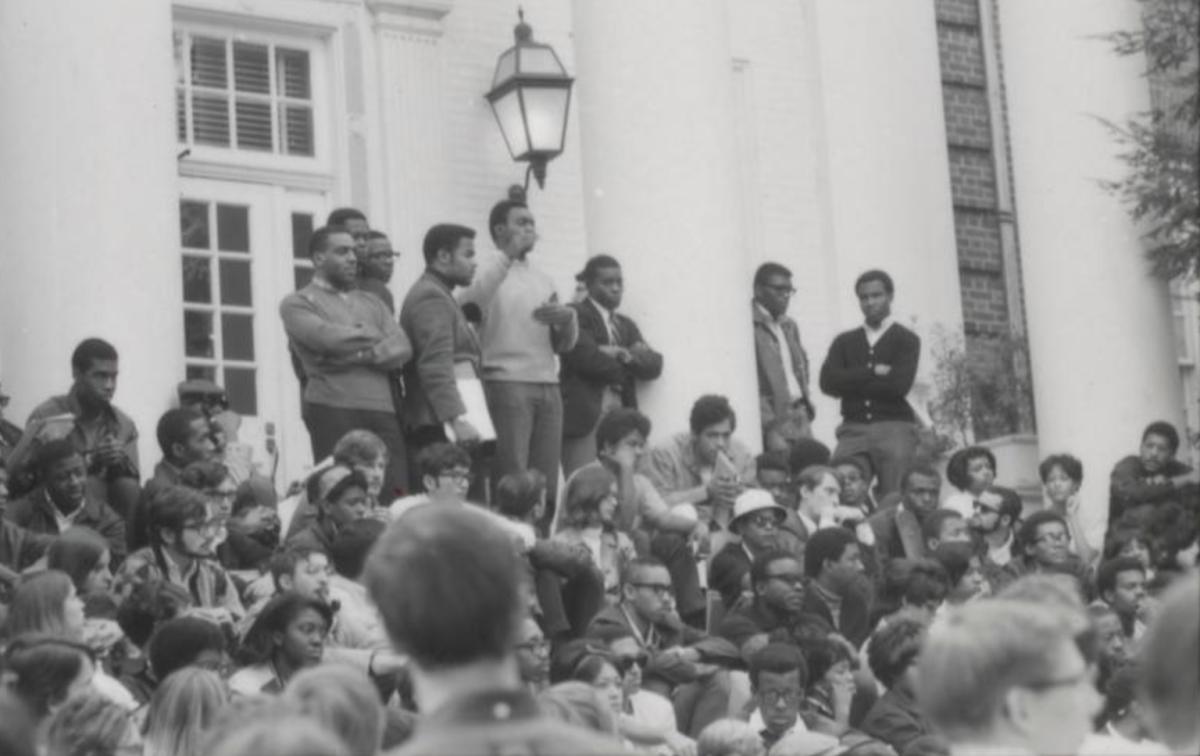
Resources for Understanding Systemic Racism

Articles
- Read
- 7 Ways We Know Systemic Racism is Real by Ben & Jerrry's
- 10 action steps to sustain the fight against systemic racism by Stephen Babcok in Technical.ly Baltimore
- 75 Things White People Can Do for Racial Justice
- A Timeline of Events That Led to the 2020 “Fed Up”-rising by Michael Harriot published by The Root
- America’s Racial Contract Is Killing Us by Adam Serwer in The Atlantic on May 8, 2020
- America, This is Your Chance by Michelle Alexander
- Becoming A Parent in the Age of Black Lives Matter by Clint Smith
- Breaking Barriers: Strategies For Inclusivity in Sports by Alexis Bennett
- George Floyd death: Why US protests resonate in the UK
- Global Anger Grows Over George Floyd Death, and Becomes an Anti-Trump Cudgel
- How to Talk to Relatives That Care More About Looting Than Black Lives by Rachel Miller
- Letter to My Son by Ta-Nehisi Coates
- ”My Life as an Undocumented Immigrant” by Jose Antonio Vargas in the The New York Times Magazine on June 22, 2011
- PBS’s Teaching Your Child About Black History Month
- Save the Tears: White Woman’s Guide by Tatiana Mac
- Teaching About King’s Radical Approach to Social Justice by Coshandra Dillard
- The Case For Reparations by Ta-Nehisi Coates
- The Combahee River Collective Statement
- The Intersectionality Wars by Jane Coaston in Vox on May 28, 2019
- Tips for Creating Effective White Caucus Groups developed by Craig Elliott PhD (pdf)
- Too Many Names, Too Many Hashtags: The Killing of Unarmed Black People is a Public Health Pandemic “Where do I donate? Why is the uprising violent? Should I go protest?” by Courtney Martin on June 1, 2020
- White Privilege: Unpacking the Invisible Knapsack” by Knapsack Peggy McIntosh (pdf)
- White Guyde To The Galaxy by Tatiana Mac
- What is Juneteenth? by Henry Louis Gates, Jr.
- Who Gets to Be Afraid in America? by Dr. Ibram X. Kendi in The Atlantic on May 12, 2020
- Why Teaching Black Lives Matter Matters | Part I, by Jamilah Pitts in the Learning for Justice Magazine, Summer 2017; Bringing Black Lives Matter Into the Classroom | Part II by Jamillah Pitts in the Learning for Justice Magazine, Summer 2017
- Why You Need to Stop Saying “All Lives Matter” by Rachel Elizabeth Cargle | Harper’s Bazaar
- Your Kids Aren't Too Young to Talk About Race: Resource Roundup from Pretty Good
Blogs
Books
- Read
- A list of children's books to support conversations on race, racism and resistance
- A Terrible Thing To Waste: Environmental Racism And Its Assault On The American Mind by Harriet A. Washington
- Automating Inequality: How High-Tech Tools Profile, Police and Punish the Poor by Virginia Eubanks
- Between the World and Me by Ta-Nehisi Coates
- Black Feminist Thought by Patricia Hill Collins
- Blackballed: The Black Vote and U.S. Democracy by Darryl Pinckney
- Body and Soul: The Black Panther Party and the Fight against Medical Discrimination by Alondra Nelson
- Coretta Scott King Book Award Winners: books for children and young adults
- Daring Greatly: How the Courage to Be Vulnerable Transforms the Way We Live, Love, Parent, and Lead by Brené Brown
- Dog Whistle Politics: How Coded Racial Appeals Have Reinvented Racism and Wrecked the Middle Class by Ian Haney López
- Eloquent Rage: A Black Feminist Discovers Her Superpower by Dr. Brittney Cooper
- From #BlackLivesMatter to Black Liberation by Keeanga-Yamahtta Taylor
- From the War on Poverty to the War on Crime: The Making of Mass Incarceration in America by Elizabeth Hinton
- Heavy: An American Memoir by Kiese Laymon
- How To Be An Antiracist by Dr. Ibram X. Kendi
- I Know Why the Caged Bird Sings by Maya Angelou
- Just Mercy by Bryan Stevenson
- Locked In: The True Causes of Mass Incarceration and How to Achieve Real Reform by John Pfaff
- Me and White Supremacy by Layla F. Saad
- Medical Bondage: Race, Gender, and the Origins of American Gynecology by Deirdre Cooper Owens
- Race for Profit: How Banks and the Real Estate Industry Undermined Black Homeownership by Keeanga-Yamahtta Taylor
- Raising Our Hands by Jenna Arnold
- Redefining Realness by Janet Mock
- Sister Outsider by Audre Lorde
- So You Want to Talk About Race by Ijeoma Oluo
- Stamped from the Beginning: The Definitive History of Racist Ideas in America by Ibram X. Kendi
- The Bluest Eye by Toni Morrison
- The End of Policing by Alex S. Vitale
- The Fire Next Time by James Baldwin
- The Meaning of Freedom and Other Difficult Dialogues by Angela Davis
- The New Jim Crow: Mass Incarceration in the Age of Colorblindness by Michelle Alexander
- The Next American Revolution: Sustainable Activism for the Twenty-First Century by Grace Lee Boggs
- The Warmth of Other Suns by Isabel Wilkerson
- Their Eyes Were Watching God by Zora Neale Hurston
- This Bridge Called My Back: Writings by Radical Women of Color by Cherríe Moraga and co-edited with Gloria Anzaldúa
- When Affirmative Action Was White: An Untold History of Racial Inequality in Twentieth-Century America by Ira Katznelson
- White Fragility: Why It's So Hard for White People to Talk About Racism by Robin DiAngelo, PhD
- Why Are All The Black Kids Sitting Together In The Cafeteria? And Other Conversations About Race by Beverly Daniel Tatum
Documentaries, Films, Television Shows & More
- Watch
- 12 Years a Slave
- 13th
- American Son
- Amistad
- Black America Since MLK and Still I Rise
- Black Power Mixtape: 1967-1975
- #BlackAF
- Black-ish
- Blindspotting
- Clemency
- Dear White People
- Django Unchained
- Do The Right Thing
- Dream Girls
- Explained: The Racial Wealth Gap
- Fruitvale Station
- Get Out
- Hidden Figures
- I Am Not Your Negro
- If Beale Street Could Talk
- Just Mercy
- King In The Wilderness
- LA 92
- Loving
- Moonlight
- Poetic Justice
- Oprah Winfrey Network - Where Do We Go From Here? (Part 1)
- See You Yesterday
- Selma
- Teach Us All
- The Black Panthers: Vanguard of the Revolution
- The Boondocks
- The Hate U Give
- The Wiz
- Us
- When They See Us
- Who Killed Malcolm X
- Whose Streets
Podcasts
- Listen
- 1619
- About Race
- Code Switch
- Fare of the Free Child
- Floodlines
- Insight Center Hidden Truths
- Integrated Schools podcast episode “Raising White Kids with Jennifer Harvey”
- Intersectionality Matters!
- Momentum: A Race Forward
- Parenting Forward podcast episode ‘Five Pandemic Parenting Lessons with Cindy Wang Brandt’
- Personology: "Martin Luther King Jr: Revolutionary Through Nonviolence"
- Planet Money: Patent Racism
- Pod for the Cause (from The Leadership Conference on Civil & Human Rights)
- Pod Save the People (Crooked Media)
- Scene on Radio: Seeing White Series
- Seeing White
- Shine Brighter Together
- Still Processing: We Celebrate the REAL MLK Day
- The Combahee River Collective Statement
- The Diversity Gap
- The Heart: Race Traitor Series
- The Nod
- The Stakes
- Throughline
- United States of Anxiety
- Unlocking Us - Brené with Ibram X. Kendi on How to Be an Antiracist
More Anti-Racism Resources
- Check out these projects and helpful content
- 10 Steps to Non-Optical Allyship
- 75 Things White People Can Do for Racial Justice
- 97 Things White People Can Do for Racial Justice
- Airtable Anti-Racist Resources
- Airtable Dataset compiled by Joey Best-James
- Affirming Black Lives Without Inducing Trauma
- Alkeme Community & Crisis Resources
- Anti-Racism Resources for All Ages
- Anti-racism Resources for White People
- Anti-Racist Packet
- Anti-Racism Project
- Black Lives Matter at School
- Black Lives Matters Syllabus
- Guide to Allyship
- Jenna Arnold’s resources (books and people to follow)
- Let's Talk! Discussing Black Lives Matter Webinar
- National Museum of African American History and Culture: Talking About Race
- Poor People's Campaign
- Rachel Ricketts’ anti-racism resources
- Resources for White People to Learn and Talk About Race and Racism
- Save the Tears: White Woman’s Guide by Tatiana Mac
- #ShutDownAcademia & #ShutDownSTEM Resources for Scientists and Academics
- #ShutDownAcademia & #ShutDownSTEM Healing from Anti-Black Racism Resources
- Showing Up For Racial Justice’s educational toolkits
- Talking About Race Online Learning Portal created by the National Museum of African American History and Culture
- TED Talks on Racism
- The 1619 Project
- The [White] Shift on Instagram
- “Why is this happening?” — an introduction to police brutality from 100 Year Hoodie
- Zinn Education Project’s teaching materials
Social Media
- Follow
- Antiracism Center - Twitter
- Audre Lorde Project - Twitter, Instagram, and facebook
- Black Women’s Blueprint - Twitter and Instagram
- Color Of Change - Twitter, Instagram, and facebook
- Colorlines - Twitter, Instagram, and facebook
- The Conscious Kid - Twitter, Instagram, and facebook
- Equal Justice Initiative (EJI) - Twitter, Instagram, and facebook
- Families Belong Together - Twitter, Instagram, and facebook
- Gathering For Justice - Twitter and Instagram
- Justice League NYC - Twitter and Instagram
- The Leadership Conference on Civil & Human Rights - Twitter, Instagram, and facebook
- MPower Change - Twitter, Instagram, and facebook
- Muslim Girl - Twitter, Instagram, and facebook
- NAACP - Twitter, Instagram, and facebook
- National Domestic Workers Alliance - Twitter, Instagram, and facebook
- RAICES - Twitter, Instagram, and facebook
- Showing Up for Racial Justice (SURJ) - Twitter, Instagram, and facebook
- SisterSong - Twitter, Instagram, and facebook
- United We Dream - Twitter, Instagram, and facebook
Support Black Innovators and Entrepreneurs
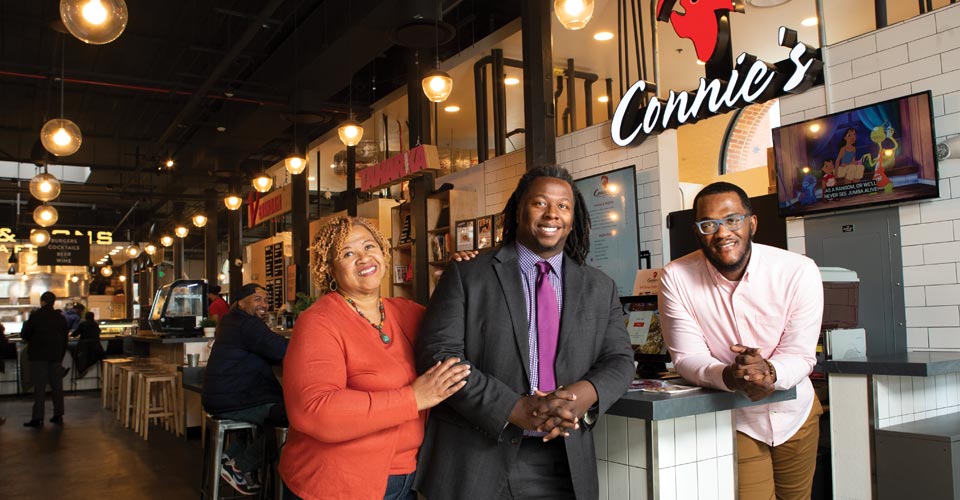
Resources for Black Founders
- 1863 Ventures Build Back Better - This initiative will provide access to Technical Assistance that helps small businesses of all industries in the nation's capital reposition themselves to succeed in our new environment.
- Advancing Black Entrepreneurs by Chase for Business - In partnership with Chase for Business, Black Enterprise, the National Urban League, and the U.S. Black Chambers is a collection of practical resources to help Black business owners grow and scale their business. This educational program, specifically for Black business owners, highlights topics that are vital to business growth and sustainability. These 90-minute guided digital sessions are focused on how business owners can address immediate and long-term financial needs and build resiliency.
- AfroTech - This platform includes business model & revenue resources, upcoming tech conferences, venture capital news, and much more.
- AmplifyHer Ventures - An early-stage fund investing in female founders and diverse leadership teams specializing in commerce, health care, and technology that helps people connect.
- AXS Law Roadmap Initiative - Provides pro bono start-up legal services for Black-owned hospitality startups. For those clients selected, AXS LAW will offer pro bono legal services such as business organizational structuring advice, entity formation and initial organizational documents, obtaining an EIN in order to set up a bank account, shareholder / partnership agreements, lease negotiation, intellectual property structuring and trademark filing, drafting confidentiality and nondisclosure agreements, and other services as needed on a case by case basis.
- Backstage Capital - This fund invests in the very best founders who identify as women, People of Color, or LGBTQ.
- Black & Brown Founders - This organization is on a mission to close the vast and growing wealth gap between Black and Latinx households and their counterparts in the United States. Black & Brown Founders has organized several national events, offers a virtual training program, and a virtual conference to help Black and Latinx entrepreneurs at the earliest stage of their journey cross the chasm from idea to revenue.
- Black Angel Tech Fund - This fund is the antidote to the so-called 2% problem in Silicon Valley. Through this fund Black Angels invest in the next generation of Black Tech innovators.
- Black Business Month - Celebrated every August — it’s a time to acknowledge and appreciate black-owned businesses across the nation and all that they represent in the country’s continual striving for diversity and equality. Learn how to show your support.
- Black Founders - Programs and events that increase the number of successful black entrepreneurs in technology.
- Black Girl Ventures - This foundation is dedicated to offering comprehensive education and advisory services that outline a road map for the growth and success of minority and/or veteran women entrepreneurs.
- Black Tech Futures Research Institute - This Institute is focused on growing the a sustainable national Black Tech Ecosystem. Sponsored by the Ewing Marion Kauffman Foundation 2020 Open Knowledge Grant and housed at a Historically Black College and University (HBCU) Stillman College, #BlackTechFutures Research Institute builds a national network of city-based researchers and practitioners conducting research on sustainable local black tech ecosystems. The outcomes of this work are actionable policy recommendations and a national public data archive.
- Black upStart - Teaches aspiring Black entrepreneurs how to start a successful and profitable business through an intense, culturally-relevant popup school.
- Blavity.org is a new racial equity and social impact organization created by the founders of Blavity Inc. Blavity.org furthers Blavity Inc.’s social impact through the development of digital programs designed to advance economic progress and racial equity for Black entrepreneurs. The core of our work is our 6-month Fellowship Program geared towards accelerating the success of Black entrepreneurs.
- BLCK VC - This group was formed to connect, engage, empower, and advance Black venture investors by providing a focused community built for and by Black venture investors.
- BrainTrust Fund - The BrainTrust Fund exists so that as the massive, growing multi-trillion-dollar beauty and wellness marketplace grows, Black founders, Black funders and allies may participate in the upside from creating and selling what shoppers want. To be considered for venture investment, companies must have at least one Black-identifying founder who is a member of BrainTrust Founders Studio, seeks coaching and advice from investors, and has repeatable revenues of $1+ million or more.
- Chingona Ventures - A $10 million seed-stage fund that invests in entrepreneurs who identify as women or people of color. They focus on rapidly evolving industries and founders that are not always well understood by the traditional investor.
- Coalition to Back Black Businesses - Supports Black-owned businesses through multi-year funding opportunities and training. The initiative aims to award 300 grants per year. Corporate sponsors include founding partner American Express, AIG Foundation, Stanley Black and Decker, U.S. Black Chambers, Inc., and the U.S. Chamber of Commerce Foundation.
- CODE 2040 - This nonprofit activating, connecting, and mobilizing the largest racial equity community in tech to dismantle the structural barriers that prevent the full participation and leadership of Black and Latinx technologists in the innovation economy.
- Collab Capital - Provides social and financial resources to Black-owned companies who’ve created a pathway to building sustainable and profitable businesses.
- Color - Invests in early-stage companies and entrepreneurs who are female, people of color, or otherwise "underestimated," working in the retail, e-commerce, and consumer product industries.
- Culture Shift Labs - A diversity and innovation consultancy that provides services under three pillars: Advising, Strategy, and Activation.
- DigitalUndivided The Doonie Fund - The fund is named after the digitalundivided founder’s grandmother, Kathryn “Doonie” Hale, who inspired her entrepreneurial journey and encouraged her to stay in the arena. Since its inception on April 5th, 2020, the fund has invested in over 500 black women entrepreneurs.
- Diversity Photo - Diversify was born out of a recognition that calling for more diversity in the photo industry is not enough. To diversify photo, we need to equip Art Buyers, Creative Directors, and Photo Directors with resources to discover photographers of color available for assignments and commissions.
- Elevate Capital - Oregon’s first institutional venture capital fund that specifically targets investments in underserved entrepreneurs—such as women and ethnic minorities, or those with limited access regionally to capital and opportunities. The Elevate Capital Fund invests locally, regionally, nationally, and globally in scalable startups.
- Exelon Racial Equity Capital Fund - Exelon launched a Racial Equity Capital Fund (RECF), in partnership with the Exelon Foundation, to expand access to capital to minority businesses so they can create more jobs, grow their companies, and reinvest in their neighborhoods and communities. The capital fund is expected to invest in numerous businesses throughout Exelon’s service areas over the next three years with estimated loan amounts between $100,000 and $300,000 and equity investments of nearly $1 million.
- EY Entrepreneurs Access Network (EAN) - Helps Black- and Latino-owned companies address the disparity gap for greater growth. Review the EAN annual report showcasing the impacts and successes of the inaugural EAN cohort. EAN provides coaching, capital, resources, and more.
- FEARLESS Fund - Fearless Fund invests in women of color led businesses seeking pre-seed, seed level or series A financing. It's mission is to bridge the gap in venture capital funding for women of color founders building scalable, growth aggressive companies. Fearless Fund is built by women of color for women of color.
- FedEx Small Business Grant Contest - A grant program started by FedEx in 2012 to award U.S. based small businesses with grants to enhance their businesses.
- ForbesBLK - The mission of ForbesBLK is to champion a global community of Black entrepreneurs, professionals, leaders and creators that are driving systematic change in business, culture and society. Our community of exceptional leaders of color are breaking down barriers, creating more equitable economies, and driving a new culture of connection, collaboration and change. In order to support our community, ForbesBLK shares inspiring content and curates in-person and digitally based networking opportunities to foster professional development, entrepreneurship, and cultural change.
- Founder First Capital Partners - They help companies grow and scale through strategic advisory and revenue-based investment. Founded in 2015, the firm's $100 million fund supports underrepresented entrepreneurs, including women of color and military veterans working in service-based industries.
- Founder Gym - It is the leading online program training underrepresented founders on how to raise money to scale their tech startups.
- Founder's Institute Resource List - The organization has compiled a list of more than 200 Black American startup resources including accelerators, incubators, investors, and more.
- FSC First - Provides small and minority businesses access to financing through 11 distinct loan products. The loans are a product of public-private partnerships between a consortium of participating banks, Prince George’s County, the State of Maryland and FSC First.
- Go.Be. Mastering Money Bootcamp - Watch YouTube videos created by Go.Be on how to gain the mastery of your financial statements and business credit to a handful of related topics.
- Google for Startups Accelerator: Black Founders - A three-month digital accelerator program for high potential Seed to Series A tech startups based in the U.S. The accelerator program is designed to bring the best of Google’s programs, products, people and technology to Black founder communities across the U.S. In addition to mentorship and technical project support, the accelerator also includes deep dives and workshops focused on product design, customer acquisition and leadership development for founders.
- Grow with Google Digital Coaches - This community provides digital skills training and coaching to help Black and Latinx small businesses reach new customers, thrive online, and grow. Participate in digital skills workshops, hands-on coaching and opportunities to meet and learn from successful businesses in your community.
- Harlem Capital Partners (HCP) HCP is a New York based early-stage venture capital firm on a mission to change the face of entrepreneurship by investing in 1,000 diverse founders over the next 20 years. HCP is focused on investing in minority and women founders in the United States.
- HerRise Micro-Grant - Provides financial assistance, with the help of our corporate sponsors and donors, to women of color creating innovative solutions that impact their community and that are often unable to secure funding for their small business. Each month a $500 micro-grant will be awarded to a small business owned by women of color.
- Hire or Wire Now - This organization's goal is to double the number of People of Color working in technology jobs and double the amount of venture capital invested in their startup businesses.
- IFundWomen of Color (ifw) - The go-to funding resource for diverse, early-stage entrepreneurs. IFundWomen of Color was created with our founding partner Caress to help diverse entrepreneurs bring their dreams into reality through raising capital via crowdfunding and providing grants, coaching, and the connections needed to launch and grow successful businesses.
- Inclusive Innovation Incubator - An innovation space in Washington, D.C. providing programs, services and events for this generation of leaders and the next.
- Impact Hub Baltimore is a hub of social innovators building an ecosystem of civic wealth in Baltimore. Members challenge the status quo, break silos, and build solutions.
- January Ventures - Founded by operators turned investors who believe in an equal opportunity tech ecosystem. They believe the founders of the next decade will look fundamentally different: more female, more diverse and more distributed. They back founders based on their tenacity and ambition, not their pedigrees or who they know
- Kaleidoscope Black Realities Grant - The Black Realities Grant is a response to the ongoing state violence and murder of Black people. The Grant awards a monthly cash prize to media projects that explore the varied conditions, experiences, feelings, and range of humanity of the Black global community.
- Latimer Ventures - Latimer Ventures deploys its proven model to build (and exit) the next generation of Black & Hispanic Enterprise SaaS Unicorns.
- Level Up Entrepreneurship Program - Designed to enhance small and minority-owned businesses within Prince George’s, Charles, Calvert, and Montgomery Counties. Level Up provides small businesses with access to education, coaching, and mentoring for efficient business management practices that elevate opportunity and accelerate post-pandemic recovery. The program also provides resources and loan packaging services.
- Lightship Capital - This fund invests in entrepreneurs that other investors have overlooked or excluded — people of color, women, members of the LGBTQIAP community, and people with disabilities. It finds and funds these remarkable entrepreneurs across the Midwest, working with them to make capital more inclusive and to create a more equitable future.
- Lockstep Ventures - Lockstep invests in companies owned, led by or serving communities of color that can impact disparities in health, wealth, education and workforce development.
- Lowe's-LISC Partnership - Thanks to a $55 million significant commitment grant from Lowe’s, LISC will provide the emergency grant assistance that small businesses desperately need to stay afloat.
- Management Leadership for Tomorrow (MLT) - MLT’s distinctive model provides the know-how, navigation systems and network to ensure talented underrepresented minorities are able to get on and stay on the path to senior leadership. MLT partners with more than 100 leading companies, social sector organizations and universities to strengthen their recruitment and retention of diverse talent.
- Marathon Fund - The Marathon Fund is a seed-stage equity fund dedicated to creating high growth, foundational businesses that embrace the diversity of talented innovators historically underserved by the private capital market ecosystem.
- Miles & Stockbridge Black Business & Startup Initiative - This initiative supports Black businesses by providing introductory legal counsel at no cost or a reduced cost. Inclusion in the initiative will be determined on a case-by-case basis, and subject to other parameters determined by the firm.
- Minority Business Development Agency (MBDA) - The MBDA is an agency of the U.S. Department of Commerce that promotes the growth of minority-owned businesses through the mobilization and advancement of public and private sector programs, policy, and research.
- Minority Christian Women Entrepreneurs Network (MCWEN) - MCWEN is a thriving community for Christian women of color who have an interest in entrepreneurship and business ownership. This nonprofit provides a community of support to Black female founders through networking events, business development services, funding opportunities, and resources for growth and success.
- Mortar - Aims to create diverse communities by enabling historically marginalized entrepreneurs to access the resources needed to start and run successful businesses.
- National Association of Investment Companies - The Largest Network of Diverse-Owned Private Equity Firms and Hedge Funds.
- National Black Chamber of Commerce (NBCC) - The NBCC is a nonprofit, nonpartisan, nonsectarian organization dedicated to the economic empowerment of African American communities. It is dedicated to economically empowering and sustaining African American communities through entrepreneurship and capitalistic activity within the United States and via interaction with the Black Diaspora.
- National Business League (NBL) - The NBL is the first and largest nonprofit, non-partisan, and non-sectarian, Black Business Professional and Trade association, founded August 23, 1900 by the iconic Booker T. Washington. The NBL has more than 120,000 members nationwide, with 4 regional offices in Atlanta, GA, Detroit, MI, Los Angeles, CA, and Washington, DC, and more than 360 local league chapters across the country. The organizations provide access to 2.6 million Black businesses throughout the United States, celebrating 120 years of service.
- National Minority Supplier Development Council Inc.® (NMSDC®) - The NMSDC® is the longest-operating business growth engine for the broadest group of systematically excluded communities of color (Asian, Black, Hispanic and Native American), and its impact goes far beyond supply chain. The organization creates connections between minority business enterprises (MBEs) and corporations, MBEs and the public sector, and MBEs and other MBEs, to help them benefit from each other, stoking entrepreneurship and growing wealth for these systemically excluded communities. The NMSDC is about correcting the unequal access to wealth-building opportunities.
- NewME - An entrepreneurship education program that is serving early stage business founders and their teams through mentorship, specialized curriculum, and capital investment.
- New Voices Foundation - Provides early-stage companies led by women of color with personalized help, either through grants, education, or pitch competitions.
- New Voices Fund - This fund invests specifically in women entrepreneurs of color
- OHUB - This is the world's first inclusive technology, startup & investment ecosystem building platform built to ensure shared prosperity and multi-generational wealth creation for all.
- PayPal Empowerment Grants for Black Businesses Program - Association for Enterprise Opportunity (AEO) is committed to addressing economic inclusion by creating transformative change, and in partnership with Paypal, will award up to $10,000 to more than 1,000 black-owned businesses that have been impacted by COVID-19 and civil unrest.
- Portfolia Rising America Fund - The Fund focuses on founders, ecosystems and products and services historically overlooked by traditional venture capitalists but positioned for significant growth and profitability. Because of recent demographic shifts and the increasing influence of POC and the LGBTQ community, numerous areas and industries present out-sized opportunities for innovation, growth investment and returns.
- Precursor Ventures - Invests in seed-stage founders who represent a wide variety of backgrounds in terms of gender, race, academic experience, and life circumstances.
- Realist Ventures - Strategically invests in founders and ideas at the development, seed, and early stage of SaaS, technology, and software companies. Realist Ventures is not seeking investments in food, consumer goods, and hardware at the moment.
- Reinventure Capital - Reinventure Capital is advancing the Third Reconstruction by investing in a more perfect multicultural, equitable, and prosperous union.
- Reign Ventures - Invests in women and people of color. The firm's goal is for at least half of its entrepreneurs to be Black, Indigenous, or people of color.
- Revolution Growth - Invests in technology-enabled companies outside of tech hubs in California, New York, and Massachusetts. That's resulted in a more diverse portfolio, with nearly one-third (28 percent) of their founders being Black, Indigenous, or people of color.
- Rock Creek Racial Equity Capital Fund - one of the largest diverse-owned global investment firms, has opened applications for the $36 million Exelon-funded Racial Equity Capital Fund to support minority-owned businesses in Exelon’s service areas in Delaware, Maryland, Illinois, New Jersey, Pennsylvania, and Washington, DC. The fund will help minority businesses obtain capital to fuel growth, create jobs, and strengthen communities that have historically been underserved, under-resourced, and overlooked by financial markets. The fund will provide loans and equity investments for numerous minority businesses throughout Exelon’s service areas over the next three years, with estimated loan amounts between $100,000 and $300,000, and equity investments of nearly $1 million.
- Rollingout Business Exchange Section - Read the latest business news about black investors, entrepreneurs, and founders. The section also provides lessons learned and a variety of sections ranging from Business Videos to Sisters with Superpowers.
- Seizing Every Opportunity (SEO) - This organization has been an innovator in education, mentorship, positive peer pressure, high standards, and networks to turn untapped potential into newfound greatness.
- Shea Moisture Fund - A $1 million fund supporting minority and women of color business owners affected by the pandemic. The fund is aimed at supporting small businesses in the hospitality, e-commerce, and wellness industries, along with other businesses that serve their communities.
- Sixty8 Capital - A seed-stage Fund for Black, BROWN, women, and LGBTQ+ led startups.
- SoftBank Group Opportunity Fund - launched a $100 million fund to support Black, Latinx, and Indigenous entrepreneurs. The fund invests in companies across both early and growth stages that are using technology to innovate and challenge traditional industries.
- SoGal - The largest global platform for the education and empowerment of diverse entrepreneurs and investors.
- SoGal Ventures - The first female-led, next generation venture fund. Its mission is to close the diversity gap in entrepreneurship and venture capital. Invests in diverse, early-stage founding teams in the U.S. and Asia
- Startup-Investor Matching Tool - Lolita Taub has developed this site for underestimated founders to gain access to investors and capital.
- TEN X Lab - TEN X Lab is the venture studio and investor of choice for new majority entrepreneurs to create and accelerate the growth of their companies. By serving as a venture studio, TEN X Lab is able to co-create emerging, high-quality or original products that are in need of digital transformation. The studio will fuel, grow, and innovate new majority businesses within the digital consumer goods and fintech industries. And in doing so, will increase both the intrinsic and enterprise value of these companies 10x over the next 5 years
- The 3rd - This 501(c)3 non-profit, is a co-created community of Women of Color entrepreneurs. The 3rd believes Women of Color need a space to build, execute, and thrive. The organization is about providing access, skill building, funding, collaboration, accountability, sister friends, and a community that understands the unique gifts and the unique challenges faced by Women of Color entrepreneurs.
- The Black upStart - This organization teaches aspiring Black entrepreneurs how to start a successful and profitable business through an intense, culturally-relevant popup school.
- The Plug - Humanizes Black people’s engagement in technology related markets and industries one investigative narrative at a time. Through quality journalism and reporting, it brings underserved and under-covered entrepreneurs and their companies to the forefront of tech’s evolution.
- Toigo - This foundation opens doors for some of the most talented under-represented minorities working in the investment and finance industry.
- U.S. Black Chambers, Inc. (USBC) - Affectionately known as the “National Voice of Black Businesses”, USBC provides committed, visionary leadership, and advocacy in the realization of economic empowerment. Through the creation of resources and initiatives, USBC supports a network of African American Chambers of Commerce and business organizations in their work of developing and growing Black enterprises.
- U.S. Department of Commerce, Minority Business Development Agency (MBDA) - The MBDA is the only federal agency solely dedicated to the growth and global competitiveness of minority business enterprises.
- United States Patent and Trademark Office (USPTO) - The USPTO has many resources for entrepreneurs and innovators dedicated to patent, trademark, and copyright basics.
- Valence - Valence connects, showcases, and empowers the global black professional community through the magic of technology and art. We establish meaningful connections with companies and capital that create career opportunities and spawn new ventures. We help demystify professional advancement pathways through inspirational storytelling and structured community driven mentorship.
- Venture Forward - A 501(c)(3) non-profit and supporting organization to the National Venture Capital Association (NVCA). It was founded to drive human capital, culture, values, and narrative of venture capital to promote a strong and inclusive community that will fuel the economy of tomorrow.
- Vertical 404 - This Fund invests in early-stage Black, Latinx and Women founders who are rethinking & advancing the Future of Work, Health, Finance and Media.
- Walker's Legacy - This global platform for the professional and entrepreneurial multicultural woman exists to inspire, equip, and engage its community through thought-provoking content and educational programming.
Support Black Founders
- Black Nation App - Find or list your black-owned business in the highest rated social discovery app. You can now create giveaways, follow friends and family, earn Black Gold, win free gifts and much more.
- Black Women Talk Tech - The mission is to help Black women dream big and build the next billion-dollar tech or scalable company. They created a tech conference designed specifically for Black women tech entrepreneurs to create a space where black women could for once, be seen and heard and have their ideas invested in.
- Buy From A Black Woman - A registered tax-exempt nonprofit 501(c)(3) organization that ensures Black Women have the tools and resources that will allow them to be successful. Through educational programs, an online directory, and funding, Buy from a Black Woman continues to grow as a trusted resource that helps Black Women in business.
- ByBlack - ByBlack's mission is to create meaningful economic opportunities for Black people through the Black businesses in our communities. ByBlack realizes this goal by building bold tools and strategic partnerships that enable Black enterprises to grow and thrive. We are a nonprofit, 501(c)(3) organization, developing everyday solutions to the generational problems of the Black economic agenda.
- Five Big Ideas to Narrow the Racial Wealth Gap - After centuries of systemic barriers, the median net worth of Black households is one tenth that of white ones. The first idea on the list is to "funnel capital to black-owned businesses.
- Hire and Wire - The startup community must do more to demonstrate their solidarity for Black entrepreneurs. Two ways to do that is to hire black people and invest in startups founded by Black entrepreneurs.
- It's Time We Dealt with White Supremacy in Tech - This article provides tangible ways to support black entrepreneurs and tech workers.
- Learn how crowdfunding is supporting Black livelihoods and communities - If you are interested in supporting Black-owned businesses currently raising money online, check out this list of active Black-founded campaigns.
- Karma - Read what Black entrepreneurs and investors have to say on how impact investors might address the centuries-long American problem of racial injustice.
- So You Want to Fund Black Investors - This article elaborates on three specific and immediate actions VC firms should take now to show their commitment to racial equality.
- Startup Champions Networks - Find a breakdown 13 organizations that support Black entrepreneurs
- Support Black Owned (SBO) - This website hosts a free Black and African American owned business directory and blog filled with thousands of 100% Black, Moorish, and African American owned businesses, spread all over the world. Support Black Owned Businesses in Maryland.
- We Buy Black - The largest e-marketplace for Black owned businesses.
Get to Know Black Changemakers
Learn about the contributions made by Black Innovators, Entrepreneurs, and Leaders.
- Black STEM Innovators and Leaders - A list of 16 Black innovators who have defined our modern world.
- For Harriett - 9 Black Women Game-Changers in the STEM Fields
- The Black Inventor Online Museum - The number one resource on the web focusing on the ingenuity and accomplishments of the top Black inventors over the last 300 years.
- The History Makers - The nation's largest African American video oral history collection.
- The Undefeated 44 - A collection of Black dreamers and doers, noisy geniuses and quiet innovators, record-breakers and symbols of pride and aspiration.
Get to Know UMD Black Trailblazers
Learn about the contributions made by University of Maryland Black Trailblazers, Innovators, Entrepreneurs, and Leaders.
- Elaine Johnson Coates ’59, the first Black woman to receive an undergraduate degree from the University of Maryland
- Jeanette Epps M.S. '94, Ph.D. '00, Astronaut
- Darryl Hill broke the color barrier at Maryland, in the the Atlantic Coast Conference (ACC) and the South, is an "unsung hero" of college football. Read more about Darryl Hill: Maryland's First Face of Social Justice.
- N.K. Jemisin M.Ed. ’97, the first writer to win the Hugo Award for best science fiction or fantasy work three years in a row.
- Billy Jones - The first Black basketball player on scholarship to don a Maryland Terrapins uniform and play in the Atlantic Coast Conference, breaking the color barrier.
- Willie E. May, PhD - Former Director of NIST, President of American Association for the Advancement of Science (AAAS), and Under Secretary of Commerce for Standards and Technology. Read more about the people who inspired Dr. May to become the U.S. Government's Chemist Leader.
- Jason Reynolds ’05, Winner of the 2024 John D. and Catherine T. MacArthur Foundation Fellowship, widely known as the “genius grant.”
Read about more Black Terps and their impact in Maryland Today's Black History Month section.
Take Action Now
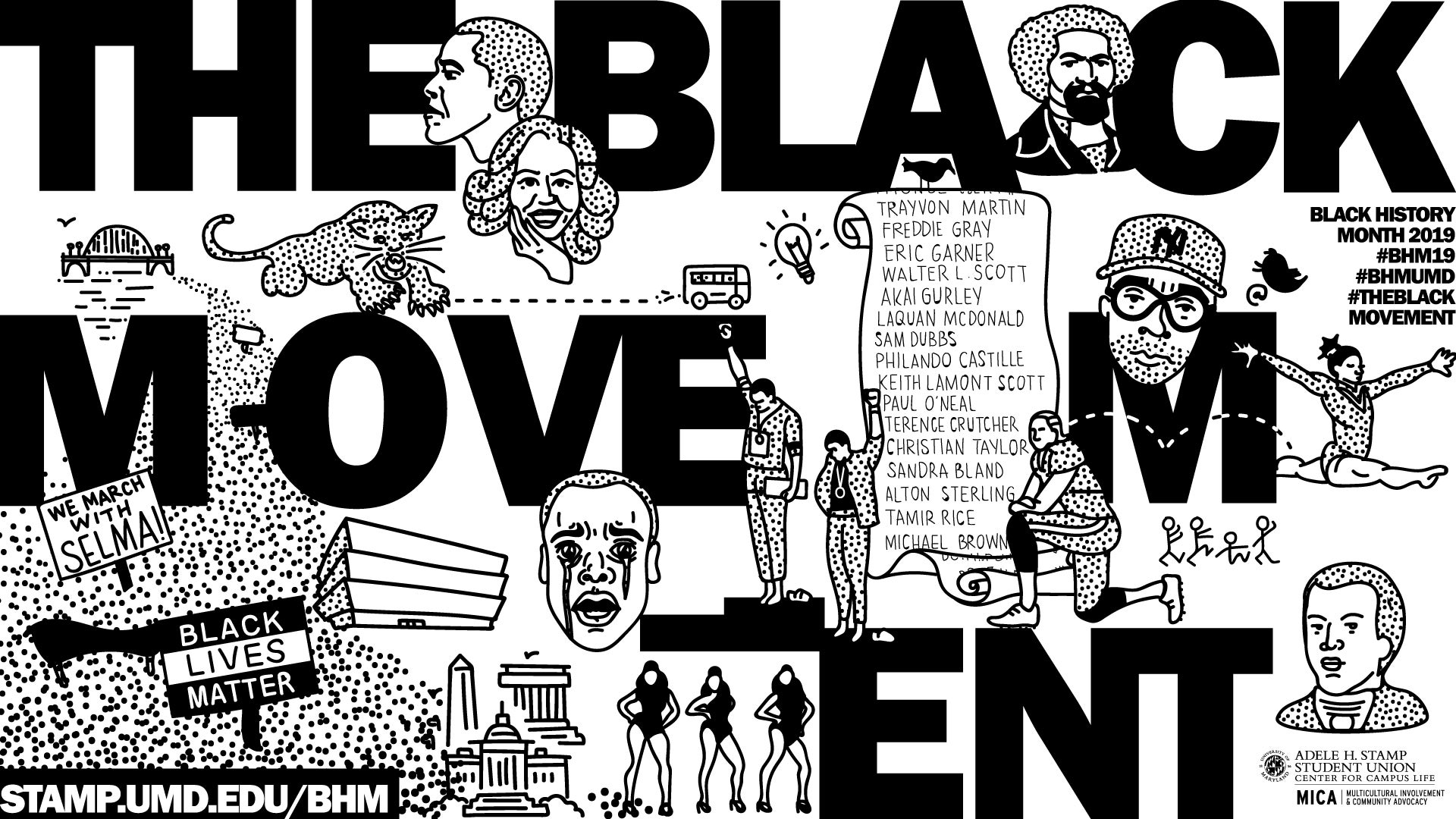
Give Back
-
Donate Locally
-
Donate Nationally
- A Better Chance
- Black Lives Matter
- Black Organizing for Leadership and Dignity
- Blackout Collective
- Black Visions Collective
- Black Women’s Blueprint
- Campaign Zero
- Black Trans Women Fund
- Crowdsourced Google Doc of bail funds
- Equal Justice Initiative
- George Floyd’s Memorial Fund
- I Run With Maud, the Ahmaud Arbery Memorial Fund
- Justice for Breonna Taylor
- Local Bail Funds
- NAACP
- NAACP Legal Defense Fund
- National Association of Black Journalists (specifically the Black Male Media Project)
- National Bail Fund Network
- National Bail Out
- National Police Accountability Project
- Nation-Wide Bail Funds
- Reclaim the Block (Minneapolis)
- Showing Up for Racial Justice (SURJ)
- SisterSong
- Southerners on New Ground
- Supplies for DC Protesters
- Support Black-Owned Businesses
- The Bail Project
- The Conscious Kid
- The Movement for Black Lives
- Twitter users continue to crowdsource lists of local organizations that help bail out protesters who get arrested.
- UndocuBlack Network
Get Involved
- Design As Protest Collective - Anti-Racist designers dedicated to Design Justice in the built environment.
- Get Involved and connected - Become a Design as Protest Field Organizer. Contribute to Research & Data. Engage Direct Action. Amplify Storytelling & Media Campaigns. Join the Mailing List.
- Guidance for Reporting and Writing About Racism - "Newsrooms, reporters and their leaders should consider diversity at all levels, including how they hire talent, make assignments, and write stories."
- This guide includes five considerations when reporting and writing about racism. As the guides states: "These considerations are not exhaustive. They should be used in tandem with other resources such as experts, organizations working toward newsroom diversity and anti-racism leaders." The page also includes half a dozen additional resources including tools, style guides, and articles helpful to writers.
- How to Make this Moment the Turning Point for Real Change by Barack Obama
- Included is a report and toolkit developed by the Leadership Conference on Civil and Human Rights, which is based on the work of the Task Force on 21st Century Policing that former President Obama formed when he was in the White House. Visit this dedicated site at the Obama Foundation, if you’re interested in taking concrete action, which will direct you to useful resources and organizations who’ve been fighting the good fight at the local and national levels for years.
- Join your local BLM chapter or start your own chapter.
- Join your local demonstrations and protests
- Mobilize Black Voters through the NAACP Civic Engagement Program.
- Follow these guidelines offered by public health officials when participating in peaceful protests.
- TEXT:
- 'FLOYD' to 55156
- 'JUSTICE' to 668336
- 'ENOUGH' 55165
- Leave a voicemail to demand justice for Breonna Taylor at (502)-574-2003
- #ShutDownAcademia & #ShutDownSTEM
- Sign Change.org Petitions
- Justice for George Floyd
- Justice for Breonna Taylor
- Justice for Ahmaud Arbery
- Justice for Tony McDad
- Civil rights group Color of Change launched a petition asking that all the officers involved in Floyd’s death are brought to justice.
- Support
- National Police Accountability Project - This group, which is a project of the National Lawyers Guild, helps people find legal counsel.
- Campaign Zero - This police reform group has been working on policy solutions “informed by data and human rights principles.”
- The Poor People’s Campaign: A National Call for Moral Revival is uniting people across the country to challenge the evils of systemic racism, poverty, the war economy, ecological devastation and the nation’s distorted moral narrative of religious nationalism.
- Write a Letter to your family members using Letters for Black Lives 2020
Get Educated
- Check out this short list of content to get started.
- Anti-Racism Project
- Anti-Racism Resource List
- Anti-Racism Resources from the GoodGoodGood Project/Sarah Sophie Flicker & Alyssa Klein
- Anti-Racism Resources for Students and Professionals in Healthcare
- Baltimore Collegetown Black Lives Matter / Anti-Racism Resources
- Coming Together: Talking to Children about Race, Ethnicity, and Culture
- Dismantling Racism Works
- The Health Impacts of Racism
- How the Black Lives Matter Movement Started
- Justice in June, a lesson plan for being a better ally
- Let’s Get to the Root of Racial Injustice
- Opportunities for White People in the Fight for Racial Justice
- Racism in Healthcare
- Resources for White People to Learn and Talk About Race and Racism
- Timeline of Black protests in America & a timeline of racial injustice
- Who Gets to be Afraid in America?
- Toolkit for Black and Non-Black POC Organizers
- Toolkit for White People
Listen. Learn. Act to End Racism.
MOVING FORWARD: TAKING ACTION ON RACE AND EQUITY
On November 19th, 2020, Points of Light hosted the first conversation of its Listen. Learn. Act to End Racism initiative, in partnership with Morehouse College. Panelists included Dr. Bernice A. King, CEO, The King Center; Frederick J. Riley, executive director, the Aspen Institute’s Weave: The Social Fabric Project; and Michael Smith, executive director, My Brother’s Keeper Alliance; with conversation moderated by Points of Light President & CEO, Natalye Paquin. Dr. David A. Thomas, president of Morehouse College, which highlighted upcoming topics of conversation that help make sense of the history, as well as current manifestations and the impact of systemic racism. Watch this conversation.
Learn & Take Informed Action
For deeper learning, the following resources are recommended by our speakers and content partners.
Websites
- Learn More about My Brother’s Keeper Alliance
- Learn More about My Brother’s Keeper Alliance Anguish and Action Initiative
- Learn More about Morehouse College
- Learn More about The King Center
- Learn more and follow the work of Weavers at WeAreWeavers
- Learn More about the #WeavingCommunity Social and Public Engagement Campaign
Articles
- The New York Times – “Extensive Data Shows Punishing of Racism for Black Boys”
- NBC News – “Poll More Voters Acknowledge Symptoms of Racism but Disagree about Its Causes”
Books
- Where Do We Go From Here: Chaos or Community? by Rev. Dr. Martin Luther King, Jr.
- How to Be Antiracist by Dr. Ibram X. Kendi
- The Warmth of Others Sun by Isabel Wilkerson
Guides
- Download The City Leader’s Compass to the My Brother’s Keeper Landscape
- Download My Brother’s Keeper Alliance Playbook for Corporations and Business
- Download My Brother’s Keeper Alliance’s Guide on Mentoring Boys and Young Men of Color
- Download Civic Life Today: A Look at American Civic Engagement Amid a Global Pandemic
Media
- Watch Rev. Dr. Martin Luther King Jr.’s Nobel Prize Speech
- Watch Federal Reserve Bank Atlanta’s Webinar, “Racism and the Economy”
Take Informed Action
- Join My Brother’s Keeper Alliance
- Visit Weaving.Us to take part in the #WeavingCommunity social and public engagement campaign to inspire Americans to start and deepen relationships where they live. Visit the partners page to see groups working in the field of community conversation and healing
- Sign up for The King Center’s Beloved Community Talks
- Learn More about The King Center’s Nonviolence365® virtual program

- Please take a few moments to read each of the statements shared by student leaders and administration officials, as well as President Darryll J. Pines' statement to the UMD community.
A Celebration of Juneteenth
A Celebration of Juneteenth
By Destiny Ward, Maryland Track & Field Student-Athlete
6/19/2022 7:00:00 AM
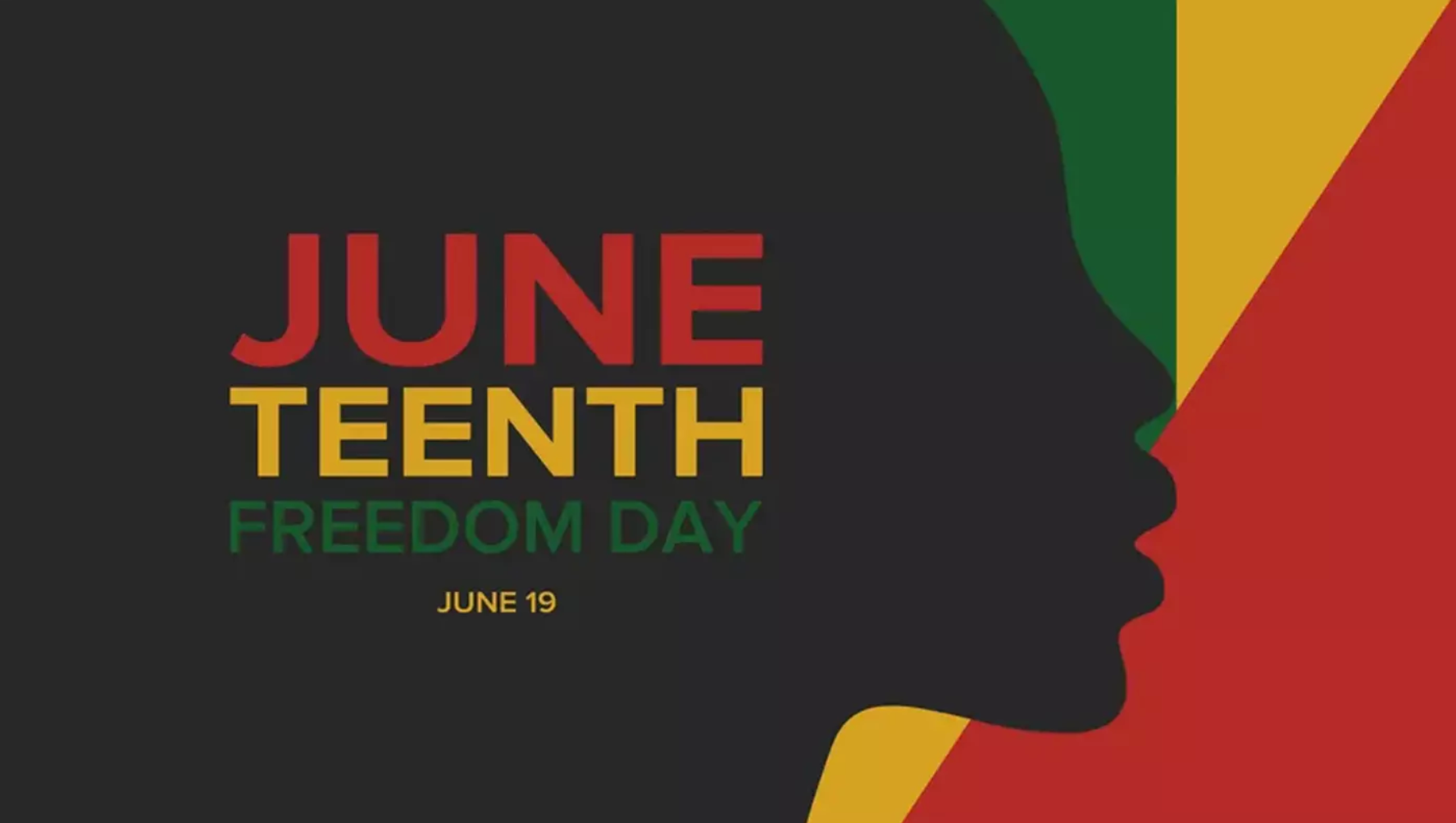
Maryland track & field student-athlete Destiny Ward writes a powerful essay about the Juneteenth holiday, what it means and why it's important for all Americans to celebrate.
Today we celebrate Black Liberation
Today we celebrate Black Freedom
Today we celebrate Black People
We celebrate this day in honor of what happened on June 19th, 1865. When Union General Gordon Granger arrived in Galveston, Texas to deliver the news that the Civil War was over, and the last group of enslaved people was free. This signifies a major stepping stone in the journey for justice that we continue to embark upon today. Today is a day to reflect on all of the things Black people in this country have not only endured, but overcome. This is the day that a victory is won!
Today we celebrate Black Leaders
Today we celebrate Black Victory
Today we celebrate Black Joy
Today we acknowledge the leadership, the innovation, the courage, and the resiliency of our ancestors, and we celebrate the strides that they have made towards equality. As a people today, we take the baton to continue the marathon towards social justice. It is the responsibility of every single one of us to commit to equality and humanity, and to advocate for the liberty and justice of all people. We celebrate Black people today from the crowns on their heads to the soles on their feet.
Today we celebrate Black Skin
Today we celebrate Black Hair
Today we celebrate Black Love
This means actively being anti-racist and refusing to uphold systems and structures designed to oppress Black people. It means having difficult conversations, challenging racist, white supremacist ideals, and promoting equality for all people. This requires acknowledging a painful past and addressing the systemic oppression that it has ingrained into the roots of this country. This acknowledgment allows us to move forward in addressing the issues at hand and actively implementing and advocating for change. Today we recognize that micro-aggressions have a major impact, and we respect and honor Black people for all that has been endured and all that has been overcome. As our national anthem composed by Rosamond Johnson states, “Lift every voice and sing, til earth and heaven ring, ring with the harmonies of liberty.” “Facing the rising sun, of our new day begun, let us march on till victory is won.”
Today we celebrate Black Creativity
Today we celebrate Black Culture
Today we celebrate Black Lives
Today we celebrate Juneteenth

Destiny Ward
Blocking Out the Hate: Maryland Volleyball Leads the Charge on Social Justice
Blocking Out the Hate: Maryland Volleyball Leads the Charge on Social Justice
By Matt Gilpin, Maryland Athletics Staff Writer
9/1/2021 8:00:00 AM

Donning wrist tape with the letters “BLM” written on it, senior middle blocker Rainelle Jones chooses to wear her beliefs on her body every time she steps on the court at the XFINITY Center Pavilion.
While 2020 was a year that will undoubtedly be synonymous with the COVID-19 pandemic, social justice issues also rose to the forefront of the world after the murder of George Floyd in Minneapolis, Minnesota.
On May 25th, Minneapolis police officer Derek Chauvin sparked a global outcry by pinning the unarmed Floyd down and suffocating him. Chauvin has since been found guilty of second - and third-degree murder and second-degree manslaughter and sentenced to 22 and a half years in prison for the crimes.
Sadly, it was nothing new for Jones, Cara Lewis, Hannah Thompson, and all the Maryland volleyball players.
“It breaks your heart every time it happens,” Jones said. “Once it happens again you’re just reminded about all the problems facing you and all the people who look like you. It won’t stop unless we take a stand now and do it together.”

Rainelle Jones
It's incredible coaching a team of young women that is so passionate about issues like this in order to create a better world for themselves and the future. Each and every day I learn something new from them and as a staff we take pride in supporting them however we can both on and off the court.
Adam Hughes, Maryland Volleyball Head Coach
Floyd’s murder led to a reckoning in the sports world where major sports leagues like the WNBA, NBA, and NFL took stands against racial injustice.
The NBA, which was playing in its season in an Orlando-based bubble, was so affected by Floyd's murder that a league-wide player's meeting was held to discuss whether or not to cancel the season.
The players ultimately chose to keep playing but not before they made their voices heard.
Players wore t-shirts, armbands, and messages on their gear to express solidarity for not just Floyd, but also the deaths of black Americans like Breonna Taylor, Eric Garner, and Trayvon Martin.
The NFL took a very visual approach to express their solidarity as all 30 stadiums painted “It Takes All Of Us” and “End Racism” in their end zones while also allowing league-approved messages on helmets, hats, and warm up gear.
The WNBA is synonymous with activism as its players have not shied away from making their voices heard when it comes to social justice.
During their bubble season last summer, WNBA players created homemade shirts and knelt during the playing of the national anthem as a way to peacefully protest the treatment of Black Americans.
With kneeling for the anthem being made mainstream and normalized by the likes of former NFL player Colin Kaepernick and women’s athletes across the country, several Maryland volleyball players have chosen to take a knee themselves.
“It’s our way to peacefully protest,” Lewis said of the decision to kneel. “We’re not hurting anybody and we have the support of our team, our athletic department and our fans. Everyone supports it and even if some people outside of this family don’t, we don’t care.”
Lewis is joined in kneeling by Jones and senior Maddie Naumann, with Thompson choosing to not hold her hand over her heart.
Naumann, who is white, feels that it is important for her to not only understand the plight of her teammates but to join them and support them in anything that they need.
The senior defensive specialist sits on the leadership committee for the team along with Jones and the two of them remained in constant communication throughout the summer of 2020.
The Austin, Texas, native wanted to make sure that while her support was there, she also didn’t want to overstep any boundaries.
“This isn’t about me,” Naumann said. “This is about all the victims of racial injustice and all those who are living with that fear every day.”

Maddie Naumann
We’re just doing what’s right. We can’t let other people who aren’t here or aren’t experiencing what we’re experiencing tell us what’s right and what’s wrong. I’m proud of the way this team and this school has come together over all of this.
Cara Lewis
This past summer Maryland added Thompson as a graduate transfer from Notre Dame and her voice was a much-welcomed one to the locker room.
Thompson majored in psychology and Africana studies and is known for her charity work with groups such as the Road Runner Food Bank, Breast Cancer Walk, and Feed My Starving Children on top of being an advocate for social justice.
When she entered the transfer portal after last season, Maryland’s diversity, equality, inclusivity and commitment to Black student-athletes stood out to her and made her decision a simple one.
“Maryland felt like a place committed to those kinds of ideas,” Thompson said. “If you look at girls like Rainelle, Cara and people like coach Hughes, they lead by example and they’re not afraid to be who they are and I was really impressed by that.”
What was once considered niche political statements that have landed athletes in trouble in the past have now become mainstream and been embraced throughout the college ranks.
For Maryland volleyball, the decision to embrace the movement ultimately fell to the players but the choice was much easier after head coach Adam Hughes made it abundantly clear that he was behind the movement 100%.
“Adam has been amazing throughout this whole thing,” Jones said. “He called everyone as the protests last summer were happening and made sure everyone was okay. I can’t thank him enough for that kind of support.”

Hannah Thompson
Hughes, like most people around the world who were aware of what was happening, was saddened and angered by what was happening.
During the height of the protests and marches, Hughes decided to call every member of his team to make sure they were doing okay. In doing so, he learned just how strong and resilient his team was.
"It's incredible coaching a team of young women that is so passionate about issues like this in order to create a better world for themselves and the future,” Hughes said. “Each and every day I learn something new from them and as a staff we take pride in supporting them however we can both on and off the court."
Historically, the Maryland Terrapins have always been leaders when it comes to social justice in the NCAA.
In 1963, Darryl Hill became the first Black football player in any of the southern athletic conferences. Just two years later, Billy Jones became the first Black basketball player to play in the ACC.
Both men have since been honored by the university for their trailblazing careers with Jones-Hill House being named after them. Nearly 60 years after Hill and Jones took their courageous stands and broke down barriers, the mantle has been taken up by the modern-day Terps.
The football team has committed itself to be more socially conscious as the football team wore custom nameplates, stickers, and warm-up shirts that displayed social justice messages.
If you go to a women’s soccer match, you’ll see athletes such as Alyssa Poarch and Kori Locksley kneeling for the national anthem with their teammates standing with their hands on the kneeling player's shoulders in solidarity with them.
Not being the only team in this fight makes a world of difference for Lewis as she sees the movement growing and becoming a university-wide issue.
“We’re just doing what’s right,” Lewis said. “We can’t let other people who aren’t here or aren’t experiencing what we’re experiencing tell us what’s right and what’s wrong. I’m proud of the way this team and this school has come together over all of this.”

Cara Lewis
Maryland felt like a place committed to [diversity, equality and inclusivity]. If you look at girls like Rainelle, Cara and people like coach Hughes, they lead by example and they’re not afraid to be who they are and I was really impressed by that.
Hannah Thompson
Players like Jones, Lewis, and Thompson have chosen to live and play the game they love without fear, but that doesn’t mean there isn’t trepidation.
That sort of apprehension isn’t related to the backlash, it’s as if everything they’ve worked for falls out of favor with society and becomes a forgotten issue.
Rainelle Jones has a mantra about her and her team’s commitment to making the world a better and more inclusive place. It’s a mantra that has resonated with everybody on the team regardless of skin color and stays as a reminder that this shouldn’t be a fleeting issue.
“It’s a movement, not a moment”
---
Behind the Demands
Behind the Demands
The Diamondback, April 7th, 2021
It began almost a year ago.
Last spring, as protests exploded across the country following the killing of George Floyd, administrators at the University of Maryland sent a meeting invitation to the members of more than 30 Black student groups. During a time of so much pain and trauma, the officials wanted to know how the school could better support Black students — how they could help them feel included, valued, seen and safe on the campus.
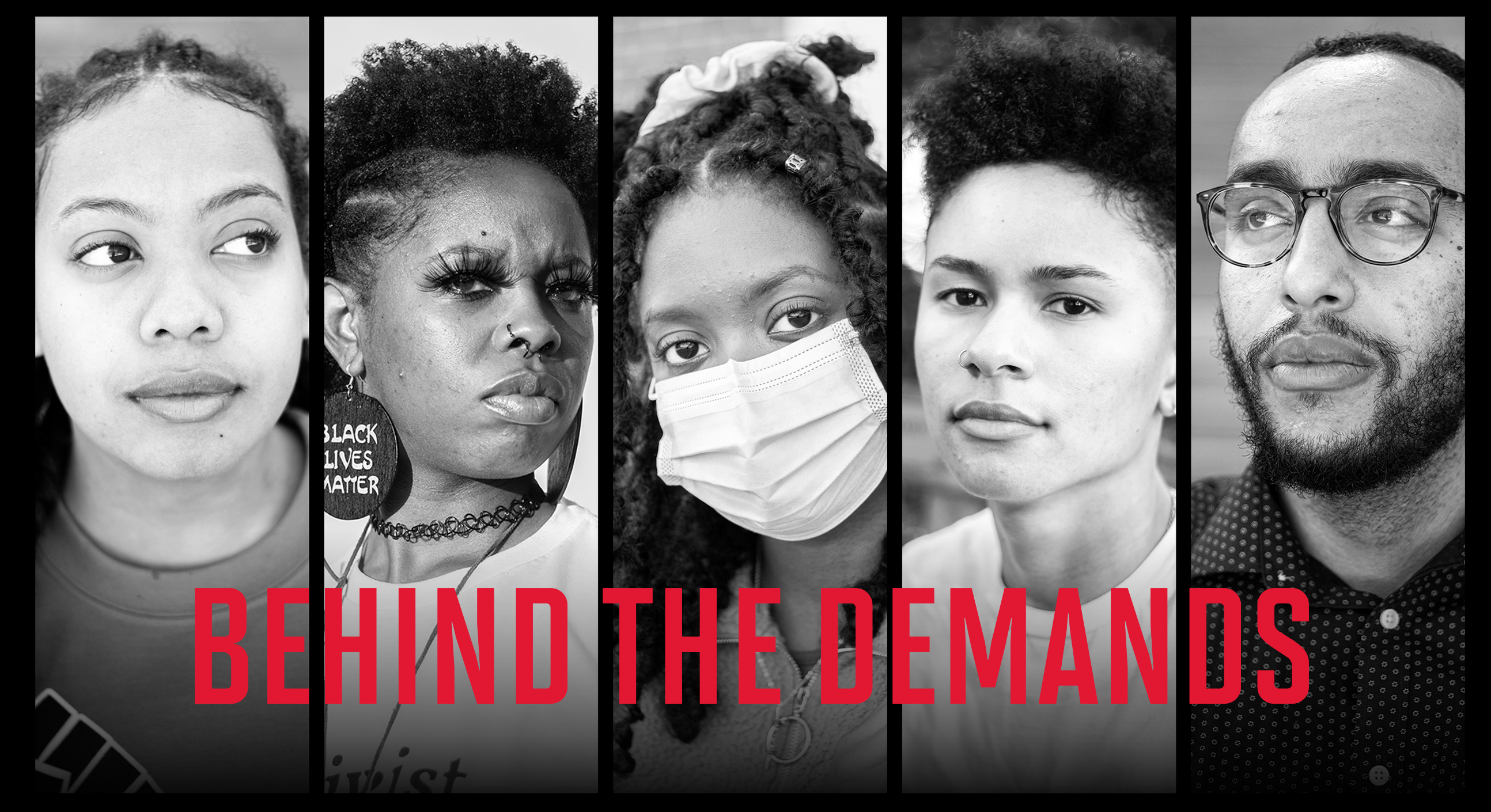
The meetings continued from there, once every three to four weeks. Ultimately, university President Dr. Darryll Pines convened a task force of five student leaders to draw up a list of issues for the school to address. In October, the students — undergraduates Saba Tshibaka, Adam Ahmed, Nadia Owusu and Pauline Sow, and doctoral student Jehnae Linkins — delivered their list to the university. By November, it was published on the school’s website.
The demands — referred to as “critical issues” on the university's website — encompass a wide variety of topics, including campus policing, mental health services for Black students and the university’s relationship with Prince George’s County.
A collective of Black graduate students, UMD BLK Grads for BLK Lives, also sent its own list of demands to the university administration over the summer, in a letter signed by more than 200 people. Last month, school officials met with the group for the first time. In a recent interview with The Diamondback, Dr. Patty Perillo, student affairs vice president, noted that the school has already addressed some of the demands from these students and may need to negotiate the timeline for meeting others. She and other administrators will, however, continue regularly meeting with the students, she said.
Credits
WRITING: Angela Roberts, Clara Longo de Freitas, Madison Peek, Clara Niel, Eric Neugeboren, Rina Torchinsky, Christine Zhu, Amanda Hernández, Joelle Anselmo, Emily Williams, Matt McDonald, Jonathan Tercasio, Khushboo Rathore and Anaya Truss-Williams
EDITING: Daisy Grant, Jenn Attanasio, Sahana Jayaraman, Anastazja Kolodziej, Zoe Pierce, Owen Donohue, Gabby Lewis, Devon Milley, Shauneen Miranda, Colleen Neely, Ami Oberg, Celia Richardson, Ella Sherman, Mira Varghese and Ryan White
Photography: Julia Nikhinson
Website Design: Vishal Patel and Anthony Breder
Justice for Black lives
August 27, 2020
Dear University of Maryland community,
As we fight two pandemics - COVID-19 and racial injustice - it pains and angers me that we continue to see the senseless shooting of Black people. This includes Jacob Blake and the many before him who have been killed or wounded. And, again, we find ourselves being forced to fight for justice, while also fighting to protect our health.
We see advocates in the spotlight - like many athletes and demonstrators across our country - rising up, protesting and advocating for change. We must all rise up, becoming advocates within our own community and supporting our fellow Terps. Here at Maryland, we will continue to grow and enhance the ways in which we educate and activate our community on the issues of racism and violence.
If you have not already done so, I urge you to learn, reflect, and determine ways that you can take action by accessing resources from the Office of Diversity and Inclusion:
I am joining the Virtual March on Washington - a demonstration honoring the 57th anniversary of the March on Washington, where Dr. Martin Luther King Jr. delivered his "I Have a Dream" Speech. The March will demonstrate advocacy for comprehensive police accountability reform, the Census, and mobilizing voters for the November elections. I hope many of you will consider participating as well.
We understand ongoing social injustices impact our mental health, and please don't hesitate to reach out to the Counseling Center for help.
As we continue to fight injustices as a country and a community, I must say it again and ask you to say with me:
Black Lives Matter.
TerrapinSTRONG,

Darryll J. Pines
President, University of Maryland
He/Him/His

University of Maryland, Office of the President
1101 Main Administration Building / College Park, MD 20742-5025, USA
301.405.5803 / president@umd.edu / @President_Pines / president.umd.edu
In Wake of Black Americans’ Killings, Campus Leaders Call for Action
Dear University of Maryland community,
We are grieving the killing of George Floyd, McKinsley Lincoln, Tony McDade, Breonna Taylor, Nina Pop and Ahmaud Arbery, and all who came before.
We are deeply concerned about insufficient police accountability across the country, systemic racism, and the social, economic and health inequities that have led to protests born of despair, anger and hope. We support the many peaceful demonstrations for justice across the United States.
We acknowledge that we have our own painful history at UMD, which includes the tragic murder of Lt. Richard Collins III.
The University System of Maryland (USM) chancellor and all the presidents of USM institutions recently stated publicly: "We acknowledge with one voice the structural racism that’s taking the lives of our fellow citizens, and we stand in solidarity as we speak out against racism, anti-Semitism, sexism, discrimination against our LGBTQ+ and immigrant communities, religious intolerance, and bigotry of any kind."
Our university must be even more committed to creating a more inclusive, respectful and supportive environment, and follow up with actions that will help shape a more just and equitable campus community and society.
We would like to inform students, staff and faculty of the following campus opportunities, and invite your participation as a step toward taking action:
- If you are interested in being in community with others, to process the pain, exhaustion and fear, email the Office of Diversity and Inclusion at DiverseTerps@umd.edu.
- If you seek individual support, email Dr. Chetan Joshi, director of the Counseling Center, at cajoshi@umd.edu.
- If you seek spiritual support, email campus Chaplain Holly Ulmer at ulmer@umd.edu, and she will connect you to other campus chaplains as needed.
- If you are interested in reading “White Fragility” or “Me & White Supremacy” and discussing it with members of the community and leaders from embraceRace@umd, email Student Affairs at vpsa@umd.edu.
- If you are interested in working with your leadership team, unit, department or division to strengthen cultural competency, and engage in doing the work, email Dr. Carlton Green, director of Diversity Training and Education, at cegreen@umd.edu.
- If you want to connect with and/or receive support from leaders within our Nyumburu Center, email director Dr. Ron Ziegler at nyumbz@umd.edu.
- If you are a member of a cultural student organization, and want to be in community with others, email Brandon Dula, assistant director of Multicultural Involvement and Community Advocacy (MICA) at bdula@umd.edu.
- If you have concerns or questions about current policies that could negatively impact you and members of your community, email Dr. Andrea Goodwin, director of Student Conduct, at agoodwin@umd.edu.
- If you would like to know more about our University of Maryland Police Department and its policies and protocols, email Chief David Mitchell at UMPDchief@umpd.umd.edu.
- If you are interested in organizing other efforts that help our university become more of what it professes and aspires to be, email any of us your ideas and we will help you organize and connect with others.
In community and solidarity,
- Dan Alpert, Student Government Association, President
- Annie Rappeport, Graduate Student Government, President
- Laura Dugan, University Senate, Chair
- Wallace D. Loh, President
- Mary Ann Rankin, Senior Vice President and Provost
- Carlo Colella, Vice President for Administration and Finance
- Georgina Dodge, Vice President for Diversity and Inclusion
- Damon Evans, Director of Athletics
- Jeffrey K. Hollingsworth, Vice President for Information Technology
- Jackie Lewis, Vice President for University Relations
- Laurie E. Locascio, Vice President for Research
- Patty Perillo, Vice President for Student Affairs
- Mike Poterala, Vice President for Legal Affairs and General Counsel
Stand in Solidarity, Unite Against Injustice
June 1, 2020
Dear University of Maryland Community,
On Wednesday morning, May 26, 2020, I woke up to go through my normal daily routine of getting prepared for the work day. But even before I could start my morning walk with my dog, my cellphone was already vibrating with texts and emails about something that had happened the evening before. Many colleagues, family members, and friends had sent me links to the now-infamous video of yet another black man losing his life at the hands of law enforcement. This time, for allegedly using a counterfeit $20 bill at a local shop in Minneapolis, MN.
I took a moment to click on the links and watch the more than 9-minute video of the last breath being sucked out of the body of Mr. George Floyd. As a black man, I screamed words that I cannot repeat here. As a father, I started to reflect on the safety of my son and daughter and on all the diverse communities who are negatively impacted by acts of injustice. I asked myself, what is wrong with our country when these incidents continue to happen time and time again?
In recent weeks we have again witnessed senseless acts of violence perpetrated against the black community. The tragic loss of lives -- those of George Floyd in Minneapolis, and before that, the deaths of Ahmaud Arbery, Breonna Taylor, Tony McDade, and Sean Reed -- due to racial violence is deeply saddening and a stain against the values that we personally hold, and that the University of Maryland, as an institution, cherishes.
The fact that these horrific acts have occurred in the midst of a pandemic is a double blow to black and brown communities. They cause additional pain and grief at a time when we are dealing with so many other challenges. But the shameful reality is that the virus has disproportionately affected communities of color. It has exposed the base inequities of our healthcare system and made painfully clear how those who have suffered so many other injustices for so long must also unequally bear the burden of this disease. These additional acts of racism and hatred bring into greater focus the injustices occurring in our nation.
Martin Luther King, Jr., once said that:
"The ultimate measure of a man is not where one stands in moments of comfort and convenience but where one stands in times of challenge and controversy."
As a university community, we must not accept these latest incidents as inconsequential. We all must rise up and stand together to show our humanity to one another. We must remind ourselves of Dr. Martin Luther King, Jr.'s words that "injustice anywhere is a threat to justice everywhere." Finally, we must heed the words of the late President John F. Kennedy, "what unites us is greater than what divides us."
Even though we are physically separated, now is the time to stand in solidarity and unite against any injustice.
Sincerely,
Darryll J. Pines
Glenn L. Martin Professor of Aerospace Engineering
President-Designate
University of Maryland
A Letter to the Do Good Community: Black Lives Matter
To Our Do Good Community,
The last few weeks have been a devastating reminder of the hard work we still have to do to ensure justice prevails, for all. While our country continues to struggle with a pandemic, we are also grappling with the ramifications of our centuries-long history of racial injustice, white supremacy, and systemic racism. This time, the movement was sparked by the murders of Ahmaud Arbery and George Floyd, and intensified by the murders of Breonna Taylor, Tony McDade, and Rayshard Brooks. We, as the Do Good Institute team, see Black lives. We hear Black lives. We stand with Black lives. And, we unequivocally believe that Black Lives Matter.
As educators and advocates, we have always encouraged understanding, action, and doing good for our communities, but we’re embracing and encouraging this now more than ever. As we often suggest to our students, our team has taken a step back over these last few weeks to listen and learn. We are committed to learning as much as we can about how to be anti-racist and how to best support Black communities and other communities of color. You can find some of the resources we have been using to learn on our social channels.
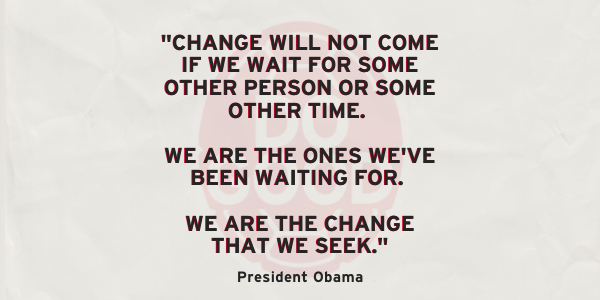
“Change will not come if we wait for some other person or some other time. We are the ones we've been waiting for. We are the change that we seek.” This quote from former President Obama is emboldened on the wall in our Do Good Accelerator, which serves as daily inspiration for our team and students that we can create meaningful change no matter your background, interests, or race. Now, more than ever, it’s an important reminder that change cannot wait. And, we have the power to create that change.
Below are a few concrete learnings, actions, and commitments that we’re starting with to support Black communities right now:
-
Educating Ourselves: We’re reading more, actively listening, watching films, and are committed to having difficult and open discussions about race and injustices in this country. Our full team is joining the Black Students in Public Policy and the Diversity, Inclusion, and Belonging Taskforce for a School of Public Policy Antiracist Discussion Series using Ibram X. Kendi’s How to Be An Antiracist as a tool to guide the discussion.
-
Supporting Black Communities: As part of Young, Black & Giving Back Institute’s Give 8/28 campaign, which closes out Black Philanthropy Month, we’ll be giving a grant to support black-led and black-benefiting grassroots organizations. The event takes place on August 28 - the anniversary of Martin Luther King, Jr.’s “I Have a Dream” speech - but giving is live now to help participating organizations stay funded during this crucial moment.
-
Revising What We Teach: We're dissecting and reevaluating our program offerings like the Do Good Challenge, Accelerator Fellows, and workshops. We're working to ensure we include diverse voices and perspectives, that we consider the historical, political, and social contexts of the social issues students are working on, and that we're "decolonizing" any curriculum we offer.
This is just the start. We know there’s so much work and progress to be made, we know we cannot remain silent. We take our responsibility as educators seriously, and we’re committed to using our voices, expertise, and funds to develop emerging leaders who are prepared to create meaningful change for a truly equitable world. Over the coming weeks and months, we’ll regularly share updates on our actions and commitments to becoming actively anti-racist and more supportive of Black communities.
We’re calling on our Do Good community - full of passionate leaders, innovative thinkers, talented changemakers, and staunch advocates - to join us and countless others breaking the silence and fighting to rid our nation of white supremacy. Do you have ideas or feedback? Please reach out to us - our doors are always open. We urge you to find ways to help now and in the future, whether you take ideas from our commitment, or find new ideas from experts like Equal Justice Initiative, Black Visions Collective, or Black Lives Matter.
We stand in solidarity,
The Do Good Institute Team
Uniting in Times of Uncertainty

Terrapin Athletics 6/1/2020 6:50:00 PM Damon Evans, Athletic Director
One Maryland: Uniting in Times of Uncertainty
Today, I feel compelled to write to you as we face these times of challenge, difficulty, and uncertainty. The impact of the COVID-19 pandemic on our world is utterly unprecedented. We have seen our lives turned upside down and our sense of normalcy stolen. Now, during one of the most difficult times in our history, we must face another enemy. This enemy is more familiar to us, and just as deadly as any virus. I am talking about systemic racism and injustice.
The events that continue to transpire -- in Minneapolis, Georgia, New York and elsewhere across our country-- simply go against the moral code of our nation. The deaths of Ahmaud Arbery and George Floyd and others, and the threats against Christian Cooper, a black man who was accosted while bird watching in New York's Central Park, illustrate that racism and discrimination are still part of the daily lives for people of color.
I know many of you are struggling with these injustices. So am I. I feel anger, frustration, sadness, and fear.
But we are not powerless. We cannot let these injustices overwhelm us into inaction or complacency. I believe we have an obligation to unite, to bring about the change we want to see. The combination of hope, belief, and unity is powerful. It is a strong recipe to combat systemic bias and racism.
As your athletic director, I promise that we will do all we can to strengthen our community. Our athletic family is made up of different genders, ethnicities, cultures, and religious beliefs. There is beauty in our diversity. We must respect and celebrate our differences and look for ways we can be part of a solution to the threats of racism and inequality.
Our mantra -- One Maryland -- has never been more important. Because when you attack one of us, you attack all of us.
So today, and every day forward, we must stand together, steadfast and fearless, and lead the change. I am guided by a relentless belief that all of us, together as Terps, can be a force in the dismantling of injustice in our society.
Please remember that we are here for you and will do all we can to help you through these difficult times.
One Maryland,
Damon
Black Terps Matter
We are here. We are here to stay and we are here to say: Black Terps Matter. Black Lives Matter. Join the movement.
Find out more information at: https://linktr.ee/blackterpsmatter
Black Terps Matter organizes to:
- call attention to the urgent (though often invisible) problem to law enforcement violence against women of color and trans people of color
- collect stories from women and men of color and transgender people of color about their experiences with law enforcement violence to use as further evidence of how gender- and race-based oppression are used to target us
- build strong networks among other Black-led organizations at the University of Maryland to strengthen our ongoing work addressing violence
- advocate for and develop community-based alternative responses to addressing domestic and sexual violence so that survivors are not forced to rely on police and prisons
- make critical partnerships with groups organizing against police brutality and prisons to support a critical gender analysis when considering what police and prison violence looks like and how to end it; and with groups addressing “violence against women,” such as anti-domestic violence and anti-rape organizations, to use a critical race analysis and expand our notion of “violence against women” to include state-sponsored violence such as law enforcement violence
- make connections between all kinds of law enforcement (including local and state police; immigration enforcement such as ICE, Border Patrol, and Customs; Drug Enforcement Agents; the FBI; private security agents; and military forces) so that we better understand - how local police collaborate with immigration police, how local police are often trained by military forces, how U.S. neighborhoods are actually occupied by military forces (such as in post-Katrina New Orleans), how military violence abroad is connected to police and military violence in the U.S., how private security contractors play a critical role in the function and violence of law enforcement
- make connections between gender-policing and gender violence targeting transgender people of color and non-trans women of color
Gender Violence & Race
What counts as “gender violence”?
Black Terps Matter addresses violence against women of color (including trans women) and trans/queer people of color as a combination of “violence directed at communities,” such as police violence, war, and colonialism, and “violence within communities,” such as rape and domestic violence.
We are told to call the police and rely on the criminal justice system to address violence within our communities. However, if police and prisons facilitate or perpetrate violence against us rather than increase our safety, how do we re-imagine a radical anti-violence movement?
Fact: Although the US has the highest incarceration rate in the world, the mass proliferation of prisons has not lead to a decrease in crime rates, or to a decrease in the amount of gender violence. Prisons have never had an effect on decreasing crime in society.
Fact: Over $100 billion is spent each year to support a prison industrial complex from funds that could otherwise go to support education and social services. This money almost equals the amount spent to support the US military industrial complex.
Fact: Communities of color are disproportionately impacted by the criminal justice system. People of color constitute over 70 percent of state and federal prisoners. Also, survivors of domestic & sexual violence represent the vast majority of people in women’s prisons.
As we build a movement to end violence against and within our communities, it is critical that we ask ourselves the following questions:
1. How can we develop an anti-violence movement that simultaneously struggles against state violence, including violence as a result of:
- prisons and police
- militarism
- reproductive violence
- poverty and economic exploitation
- environmental violence
2. How can we develop responses to sexual and domestic violence in our communities that do not solely depend on a racist, classist, sexist, and homophobic criminal justice system and fuel the right-wing agenda of “getting tough on crime” through the proliferation of prisons, unrestrained police brutality, and the mass incarceration of communities of color?
3. How do we build coalitions across movements?
Community Accountability
How do we address violence within our communities?
We are told to call the police and rely on the criminal justice system to address violence within our communities. However, if police and prisons facilitate or perpetrate violence against us rather than increase our safety, how do we create strategies to address violence within our communities, including domestic violence, sexual violence, and child abuse, that don’t rely on police or prisons?
Developing community-based responses to violence is one critical option. Community accountability is a community-based strategy, rather than a police/prison-based strategy, to address violence within our communities. Community accountability is a process in which a community – a group of friends, a family, a church, a workplace, an apartment complex, a neighborhood, etc – work together to do the following things:
- Create and affirm values & practices that resist abuse and oppression and encourage safety, support, and accountability
- Develop sustainable strategies to address community members’ abusive behavior, creating a process for them to account for their actions and transform their behavior
- Commit to ongoing development of all members of the community, and the community itself, to transform the political conditions that reinforce oppression and violence
- Provide safety & support to community members who are violently targeted that respects their self-determination
To learn more about violence against women of color and concrete strategies for community accountability, check out these resources:
- Videos from the April 2019 Building Accountable Communities National Gathering.
- TransformHarm.org – A Resource Hub
- Fumbling Toward Repair a community accountability workbook for facilitators, by Mariame Kaba and Shira Hassan
- Resources for Organizing
- Community Accountability Resource Website
- Community Accountability: Emerging Movements to Transform Violence (Social Justice Journal)
- Creative Interventions Toolkit: A Practical Guide to Stopping Interpersonal Violence
- Storytelling & Organizing Project
- Violence against Women of Color
- INCITE! – Critical Resistance Statement on Gender Violence and the Prison Industrial Complex
- Community Accountability Fact Sheet from the project to Stop Law Enforcement Violence Against Women of Color and Trans People of Color
- INCITE! Working Document: Community Accountability Principles/Concerns/Strategies/Models
- Community Accountability Within People of Color Progressive Movements
- Anti-Street Harassment Brochure, INCITE! DC
- Sistas Liberated Ground, Sista II Sista
- Zine from The Revolution Starts At Home Collective: Confronting Partner Abuse In Activist Communities
- Community Accountability Within People of Color Progressive Movements
- Community Accountability Working Document
Stop Law Enforcement Violence
Law enforcement violence against women of color and trans people of color is largely invisible in discussions about police brutality. Similarly, discussions about “violence against women” rarely, if ever, meaningfully address violence perpetrated by law enforcement officers. As a result, police brutality against women of color and trans people of color is often unacknowledged, leaving our voices largely unheard and our experiences unaddressed.
Yet since the arrival of European colonists on this continent and the creation of slave patrols — the first state-sponsored law enforcement agencies in the U.S. — Native, Black, Latina, Asian, and Arab women and girls have been and continue to be harassed, profiled, strip searched, body cavity searched, raped, beaten, and murdered by agents of the state on a systematic basis. Such abuses remain widespread and entrenched across the country, in the context of the “war on drugs,” policing of sex and sex work, the “war of terror,” “quality of life,” “zero tolerance” and “broken windows” policing.
In addition to breaking the silence around law enforcement violence against women of color and trans people of color, we focus on violence by police and other law enforcement agents for two main reasons:
- First, to foreground the central role of law enforcement in the prison-industrial complex – they represent the front lines of the criminal injustice system, and are often primarily responsible for determining who will be targeted for heightened surveillance and policing, enforcing systemic oppressions based on race, gender, gender identity and expression, sexual orientation, immigration status, class and ability, and feeding people into the prison-industrial complex.
- Second, because mainstream responses to violence against women have relied almost exclusively on the police to protect us from violence, when in fact, police not only often fail to protect women of color and trans folks of color from interpersonal and community violence, they often perpetrate further violence against us, including when responding to calls for help.
What is “law enforcement violence”?
We use the term “law enforcement violence” to reflect an analysis that includes police brutality by local, state and federal police, as well as immigration enforcement officers, Border Patrol, private security, and military forces. We use the terms “police brutality” and “law enforcement violence” alternatively to mean the same thing.
We focus on law enforcement violence experienced by women of color and trans people of color of all genders because we recognize that law enforcement agents police race and gender simultaneously, and deem gender non-conformity, be it through acts or expression, a sign of disorder to be punished. As the political group TransJustice asserts, “Gender policing, like race-based policing, has always been part of this nation’s bloody history.”
We integrate an analysis of militarism because of the close collaboration between military and police forces in the “U.S.” and abroad, which involves sharing tactics, personnel, equipment, and targets, which include women and trans people of color at home and around the world.
Stop law enforcement violence against women of color & trans people of color!
Get involved!
Share your story as a women of color and trans person of color who has experienced violence from law enforcement. Organize with a national network of women of color and trans people of color to connect and strengthen our work on law enforcement violence and community accountability. Document violence by police, immigration officers, customs, drug enforcement agents, and the military against women of color and trans people of color using interviews, video, and other forms of participatory action research (PAR).
Build coalitions between anti-police brutality/prison, immigrant rights, LGBT, and anti-violence groups to prioritize police brutality against women of color and trans people of color.
Investigate ideas and tools for organizing community-based responses to violence in our homes and communities, such as domestic violence and sexual violence, so that we do not have to rely on police and prisons to create safety in our communities.
Statement from the Maryland Football Team
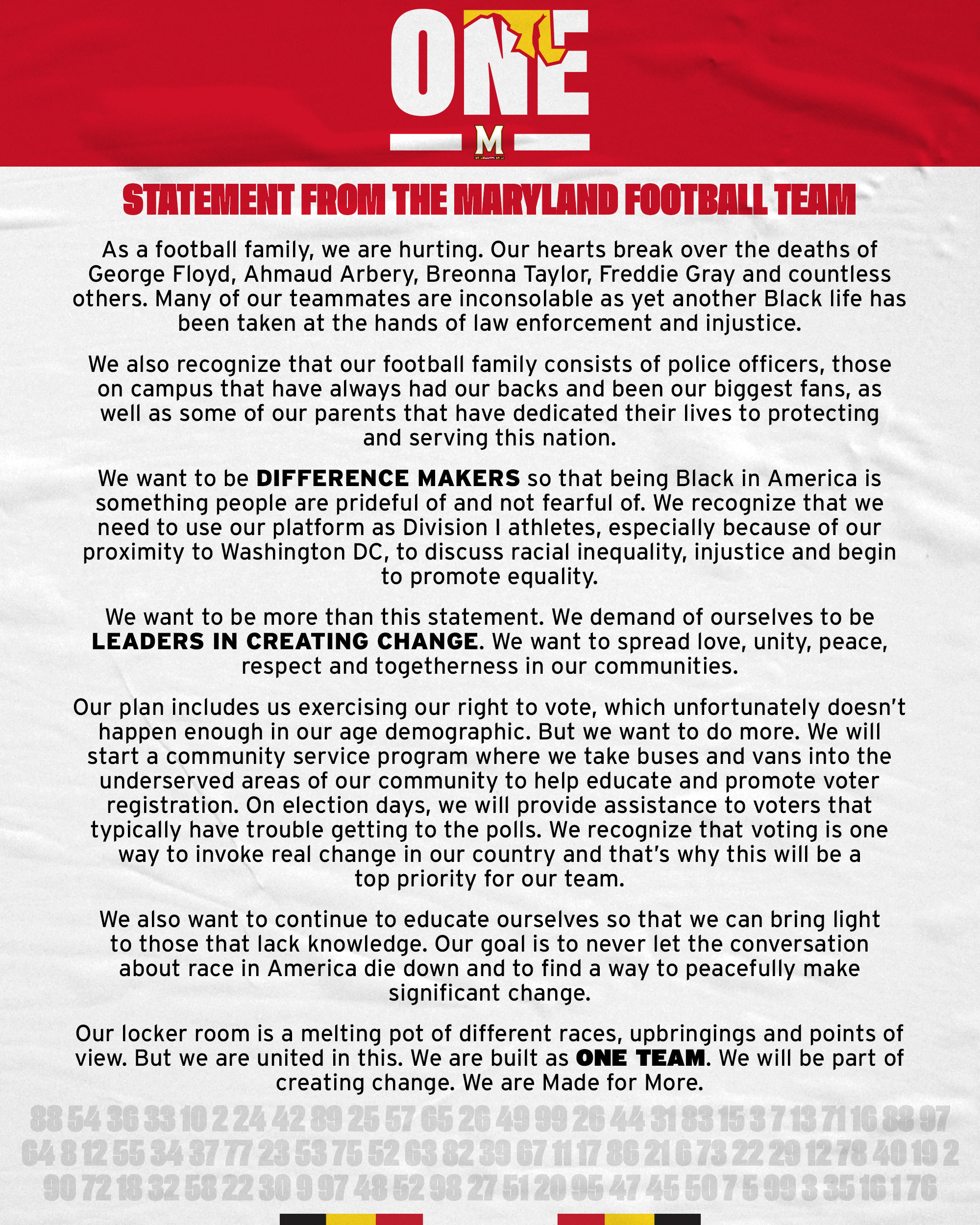
Get Comfortable Being Uncomfortable
June 5, 2020
Black Lives Matter. Three words that have sparked a national debate over a relatively simple concept: The lives of black people in America matter. And before you click away, I want you to ask yourself why? Are you uncomfortable? Good. Get comfortable being uncomfortable, because the days of catering to societal comfort are over. The time for change is now.
The recent murders of Ahmaud Arbery, Breonna Taylor, George Floyd and Tony McDade are not isolated incidents. They are merely the most recent results of a system that has vilified blackness and weaponized black skin since this country’s inception. The system I am referring to is racism. Institutionalized racism takes many shapes and in order to dismantle the system that continues to oppress and kill black people, it is important to understand that racism is more than blatant or explicit bigotry.
Racism is housing discrimination, food inequity, mass incarceration, underfunded schools, unequal access to sport, over-policing, voter disenfranchisement, the war on drugs, hiring discrimination, unequal access to health care and a flawed criminal justice system that far too often lets officers go unchecked for abusing their power.
I am tired of seeing black people beaten and murdered by police. I am deeply disturbed by the lack of accountability for police officers who so blatantly cause harm, shielded by a blue wall of silence that seems impenetrable by the justice system. Over the last month, I have seen people who look like me, who look like my brother, who look like my father, brutalized and killed at the hands of the police. It is unfair, unjust and unconstitutional.
At first, I was angry. Then I was fearful, heartbroken, bitter and full of resentment until all of a sudden, I was numb.
And with numbness came a familiar sense of anguish. A feeling of defeat. No matter how many names we add to the never-ending list of black people who've been wrongfully murdered in this country, nothing changes. It feels like screaming in your dreams when no one can hear you and suffering in silence as life goes on around you. It's waking up exhausted, not being able to explain why. It’s not wanting to check your phone or talk to anyone who asks, “How are you doing?” Simply put, it's draining.
I, a 20-year-old, am drained.
I can only imagine how my parents feel or how their parents feel, having to relive the nightmare that is watching people from your community killed senselessly because to be black in America is to be inherently threatening. Because society tells us that in order to survive an interaction with the police everything has to be just perfect. Don’t move too fast, don’t move too slow, put your hands out the window, wait, no put them on the steering wheel, where is my license? A routine traffic stop can easily become a crime scene as was the case in 2016 for Philando Castile, who was shot and killed in front of his girlfriend and 4-year-old daughter.
So here we are, years later, in the middle of a pandemic still demanding justice and systemic change. Trying to cash the same check Dr. King spoke of in his “I Have a Dream” speech. Almost 56 years after the Civil Rights Act was signed, and black people are still fighting for equal protection under the law and the genuine right to life, liberty and the pursuit of happiness.
America can do better. America needs to do better.
It took a video of a black man being pinned down in the middle of the street, in broad daylight, literally having the life choked out of him for people to finally look up and realize we need change, and we need it now. Call it an amalgamation of being quarantined for three months, pent up rage, I don’t care. Non-black people are slowly starting to realize there is a problem in this country and they are pissed.
Everyone is finally acknowledging the fact that black bodies are viewed as dispensable. Playthings, to be discarded when they aren’t wearing your favorite team’s jersey or performing in any other arena that directly benefits whiteness in America.
Enough is enough. “Thoughts and prayers” is no longer a sufficient response to the atrocities that continue to plague black communities across the country. Stop saying you are with us and be for us. Not because it affects you, but because for too long this country has profited from the achievements, culture and lives of black people without holding up its end of the bargain.
White people: The time has come for you to sacrifice your privilege. Educate yourself on the ways your whiteness has benefited you up to this point and work to utilize your privilege for social justice. Engage in meaningful dialogue, read about black history, support black businesses, advocate for the end of police brutality and racism and demand structural change. Pride yourself on being a lifelong learner and consumer of knowledge. Focus on facts and form your own opinions.
Please understand. All Black Lives Matter. It’s not just a hashtag, it is a movement, created to affirm the humanity of black people. Callously stating all lives matter in response to Black Lives Matter invalidates the experiences of black people and perpetuates the same racism that continues to murder us.
Denounce racism when it's not convenient for you. In rooms where there are no black people. At parties when you hear people rapping along with the n-word. In every space, especially those in which you hold a position of power or influence, leverage your privilege. Do not stay silent. Be explicitly anti-racist and hold others accountable for their words and actions.
We are at a pivotal point in this nation’s history. On the precipice of progress, the time has come for us to do the work. Black people cannot end racism. We can continue to lead, educate, and challenge, but we alone, cannot end racism. Racism will persist in this country until white people and non-black people of color who benefit from the many systems suppressing Black people do the work. Work that is challenging and uncomfortable, but nevertheless necessary.
Racism will not just go away with time. Injustices being committed against Black people won’t magically stop if we pretend that we don’t see them. We have the chance right here, right now to start dismantling the very systems that continue to oppress and kill black people in this country. A chance to end the vicious cycle that has crushed generations, so America can finally begin to live up to its promise.
Let this be the last time our 50 states and countless countries have to protest the murder of a black person at the hands of the police. Assemble. Petition the government. Vote. Do something. Because to do nothing in the face of injustice is unacceptable.
If reading this made you uncomfortable, good. Get comfortable being uncomfortable because I promise you, this is just the beginning.
 Taylor Wilson '21 is majoring in Kinesiology and plays infield on the Maryland softball team.
In Her Own Words: Ayana Akli
July 10, 2020
The past couple of weeks you all have been exposed to the reality of police brutality that has targeted the Black community for far too long. And while it may be hard for some of you to comprehend, this is just an everyday look into our everyday lives.
This is about a system of oppression and systemic racism which lies at the very foundation of this country’s origins. I went to a protest and a University of Maryland student who was speaking said that, “This country was built by me but not made for me.”
Let that sink in!
From my experience this movement is not about looting or rioting. The media is misconstruing the situation and looting is a very small fraction of what has and is still occurring today. Those stores and material things can be replaced but the lives lost cannot.
This movement is also exposing the idea of privilege to people across this country -- many of whom don’t have to think about the everyday occurrences that affect people of color.
- If you have never had to worry about a cop pulling you over and asking yourself “will I die today?”, then you are privileged!
- If your parents have never had to have a conversation to explain to you why people may say hateful things towards you because of the color of your skin then you are privileged!
- If you have never been questioned walking into your own home then you are privileged!
- If you have never had to worry about your chances of dying in childbirth due to racial bias, then you are privileged!
We travel all the time to play tennis and being an African American female, I always have to check where we are going, and to see if I will feel safe there or wonder will my team protect me in certain situations?
It is not just about blatant racism; it is also about the daily microaggressions we face as Black people. Being in a predominantly white sport, there is a double standard. I have to act better than everyone else. I have to be more polite. To even be looked at by college coaches I had to work three times harder to be seen as half as good as my counterparts. And these are not just my experiences, these are the same experiences as my friends and a lot of Black tennis players.
On more than one occasion, my doubles partner and I experienced multiple forms of discrimination such as: it was implied that the only reason we were winning was because the referee was Black, or telling us to calm down when we win a point but someone who isn’t a person of color can scream at the top of their lungs and not get a code violation.
There was another instance when we were playing zonals, and we were only 14. At 14 we were getting called monkeys and that we were too dark and teams would come behind my friend’s court and shake rocks while she served. This is something that must change.
I should not have to be uncomfortable to play a sport I love. No one should. Being in a predominantly white major (civil engineering), these issues follow me into the classroom as well. I am regularly asked questions like, “Are sure you are in the right class?” or “Did you get in on affirmative action?”
Not only is it these questions geared toward my peers, it’s the actions as well. Speaking over us when we are trying to explain things or touching our hair without our permission.
There are a lot of things that need to change, and that starts with us. If we are really One Maryland then we need to act like it creates change.
The main way everyone can help is acknowledging that they have the privilege and taking advantage of that in order to help minority individuals. First, it’s important to listen. This situation is not about you, it is about your teammate, your Maryland community, and in order to make a change, you need to listen.
No one is faulting you for having privilege or white privilege, but my point is there are resources out there for you to understand your privilege and to understand how you can use your privilege to help others. Also, Black people are not your only resource and they do not have to answer your questions.
It can be exhausting to live your life scared and tiptoeing around people, and then on top of that having to explain your pain multiple times.
Like I said earlier, there are other resources available to you. All I am asking for you to do at this time is to be an ally for me and other people of color. It is not a political issue, there should be no debate. This is not a trend, these are our lives.
Below are some informational resources and educational items that could be useful for you!
- Mary Turner
- Tulsa
- Black Wall Street
- Just Mercy
- When They See Us
- Fruitvale Station
- White Man’s Burden
- King in the Wilderness
- 13th
- Dear White People
- White Fragility by Robin DiAngelo
- How to be an Anti-Racist by Ibram X. Kendi
- Medical Apartheid by Harriet A. Washington
- Elaine Massacre
- Rosewood Massacre
- Tuskegee Experiment
- How White People Can Be Allies
 Ayana Akli '23 is majoring in Civil Engineering and is the B1G TEN Freshman of the Year.
The Hitchhiker's Guide to Social Consciousness
In Their Own Words: Maxwell Costes and Noah Seth
6/12/2020
Hi!
Congratulations on discovering the fact that there are people who don’t look like you, think like you, talk like you, walk like you, share the same worldview as you, nor have the same experiences as you!!
We know that it must have taken some hard effort to arrive at this point (and we’re so proud!), but we also recognize that you’re still new to this, and given the volatility of the current political and social climate, we thought it’d be best to not only commend you, but also offer some sort of guidance before you begin this journey of yours.
So consider this your official welcome to the TRAGIC inconsistency that is the American story, a story marred by betrayed promises, the destruction and mitigation of cultures for personal enjoyment, and a cacophony of violations against the human spirit.
A story, where consortiums of political leaders have shown such paucities of moral righteousness, have shown us their darkest depths of avarice and egoism, that to this very day they continue to make a mockery of the values and ethics that are supposedly the center and foundation of this country.
This is what you’re stepping into, but don’ t worry, you aren’t going to have to face this alone … admittedly if you’re reading this it probably means you’ll never have to face it, but that’s ok, we don’t blame you for that, and it also probably means you’re trying to help someone who deals with this on a daily basis.
Truthfully, we figure that the best allies are those that are well-read and well-spoken, not necessarily seen and not heard, but rather a meticulous combination of present, open-minded, and throw in some humility just for good measure.
Unfortunately, you’re going to have to learn to step out of that bubble of comfortable innocence you have, you’re going to say something stupid, you’re going to do something stupid, and that’s OK.
See we’ve become so engrossed, so staunch in our pursuit to not be wrong, that we’ve lost any sense of our curiosity, a characteristic that has single-handedly brought about golden ages of advancements and discoveries.
The only way to grow, the only way we put some color on our sunset horizons, is to go and seek information, to challenge our beliefs, and in doing this at some point we come across something that demands we recognize a conviction we hold in our hearts as not true, and it’s perfectly fine, it’s time we normalize adjusting and reshaping our thoughts and acts around reliable information.
Now with this expansion of knowledge and awareness comes the responsibility to share it with others who are ...”behind” for lack of a better term, engage with your confidants, bring them along to events, challenge their misguided words and ill-informed actions, hold elected officials responsible for not answering the calls of justice on the first ring, because it’s easy to say that one doesn’t “see” color, but that statement entails the inability to see color PATTERNS.
Finally, recognize that this is all bigger than just George Floyd and Breonna Taylor, that America was racist before Donald Trump was conceived, that with luck these senseless deaths are the inflection point on the vast crescendo that is racism in America.
It’s recognizing that Black Lives “Mattering” is really just the baseline, it should be the standard, and it is on us to raise that standard to where Black lives are celebrated, where black lives are valued beyond our inherent talents, where black lives are afforded every right under that clause of “life, liberty, and the pursuit of happiness.”
It’s coming to terms with the fact that racism is more than consciously hating someone, that even if you’re a white person that loves black people, racism couldn’t care less, that it is a parasite, feeding off the destruction of societies from the inside out, finding any possible way to affect how you deal with other people

Yes, hatred is the preferred brand of racism, but this is just one of the many outfits in its closet that it can choose to don, it wears availability as pajamas, Friday nights it likes to wear ignorance, Saturday’s it throws on entitlement and goes to the game with friends, perception is its favorite walking shoes, and unbeknownst to most, Apathy is its Sunday best.
Because the way that they kill black men in the streets, is the same way they kill black minds in public schools, is the same way they kill black self-esteem and uniqueness with appropriation, is the same way they kill black wealth with specific market and policy discrimination, is the same way they kill black communities by defunding recreation centers, education, housing development, and libraries, is the same way they kill Black women in Doctor’s and ER offices.

If you’re still reading this, I would imagine that you’re feeling overwhelmed by this task laid in front of you, feeling simultaneously infuriated yet defeated, it only took a few moments to do that. Imagine what 400 years must feel like! But don’t fret, because we still hold the greatest superpower in the known universe:
Hope.
The most consistent partner of strength and the unsung hero of every success story, I’d wager that all of us hold some conviction on searching for a better life and working towards a better world to exist in, and I’d argue that being hopeful is the most American act conceivable.
In two weeks, none of this will be trendy anymore. You won’t see anymore black squares on social media, celebrities will have stopped making statements, and the toll of activism will start to wear on on our spirits.
So if you are really about change, about being a part of the revolution, my challenge to you is to hold on to that dream of more to be had, that dream of absolute justice, carry it, protect it, fight for it like it’s the only thing that you can be sure is real in this world.
So once again, congratulations, and welcome to social consciousness :)
Maxwell Costes '22, is a two-time All American for the Maryland Terps Baseball team
In Their Own Words: Maryland Football Stands for Racial Justice
For the opening game of the 2020 season, Maryland Football student-athletes debuted new name-plates on their jerseys, helmet stickers and warm-up shirts to make personal statements about the ongoing fight for racial justice. Each expression was chosen directly by Maryland student-athletes and reflects a department-wide commitment to racial justice.
Spencer Anderson, Brian Cobbs, Dontay Demus Jr., Darryl Jones, Joseph Petrino and Colton Spangler describe below what their expressions mean to them.

EMPATHY
“I chose EMPATHY because with an issue like this or really any issue at all, you have to be able to understand the other side of a problem to relate with that problem. In order for us to fix things, people on the other side of this issue, whether it’s social injustice or racial inequality, they need to be able to understand what everybody else is going through.”
EQUALITY
“I chose EQUALITY for my shirt because as a team we all come from different backgrounds but that doesn’t make any of us better than anyone else. In order to be successful on and off the field and just representing human nature, EQUALITY is a big standing point.”
“It’s very special to me to have this Maryland football brotherhood because I know whatever I’m feeling and whatever my thoughts are there is going to be somebody that I can bring those thoughts to. They can relate with me and we can discuss whatever it may be in the world. Whether it’s creating change or just standing up with any type of issue, I feel like that’s the most important part of our brotherhood.”
Darryl Jones
Junior Wide Receiver

EQUALITY
“I chose EQUALITY for my name-plate because I want to see my younger sisters and the kids I grew up with have an equal opportunity to fight to start on the same level as their peers that might look a little different than them. I want kids now to grow up and not have to worry about being looked at differently and not have to worry about fighting extra hard in order to get where they need to be and not get beat out by someone who has had a head start in life. I want everyone that looks like me to have that step up in order to start at the same playing field as everyone else.”
“I never really realized at first how impactful and important it is to use your voice when you have one. I never realized how being a Division I athlete is that big of a deal because I never looked like it as that. When you go home and see former friends, coaches and teachers and they all tell you that they’re really proud of you and what you’ve done, you know that their kids know you and look up to you, you realize that you are speaking for them as well. It’s important that when you have a voice to use it because there are people that are listening.”
JUSTICE
“I chose JUSTICE for my shirt because I know myself along with many of my other brothers on the team have had a family member, friend or someone that they know put in a position where they felt like JUSTICE wasn’t served in their case. It’s hard knowing someone, in my case it was a good kid I knew growing up, that is just brought about this at the wrong time and then not getting the JUSTICE that my family and theirs feels like they deserve. It’s just kind of pushed aside, police brutality and all of that. It’s a big issue right now and a hot topic in fighting for what we believe in. It’s important for everyone to know and teach their kids the meaning behind it because JUSTICE is such an important thing. It’s not about the definition of the word, it’s about what you feel and what you feel is just. It’s about what is inside. It’s important for everyone to fight for what they believe in and believe that whatever they’re doing is just and to give it 100-percent.”
Joseph Petrino
Junior Kicker

I GOT YOUR BACK
“I chose I GOT YOUR BACK because on this team we truly are a family. I think of these guys as my brothers and I don’t want anyone to feel that they are going through the struggle alone no matter what they face on a day-to-day basis.”
“I’m blessed to be a part of this team and the platform that it allows me to have. I plan on using this platform to my full advantage to show my full support by wearing this phrase on my shirt and backing it up with my actions because actions speak louder than words. I understand, I am with you and I am ready for change.”
Dontay Demus Jr.
Junior Wide Receiver

SPEAK UP
“I chose SPEAK UP because it’s just different. There are a lot of people out there that see a lot of things and can have a say in creating change. To have this platform shows that I have overcome a lot of things and have been able to use my platform to show people that it’s not always easy but you have that voice to step up and be that person of change.”
Spencer Anderson
Sophomore Offensive Lineman

UNITY
“I chose UNITY because of everything going on around the world. UNITY is special to me. Our voices together are better than one particular voice. It’s special to have my brothers with me because as we are all superstars in ourselves, we are all stronger together.”
“Whether we believe it or not, our voices are heard and people look up to us. What better way is there to showcase social injustice than on the football field. Football is something that brings the world together.”
Colton Spangler
Sophomore Punter

UNITY
“I chose UNITY because we are one team and part of one family and all have to do our jobs to succeed. Once we do that, we can succeed on and off the field together.”
“It is very important to use our voices as football players. We are very vocal and we offer a lot on our platform that we have. We have a lot of people looking at us.”
Partnering to end anti-Black racism

November 24, 2020
Dear Terrapins,
I write to you today to commend the leadership of Black student leaders who have agreed to partner with me and other university leaders to pursue an anti-racist agenda here at the University of Maryland.
On July 1, my first day as president, I announced two priorities for our campus. One, we will achieve excellence in everything we do -- research, teaching and learning, arts, and athletics. And two, we will create an inclusive, multicultural environment.
These dual priorities are profoundly and immutably interconnected. We cannot have excellence without a diverse and inclusive campus. And they are both journeys, because the pursuit of excellence and a supportive, respectful community require determined, cooperative and ceaseless work. We will build on the work we have already begun.
To that end, we have invited and convened a group of outstanding student leaders from more than 30 organizations representing Black student life, to work toward a more inclusive, multicultural environment. To be sure, there is work to be done and I am pleased that we are proceeding together.
We are discussing a number of critical issues and goals, including:
- Increasing the number of Black faculty and staff;
- Strengthening spaces, organizations, programs and initiatives supporting Black students, faculty and staff;
- Implementing bias training;
- Prioritizing minority enrollment, particularly from Prince George's County, Baltimore City and across the region;
- And, honoring the life and legacy of Lt. Richard Collins III.
Each of the objectives under discussion will proceed on varying timelines and will involve additional members of our community. Working together, we will make significant and lasting change.
To all of the student organizations and university staff and faculty participating in this critical collaborative effort, I say thank you. Vice Presidents Georgina Dodge and Patty Perillo have prioritized this work, convening with urgency after more senseless killings of Black lives this spring and summer. In addition, I want to thank Senior Associate VP Warren Kelley, Tony Randall, and Brandon Dula for their years of work to create a more equitable and inclusive environment for all.
Our willingness to advocate for and to create change is a testament to our shared commitment to inclusive excellence. While this group is dedicated to addressing anti-Black racism, we also remain focused on advocating for social justice for any member of our Terrapin family who faces inequities and bias. I can think of no greater purpose. This is the work that makes us TerrapinSTRONG.
Sincerely,
Darryll J. Pines
President, University of Maryland
He/Him/His
-
Twitter: @President_Pines
Instagram: @President_Pines
Invited Student Organizations
- Afrochique at University of Maryland
- Black Honors Caucus
- Ethiopian & Eritrean Students Association
- Multicultural Greek Council
- Student Success Leadership Council
- Charles R. Drew Pre-Health Society
- African Student Association
- African Students Progressive Action Committee
- Alliance for Diversity in Science and Engineering
- Alpha Phi Alpha Fraternity Incorporated
- Black Business Association
- Black Engineers Society
- Black Graduate Student Union
- Black Terps Matter
- Caribbean Students Association
- Code: Black
- Diazporic Dance Team
- Kappa Alpha Psi Fraternity Incorporated
- Maryland Association of Black Journalists
- NAACP
- National Association of Black Accountants
- National Council of Negro Women
- National Organization for the Professional Advancement of Black Chemists and Chemical Engineers
- National Pan-Hellenic Council
- Political Power Project
- Riddim Ryderz
- ROOTS Africa
- SGA Diversity Leader
- Society of African
- American Studies
- Somali Students Association
- The Black Student Union
- The Star Strutters
- UMSuccess
Anti-Racism Toolkit: Transforming Knowledge to Action
About the Toolkit
Welcome to the Anti-Racist Toolkit: Transforming Knowledge into Action! This toolkit is inspired by the Anti-Racism Teach-In series, particularly the two Student Voices panels in late July and early August of 2020. This teach-in series came to fruition in response to the combined impact of the May 2020 international uprisings against police brutality and anti-Black racism and the ongoing COVID-19 pandemic. For many of us, the combined reality of both of these crises revealed the depth of unlearning and re-learning that we all must do to be able to meaningfully challenge racism, anti-Blackness, and other forms of systemic oppression in our lives.
In Diversity Training & Education, we also know that in order to truly move this work forward, we must be willing to look at how racism shows up, not “out there” in the world, but right here where we are. This means that if we are to truly embody anti-racism at the University of Maryland, we must be willing to take a hard look at our specific institution at both the organizational and individual level. Therefore, the goal of this toolkit is to provide just one way for students, staff, and faculty to 1) deepen our understanding of racism at the University of Maryland and 2) to encourage commitment to long-term, sustainable anti-racist action.
To find previous teach-in recordings, you can watch them on Youtube Channel.
How To Use
We encourage students, staff, and faculty to use this toolkit at both the individual and group level, to the extent that you are able. We especially encourage group work for engaging with this toolkit as having community in any learning engagement can provide crucial support for retention of information and ongoing support for accountability. In the words of Charlene Carruthers, "Lone wolves in movement work can move fast, but can only advance transformative change as far as they are connected with people." A group might look like a student organization, co-workers within or outside of your department, a class, a small friend group of folks from across campus, yourself and your supervisees, or any other configuration of people that wishes to provide each other with support in learning about anti-racism.
Accountability Pledge
The google form titled “UMD Accountability Pledge” is included as part 1 of a process for faculty & staff specifically. In this pledge, we ask that you directly engage with student demands by 1) familiarizing yourself with the many unaddressed demands that have been made of the university in the past couple of years, and 2) begin a conversation with your department/office about how you might implement those that are relevant to your team. We hope that the resources provided in this toolkit will also help you to think through what implementation might look like in your department/unit. A second part to the pledge will be provided later in the semester that addresses the “how” of implementing change. Right now, we are focusing just on introducing the conversation to your units and asking folks to share when they have done so.
Resource Folders - entry points into anti-racism
All the resources included in each folder are listed in the table of contents below. It is up to you to decide what content feels most appropriate for your context and what your/your group’s needs are around learning about anti-racism. All of the folders include a mix of academic scholarship, popular articles/blog posts, and audio and visual material of various lengths. Some resources are also numbered to give a loose suggestion of an order in which they might be scaffolded, as necessary.
Categories:
- Accountability Pledge for Departments and Offices
- Why We’re Still Here
- Subfolder: Deepening our Understanding of White Supremacy
- Subfolder: Resistance to Systemic Racism on Our Campus
- Breaking the Cycle
- Doc: Multimedia Resources for Breaking the Cycle
- Subfolder: Praxis: Anti-Racism in the Classroom
- Subfolder: Preventing & Responding to Harm
- Subfolder: Resources for Students
- Subfolder: Setting Ourselves up for Healing & Liberation
Of course, this toolkit is not comprehensive! We will update it as capacity allows in the coming months.
Thank You
Thank you again to all panelists and moderators who participated in our Student Voices panels over the summer. Dr. Kannisha Bond, Dr. Nancy Mirabal, Christina Sessoms, Yune Weems, Saba Tschibaka, Maria Aragon, Sam Doty, Jonathan Garcia, and Shavanah Ali -- we truly cannot thank you enough for your time, energy, and labor. We could not have pulled this together without you. And Christina especially, thank you for the resources on Black joy! Thank you to my colleagues in Diversity Training & Education - Jazmin, Miya, and Dr. Green - for assisting me in building this toolkit and for your hard work on the panels. Thank you also to Timea Webster, Allison Dickinson, Brielle Merchant, and Erin McClure, who helped with behind-the-scenes logistics and support for both events. And finally, thank you so much to the co-sponsors of our teach-in series: School of Public Health, Center for Diversity and Inclusion in Higher Education, STAMP student union, the Office of Multicultural Involvement and Community Advocacy (MICA), embraceRace@UMD, and Pepsi.
TABLE OF CONTENTS
Resource Folder: Why We’re Still Here
Subfolder: “Deepening our Understandings of White Supremacy”
Resources to bring more depth to our understanding of racism and how it operates at a systemic level. Some of these resources are specific to higher education, some of them are more general to give historic context to how we’ve arrived at this current political moment.
Popular Articles & Scholarship
- “The Problem is White Supremacy” by Barbara Smith (2020)
- “Colleges need a language shift, but not the one you think” by D.L. Stewart, VIDEO: Lecture building from this essay on the “language of appeasement” by Stewart
- “Who’s the Real Problem? On White Supremacy and Institutional Gaslighting” (2019) by Anisha Sankar
- Teaching White Students Showed Me the Difference Between Power and Privilege” by Kiese Laymon
- “It’s not White Fragility, it’s White Flammability” by Sun Yung Shin
- “In Our Own Words: Institutional Betrayals” by Reshmi Dutt-Ballerstadt (2020)
- “White Supremacy Culture,” a list compiled by Tema Okun of Dismantling Racism
- “How Colleges Co-opt Black Student Protests” by Marcia Catelain (2020)
Peer-Reviewed Academic Articles
- “Ideologies of Absence: Anti-Blackness and Inclusion Rhetoric in Student Affairs Practice” (2019) by D.L. Stewart
- “The White-Centering Logic of Diversity Ideology” (2019) by Sarah Mayorga
- “Challenging Complicity: The Neoliberal University and the Prison Industrial Complex” (2014) by Julia Oparah
Doc: Multimedia Resources
Youtube Playlist: “Breaking Down the Prison Industrial Complex” Video Project
- Podcast episode: “The Anti-Black Pinnings of Ableism”
- Podcast episode: “COVID, White Power, and the Unseeing of Race Again”
- Podcast episode: “Inseparable Separations: Slavery and Indian Remvoal”
- Video: “Ruth Wilson Gilmore on COVID-19, Decarceration, and Abolition”
- Website: Quick statistics on Race, Gender, and Incarceration
Subfolder: “White Supremacy & UMCP”
Resources that provide insight on what resistance has looked like at the University of Maryland in particular. It’s important that these resources inform our understanding of 1) what kind of campus marginalized students and employees want, especially the elements which remain consistent across decades, and 2) what attempts at addressing racism have not been successful. For those signing the pledge, make sure to review at least the compilation of student demands!
- “It Runs Deep and We Can’t Talk It Out” (2017) by Dan Greene
- Compilation of current student demands
- Black Terps Matter Information
- Digital Exhibit Claiming their space: Black student activism at the University of Maryland - An online exhibit exploring Black student activism at the University of Maryland, College Park with a focus on activism in the late 60s. This exhibition was curated by UMCP students as part of a graduate-level museum research seminar.
- Notes on land acknowledgments at the University of Maryland
- Thank You Undocumented and Immigrant Students - by Laura Bohoroquez-Garcia (published here) - An outgoing letter written by former Undocumented Student Coordinator, with specific asks for accountability to the undocumented student community at Maryland.
Resource Folder: Breaking The Cycle
Doc: “Multimedia Resources to Break the Cycle”
- Video: “How Shame Can Block Accountability”
- Video: “Intergenerational Trauma Animation”
- Podcast episode: “On Radical Unlearning with Anjali Nath Upadhyay”
- Podcast episode: “On Institutions of Othering and Radical Belonging”
Subfolder: “Preventing & Responding to Harm”
As we continue to witness a wide-range of public call-outs of interpersonal and institutional harm and abuse, it’s important that we are able to challenge the way we typically respond to conflict. How can we address the root causes that led to harm? How can we practice humility and integrity in the face of critique? These resources offer some starting places for redefining the ways we typically practice “accountability,” with an emphasis on ending cycles of harm at all levels.
Interpersonal/Individual
- “How to Give a Genuine Apology” Part 1 & Part 2 by Mia Mingus
- “Taking The First Step: Suggestions to People Called Out For Abusive Behavior” by wispy cockles, contributor to Deal With It, a collective of men responding to patriarchal violence
Organizational
- “Leadership Qualities that Support Mutuality and Collaboration” by Dean Spade
- One Framework for Community Accountability - INCITE! Women of Color and Trans People of Color Against Violence
- “Decolonization is not a metaphor” (2012) by Eve Tuck and K. Wayne Yang
Subfolder: “Praxis: Anti-Racism in the Classroom”
We understand that in order to challenge racism and anti-blackness, instructors need ideas and ongoing support for how to re-think their classrooms. We will continue to update this folder with resources as well as any information specific to campus (including events) that will support this need. This is just a starting point!
- “How Can We Serve” by bell hooks from Teaching Community
- “Making Whiteness Visible in the Classroom” (2004) by Laurie Lippin
- “Sidelines and separate spaces: making education anti-racist for students of color” (2010) by Deanna M. Blackwell
- “black (beyond negation)” by Keguro Macharia
- "In an Era of Pandemic and Protest, STEM Education Can't Pretend to be Apolitical"
- “Being a Black educator doesn’t mean you aren’t teaching anti-Blackness,” Black Youth Project 100 contributors.
- “Political Education in the Time of Rebellion” by Rachel Herzing
- Notes on Decolonizing the Classroom (for a more in depth read, check out “Decolonization is not a Metaphor, located in the section above!)
Subfolder: “Resources for students”
This folder is a work in progress! It will be updated with resources to support the well-being of BIPOC students. Please share these with students or peers so that they are accessible to as many people as possible.
- UMD Black Book
- A resource curated by Black students at the University of Maryland, College Park in collaboration with the Nyumburu Cultural Center. It includes an in-depth list of resources both on and off campus that specifically support the needs and well-being of Black students.
- A resource curated by Black students at the University of Maryland, College Park in collaboration with the Nyumburu Cultural Center. It includes an in-depth list of resources both on and off campus that specifically support the needs and well-being of Black students.
- UMD Disorientation Guide
- A resource guide created by UMCP students for new students discussing lesser known perspectives on what it means to be a student on campus. Includes information about student activism, harm reduction for substance use, gender identity, the concept of the “student consumer,” mental health, etc.
Subfolder: “Setting Ourselves Up for Healing and Liberation”
Healing justice, as defined by Cara Page, “identifies how we can holistically respond to and intervene on generational trauma and violence, and to bring collective practices that can impact and transform the consequences of oppression on our bodies, hearts and minds.” The resources in this folder provide multiple entry points for thinking about the place of healing in anti-racism work. While all of them may not apply to you because of your identity or background, they can all be used to inform healing justice efforts at an organizational level.
Poetry
- “5 poems on healing and survival”
Academic Article
- “Black Joy in the Time of Ferguson” by Javon Johnson from QED: A Journal in LGBTQ Worldmaking
Scholarship
- “Refusing to be a Victim” by bell hooks from Killing Rage: Ending Racism
- “Communities of Care, Organizations for Liberation” by Yashna Maya Padamsee
- “Shedding the need for white validation and embracing the nuances of Black knowledge” by BYP 100 Contributors
Doc: Multimedia Resources for Healing and Liberation
- Video: “Feminist Futures Political Education Series: Healing Justice” webinar
- Spoken word poetry: “Black and Happy”
- Podcast episode: “Love & Rage: The Path of Liberation Through Anger”
- Video: “What is black joy and why do we need it in our lives?” - BBC Ideas
- Podcast episode: “On Resistance and Forgiveness in the Final Years of the Patriarchy”
UMD Resources and Initiatives
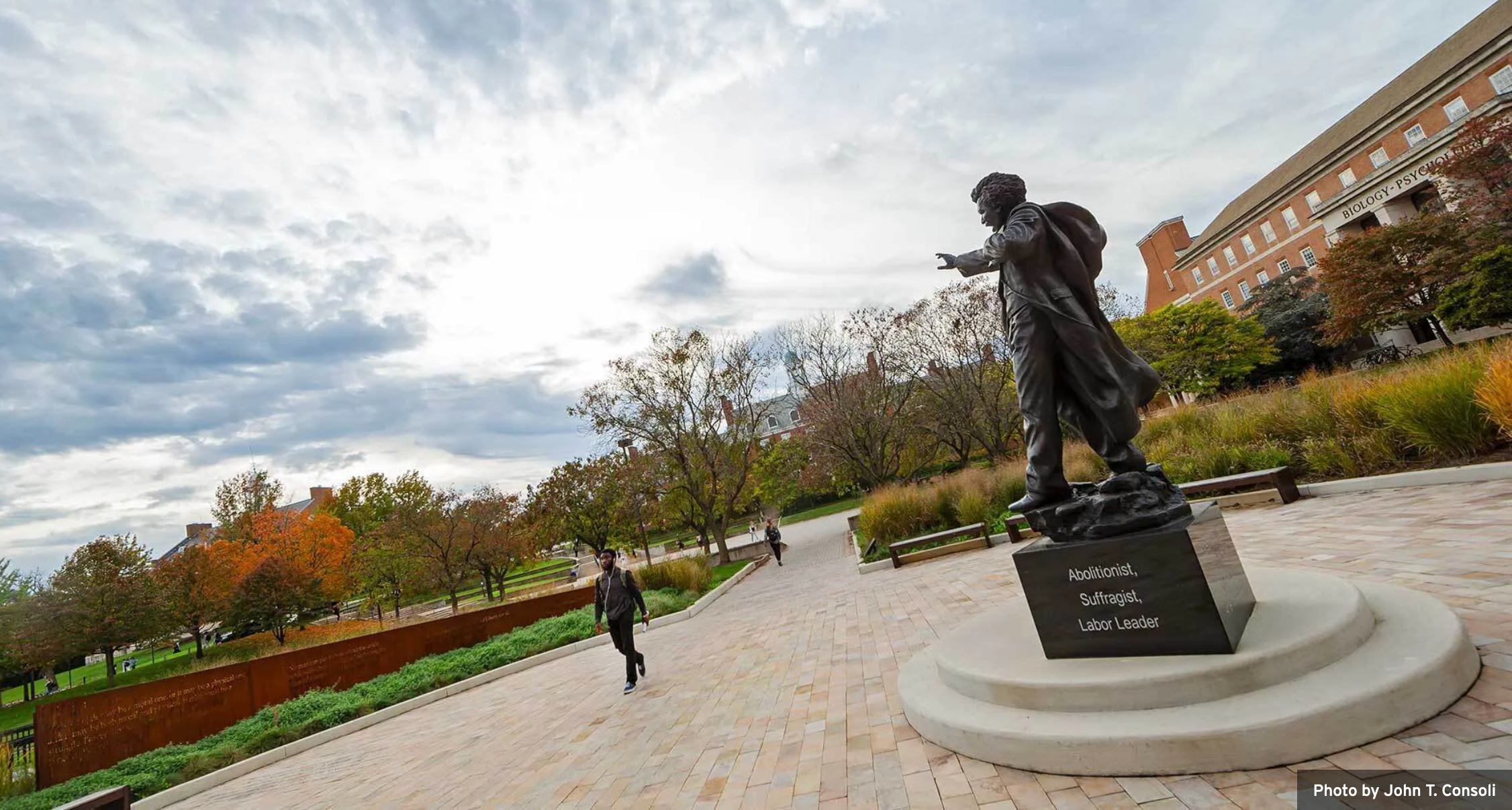
Claiming Their Space: Black Student Activism at the University of Maryland
Claiming Their Space: Black Student Activism at the University of Maryland
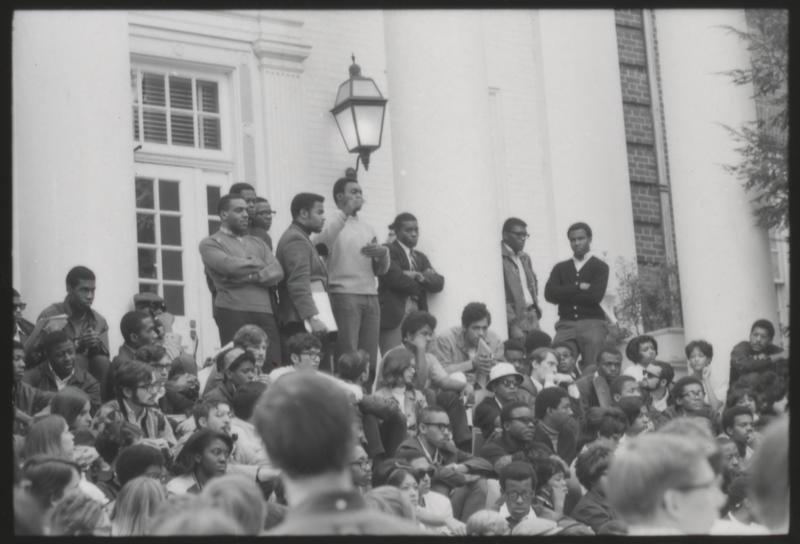
This exhibit explores Black student activism at the University of Maryland, College Park (UMD) in the late 1960s, with a focus on the fall of 1968. October was a seminal month in the history of Black student activism at UMD. The Black Student Union (BSU) formed out of a two-year-old student organization called Congress of Racial Equality (CORE), unaffiliated with the national organization of the same name. The BSU realigned their goals from mere integration to equality and Black student solidarity, reflecting national trends in the Black Power movement. This exhibit centers on several incidents in October 1968: the rejection of appointments of radical Black students to the Committee of Meaningful Integration, the October 12 ice pelting incident at a home football game against the University of North Carolina, and the rejection of four unnamed Black women students from a home economics nutrition study. Collectively, these incidents culminated in a rally on October 22 at the Home Economics building. Mixed responses by students and administrators to Black student-centered controversies demonstrated persistent discrimination on the UMD campus and lack of administrative advocacy for Black students.
This exhibit predominantly uses clippings from issues of the UMD student newspaper, Diamondback, found in the University of Maryland’s Student Newspapers database. The Student Newspapers database is a collaboration between the University Archives and the UMD Libraries’ Digital Systems and Stewardship division to digitize and make accessible student newspapers produced on the College Park campus. The database is available for research and educational purposes. For permission to reprint, reproduce, or make other uses of this material, contact askhornbake@umd.edu. Currently, the Student Newspapers database contains issues of:
- The Diamondback and its preceding papers between January 1, 1910 - August 21, 2008
- Black Explosion between May 1970 - January 2016
- The Eclipse between September 16, 1985 - May 2013
- Mitzpeh between September 14, 1983 - November 5, 2015
COVID-19
The student curators originally intended to incorporate primary source materials from the University Archives and interviews. Without the ability to access archival collections due to pandemic-related closures, the exhibit mostly features digitized content. The digitized content, mostly Diamondback clippings written from a white student perspective, is located on a timeline. The curators intend to contextualize local events in Civil Rights and Black Power movements and illuminate the curatorial process amidst a world health crisis.
DIGITAL EXHIBIT
- Timelines: The historical content of this site is concentrated on two timeline pages. The 1968 Timeline focuses on the BSU protests at UMD in October of that year, as well as connected regional, national and international events. The Pre-1968 Timeline gives context for key events that led up to the protests.
- Research Process Notes: Our reflections on the actual process of building an exhibit of this kind, including the limits and opportunities we thought through. We also include a resource guide for future researchers- a selected list of materials we wish we could have explored
- COVID-19: Read about how the Coronavirus intersected with our project which began in March 2020.
- Contributions: A chance to add stories, photos, links or commentary around the BSU Protests of 1968. Dr. Gregory will act as custodian of the site, and the current BSU has been invited to use or steward these materials if /as it may serve their work at any point in time.
ABOUT US
This exhibition was curated for a graduate-level museum research seminar by Mateo Arango, Lauren Cain, Wanda Hernández, Kristy Li Puma, Benjamin Shaw, Sarah Wampler, and Alan Wierdak. As a group, they developed a theme, an object list, captions, and from there, designed and installed the digital show. Special thanks to Dr. Quint Gregory for his constant support throughout the course.
Process and Reflection
This project's contours were shaped by absence and uncertainty. Because we began this class project in the midst of a brutal health crisis, much of our work time ended up focusing on our process, and on what would necessarily be missing from ours. As we pivoted from aspirational to realistic, we had the opportunity to look at the important gaps in our research and exhibition design, particularly around race and archival power.
Our reflections and suggestions for future research follow.
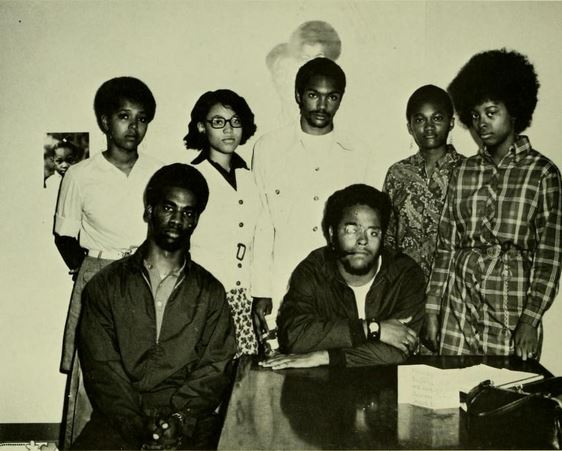
Co-Creation as a Starting Point
One of the most important limits in how this project unfolded is that it has not yet been informed by consultation or collaboration with Black Student Union alumni and current members. Under better conditions, these perspectives and potential work together would have been a natural and necessary starting point for a project about the activism and legacy of previous BSU members at UMD. The process of building the exhibit could also benefit from an understanding of current BSU priorities and recent work, and could ideally complement or support BSU work already underway or completed.
Co-creation involves relationship-building, time, energy, significant communication, and additional labor, even under the "best" conditions. With so many students, including ourselves, experiencing relocation, fear, and loss due to COVID-19 in the first two months of the project, we did not see it as a respectful or possible time to initiate any consultation or co-creation processes. In lieu of that, we have left an open invitation for the current BSU to use any resources we gathered or built during this process if it would be useful to their work down the line.
As you view the exhibit timeline... What do you imagine as the challenges and potential benefits of co-creation? Why is it important to start research and exhibit development with communities most connected to, or impacted by, the issues at hand?
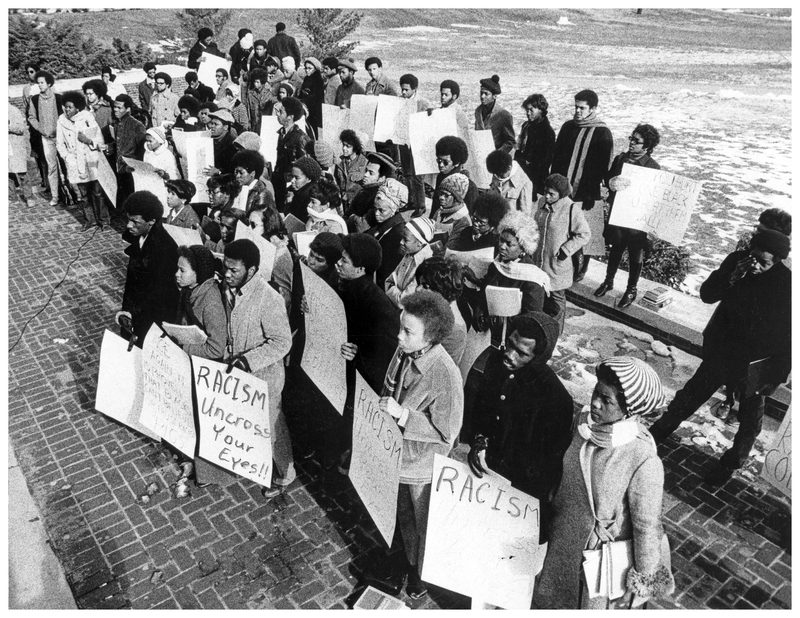
Reliance on Incomplete Sources
Working within the COVID-19 pandemic, our inability to conduct original interviews (with BSU members and alumni) and a lack of full archival access meant that we relied heavily on the online archive of the Diamondback, UMD's student-run newspaper. On one hand, this digital archive provided a wealth of details about the BSU protests in 1968, but on the other hand, it was almost always written by white writers, and the publication itself has made numerous racist decisions during its 110-year history. As we began our exhibition process, the Diamondback retrospectively acknowledged and documented these problems.
As you read through the articles on our timeline... Where do you see the presence and absence of various Black student voices? Why is it important to hear directly from people involved or present in a historical event? What perspective do you think those could have added to this exhibit?
Does it matter who writes articles about racial injustice and racism? Why or why not? How can the culture of a newsroom influence what is or is not remembered and acknowledged historically? Why does it specifically matter for Black voices to exist /narrate/create archives?
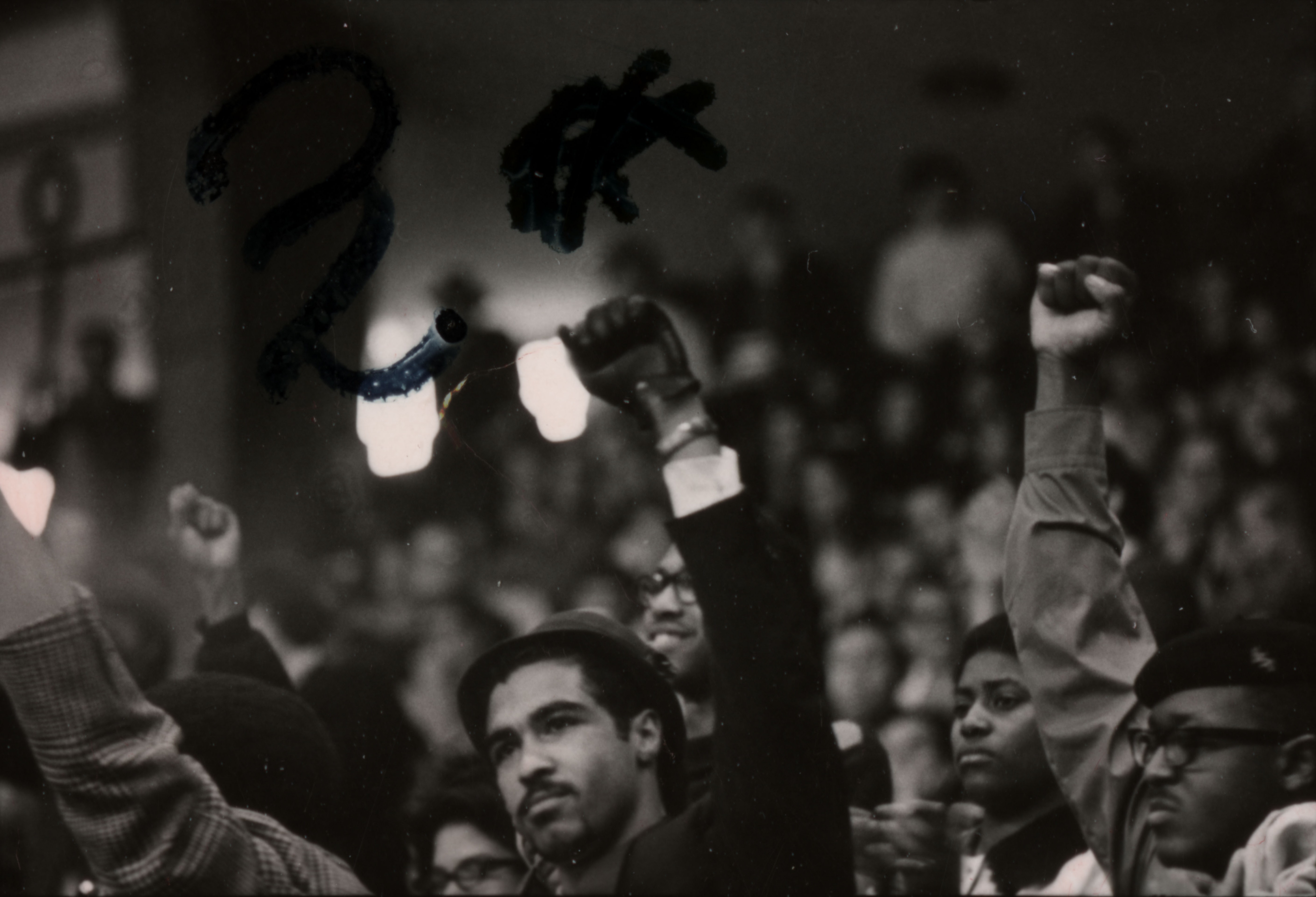
Racial and political contexts matter
Language and racial political contexts change over time, and we need to pay attention to that as researchers and as the audience.
The BSU protests arose from assertions about racial genetic differences between Black women and white women, with the BSU challenging the university to prove that difference. In building this exhibit, we understand race in this context as a social category that creates specific and inequitable experiences for Black people and people of color in a system of white supremacy.
Political contexts matter as well. For example, it can be helpful to remember that in 1968, Black and Brown armed resistance was part of the larger national context in the U.S.
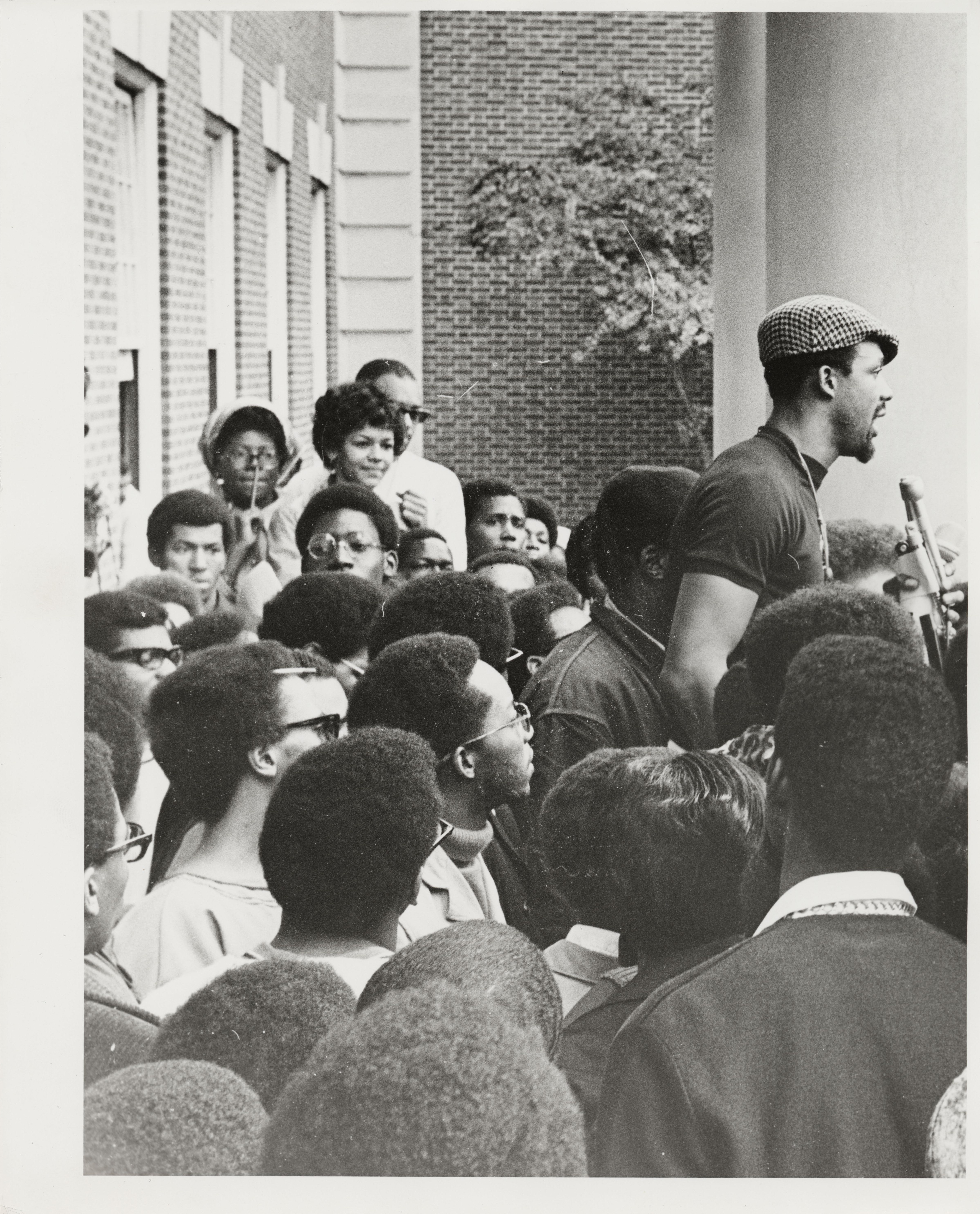
Language & Capitalization
Language is political and has specific meanings. For this exhibit, we intentionally choose to capitalize “Black” as an identity and racial category, following the BSU’s current usage in 2020. While our usage does not always adhere to official recommendations (such as the AP style guide), for us community use must be centered. We also recognize that individual capitalization of the word Black, as well as the use of other terms such as “African-American”, varies widely, and reflects cultural values, geographical experiences and generational differences.
Local UMD Campus Focus
Our choice to focus at a hyperlocal scope stems from a desire to surface nuanced details about the BSU protests at UMD, while also connecting to parallels in the national narrative and context.
Archival Gaps, Always
While noting the impacts of COVID-19 closures on our research process, we also find it important to note that an archive is always incomplete, and will often support what those in power have deemed valuable to preserve at any given time.
Part of our motivation to begin a project like this was to gather what archival materials we could, to uplift a significant student activism event on campus that challenged this very type of power.
The Black experience at UMD pre-1968
Barred from the University
Before 1950, the University of Maryland was an all-white institution. University President Harry Byrd (tenure 1936-1953) and his successor, Wilson Elkins (tenure 1954-1970) pushed back against integration, arguing that Black students would be "happier" attending "their own" institutions, meaning Morgan State and Coppin State in Baltimore.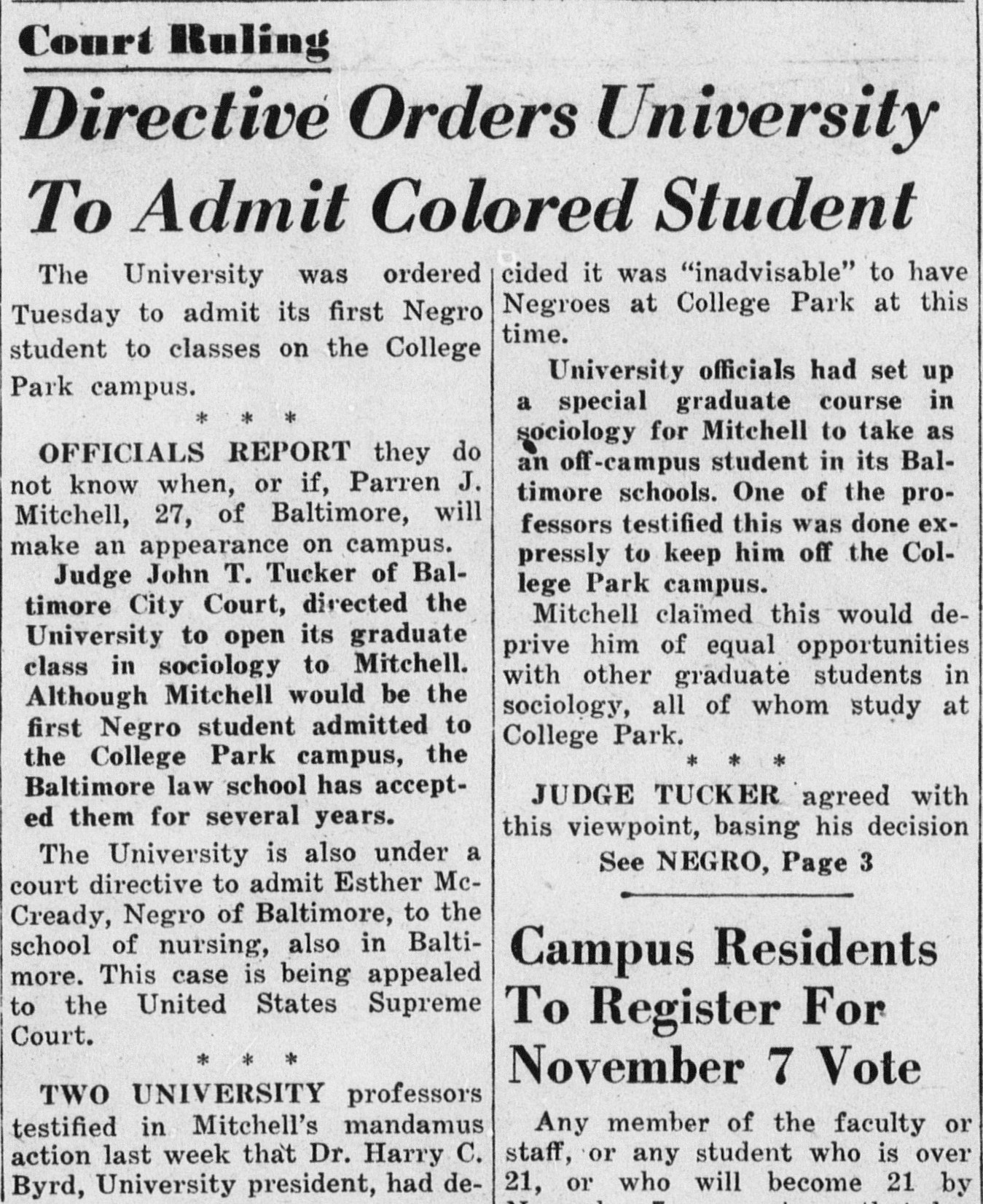
In 1950, Parren J. Mitchell applied to UMD, hoping to obtain his Master's in Sociology. However, he was turned down due to his race. Represented by Thurgood Marshall and the NAACP, Mitchell successfully sued the University, forcing them to admit him to the graduate program, along with Esther McCready, who was admitted into the Nursing program in Baltimore. University administration attempted to offer Mitchell enrollment but not allow him to attend the main campus; however, Mitchell stood firm, attaining full student status. 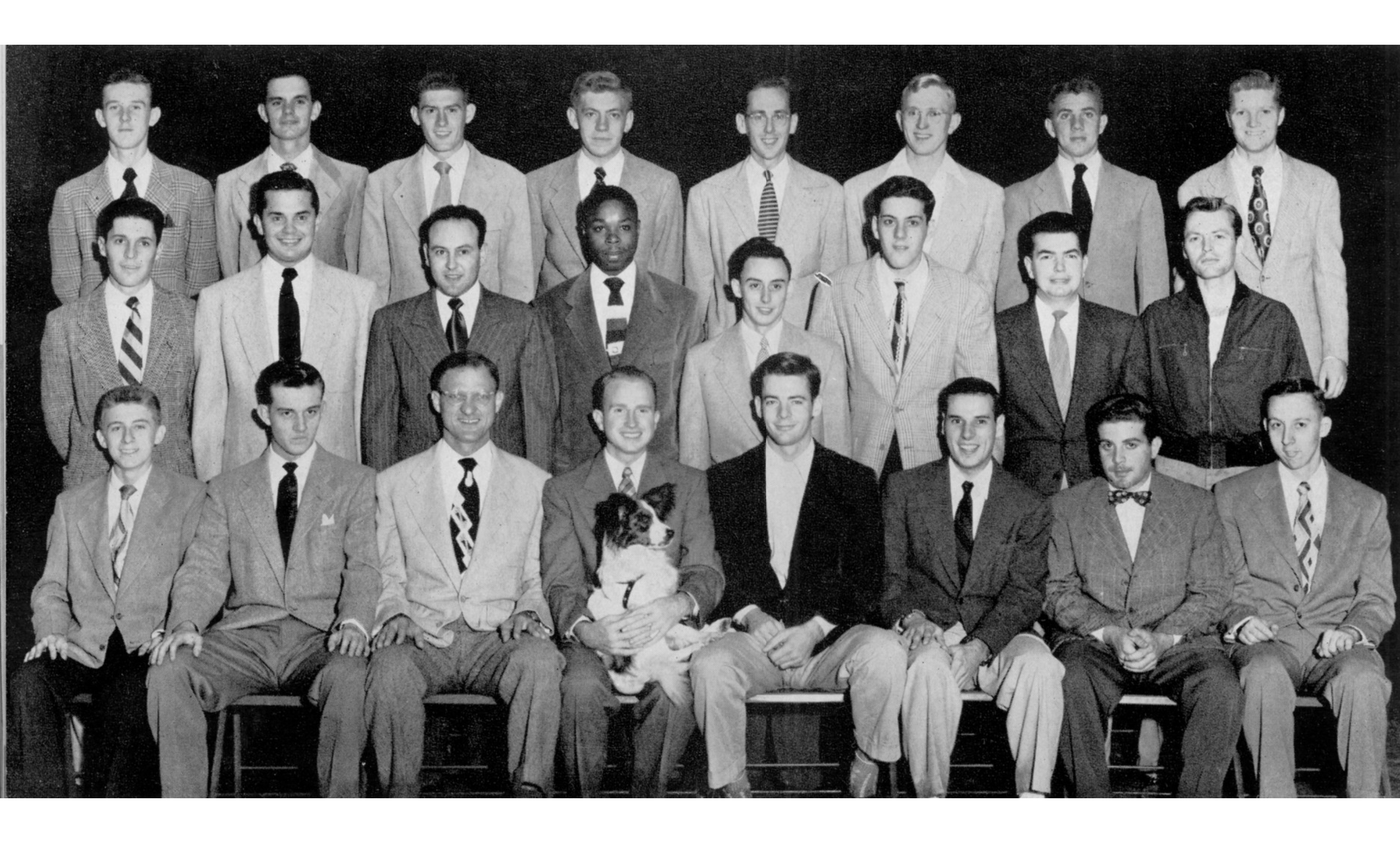
Mitchell became the first Black person to graduate from the University of Maryland.The next year, in 1951, Hiram Whittle was admitted to UMD, enrolling in the College of Engineering. Whittle (pictured at right with his dorm-mates) became the first Black undergraduate to receive his degree at Maryland.
After Brown v. Board of Education, the number of Black students enrolling grew to a steady trickle. Seven Black students enrolled at UMD in the fall of 1955, one year after Brown v. Board. Only one, Elaine Johnson Coates (left), graduated in 1959, becoming the first Black woman to graduate from UMD. The other six, including Coates' roommate, dropped out before the end of their first semester due to the unrelentingly hostile environment.
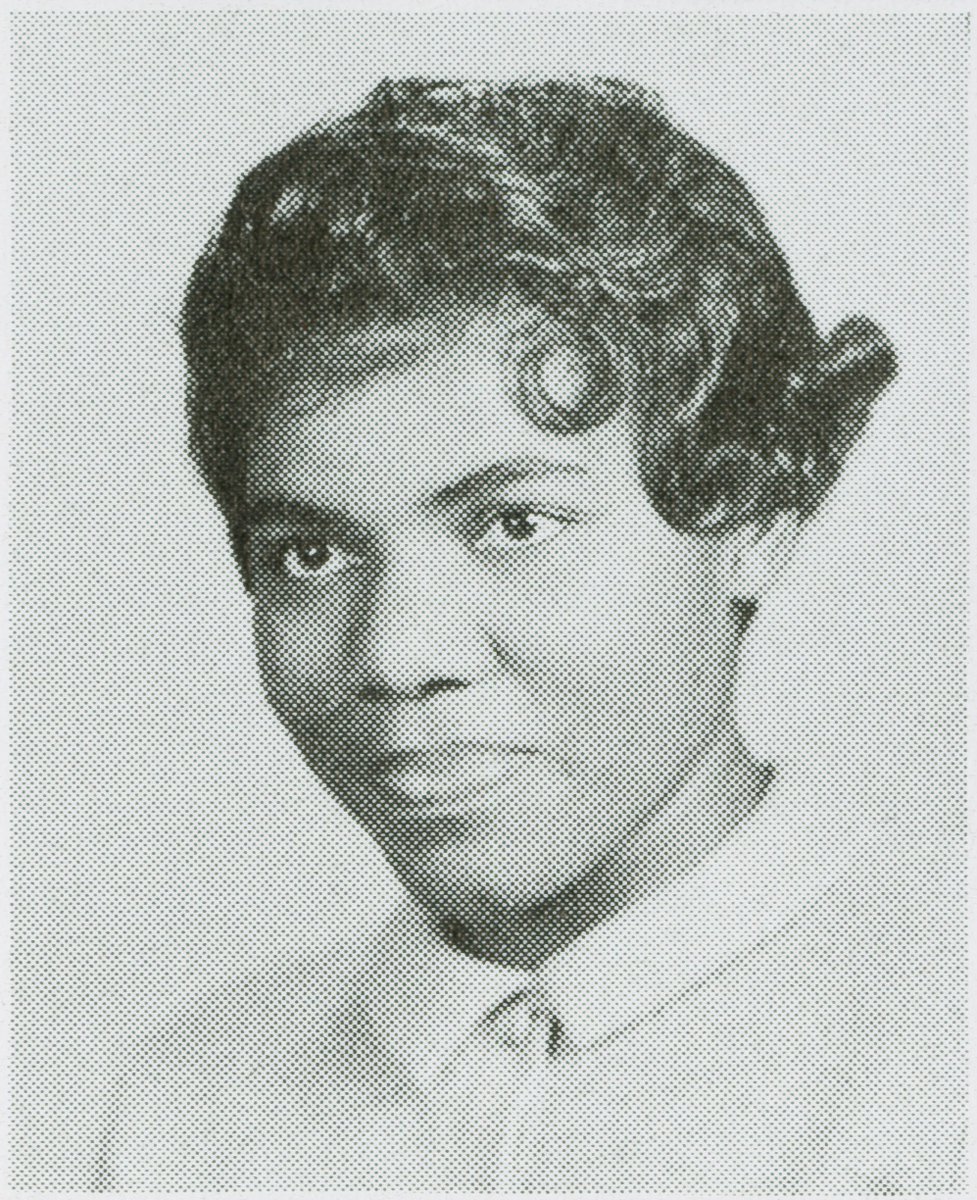
In a 2019 interview, Coates described her time at UMD as an incredibly lonely experience. She had no car, so she could not leave campus. For four years, no one would sit with her or talk to her. Practically the only time anyone talked to Coates was to shout racial slurs at her. She faced discrimination from professors, and white students would call her on her dorm phone to call her racial slurs. Coates persevered through four years of near-total isolation and hatred to become the first Black woman to graduate from the University of Maryland. A full oral history interview with Elaine J. Coates can be found here.
This was the environment for Black students at the University less than a decade before the BSU protest.
The Congress for Racial Equality and early activism
But this hostile environment does not mean that Black students and community members were not active in protesting racism. A delegation from the Congress for Racial Equality (CORE) picketed the Maryland booth at the 1964 World's Fair, which took place in New York. This delegation included several UMD students. At the time, Maryland had no legal protections ensuring that Black citizens could not be barred from businesses in the state.
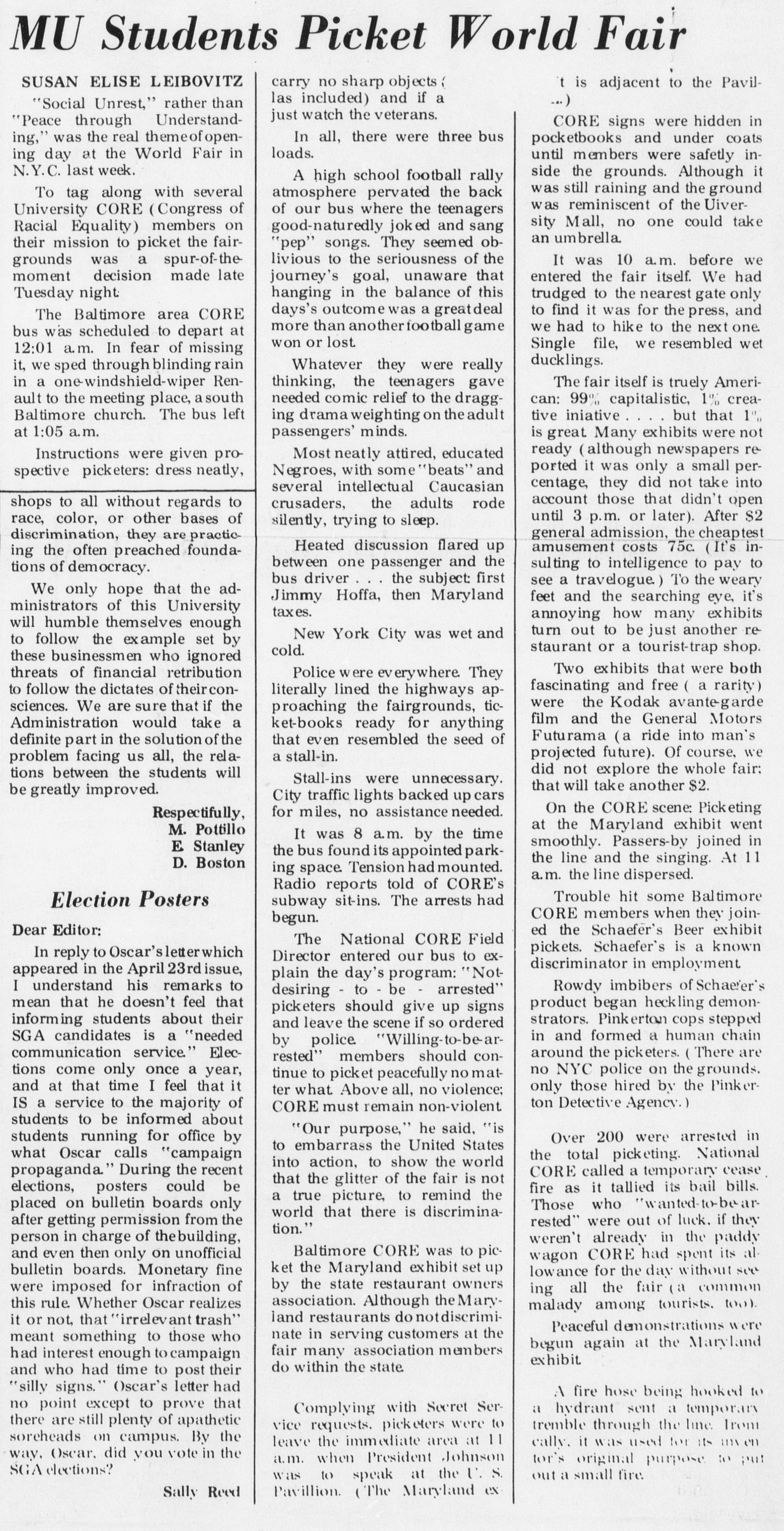
In June 1965, the Washington Suburban chapter of the Congress for Racial Equality (CORE) picketed UMD in protest of Maryland's de facto segregation in higher education. Chapter president Michael Tabor sent a letter (visible at right – click to zoom) to then-President Wilson Elkins condemning the University's lack of any Black professors, administrators, or even professional staff, and the utter lack of housing for Black students in College Park.
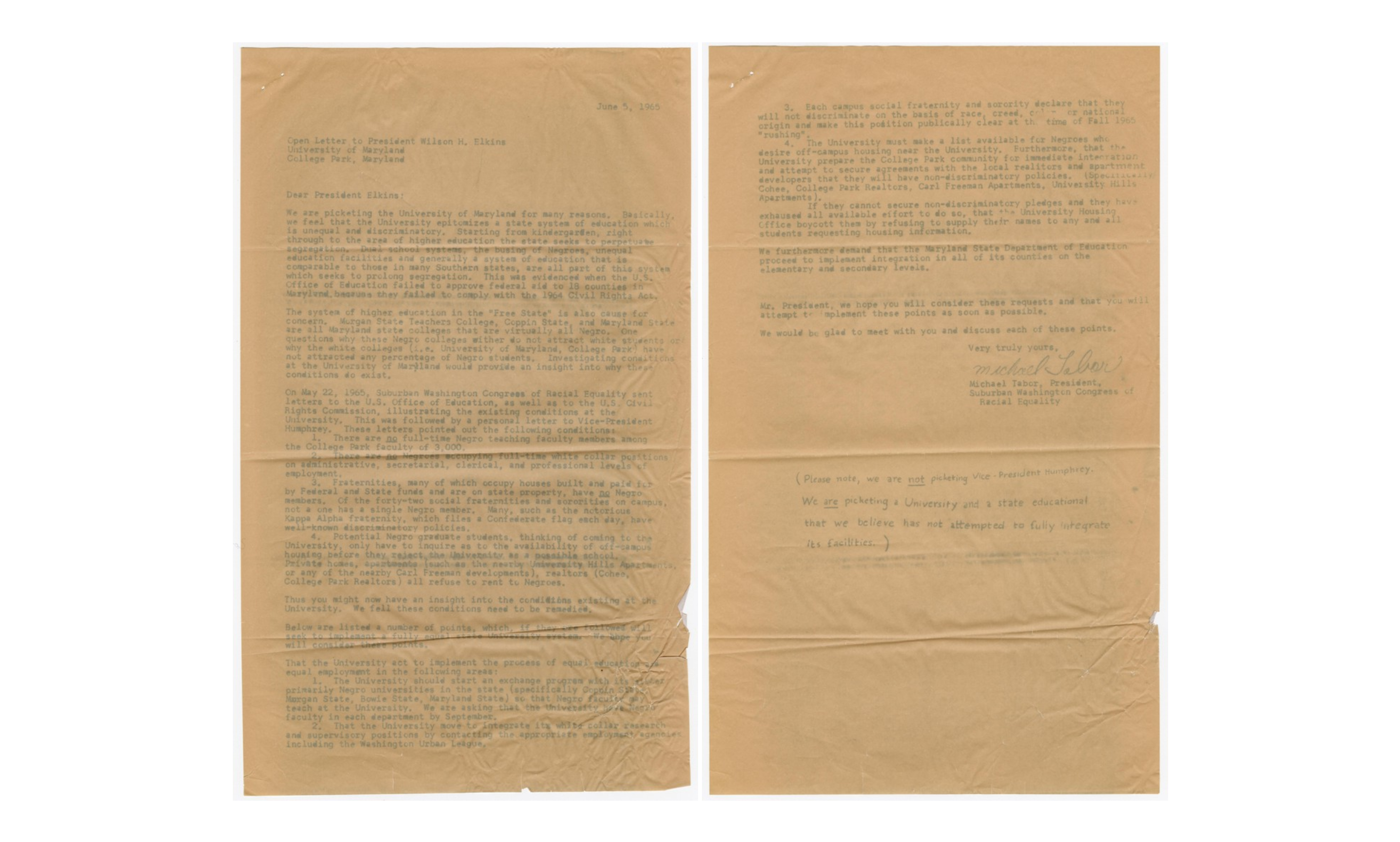
These were pervasive problems in College Park and the University community. Landlords in the city would refuse to take on Black tenants, and the University was extremely reluctant to hire Black employees of any kind. It wouldn't be until 1969, when the Black Student Union partnered with NAACP in an audit of College Park's discriminatory policies, that real change came to pass.
National Programs and increased Black presence
On November 8, 1965, Lyndon B. Johnson signed the Higher Education Act. Among other things, the Act established Upward Bound, a program designed for underprivileged high school students to get a jump on college. Students deemed to have "potential," but who had low grades, were invited to live on campus for two weeks, attending classes and social events. At UMD, this ultimately increased the number of Black students enrolled at the University.
Students from two Black high schools were the first beneficiaries of the Upward Bound program at UMD. In July 1966, nearly one hundred students from Baltimore and DC came to experience what UMD had to offer. During their two-week visit, they attended lectures and visited fraternity and sorority houses (which were under fire at the time for their de facto segregation). These students also joined a picket, demonstrating with others who were protesting the University's inaction on housing discrimination in College Park. Even before they were officially enrolled at the University, these high schoolers acted in solidarity with UMD students, recognizing that their agency and activism could make a difference for their futures at the institution.
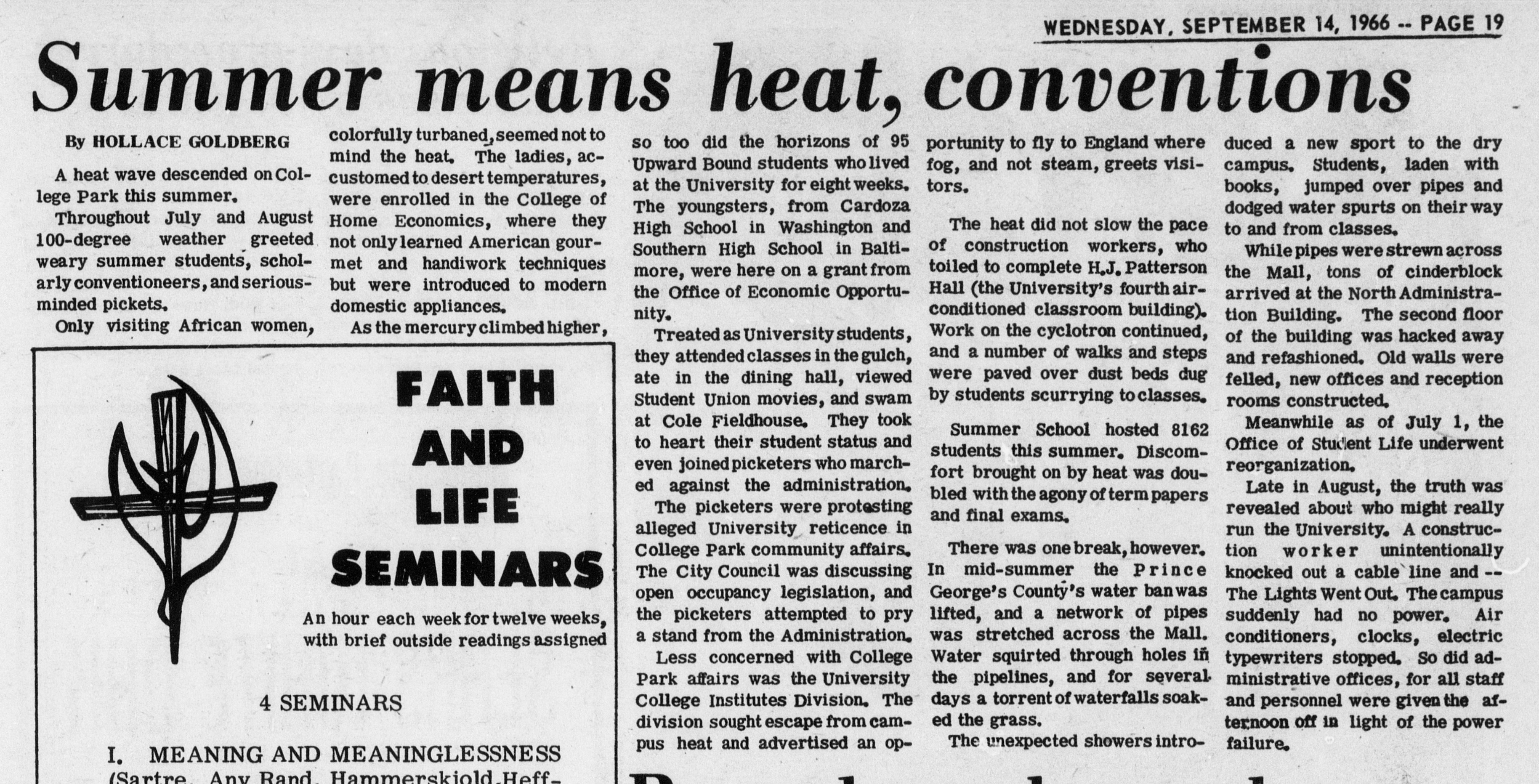
Upward Bound greatly increased the presence of Black students on campus in the late 1960s. Students created a campus chapter of the Congress of Racial Equality in 1966. This chapter was closely aligned with Upward Bound during this time, turning some of their social events into fundraisers for students in the program.
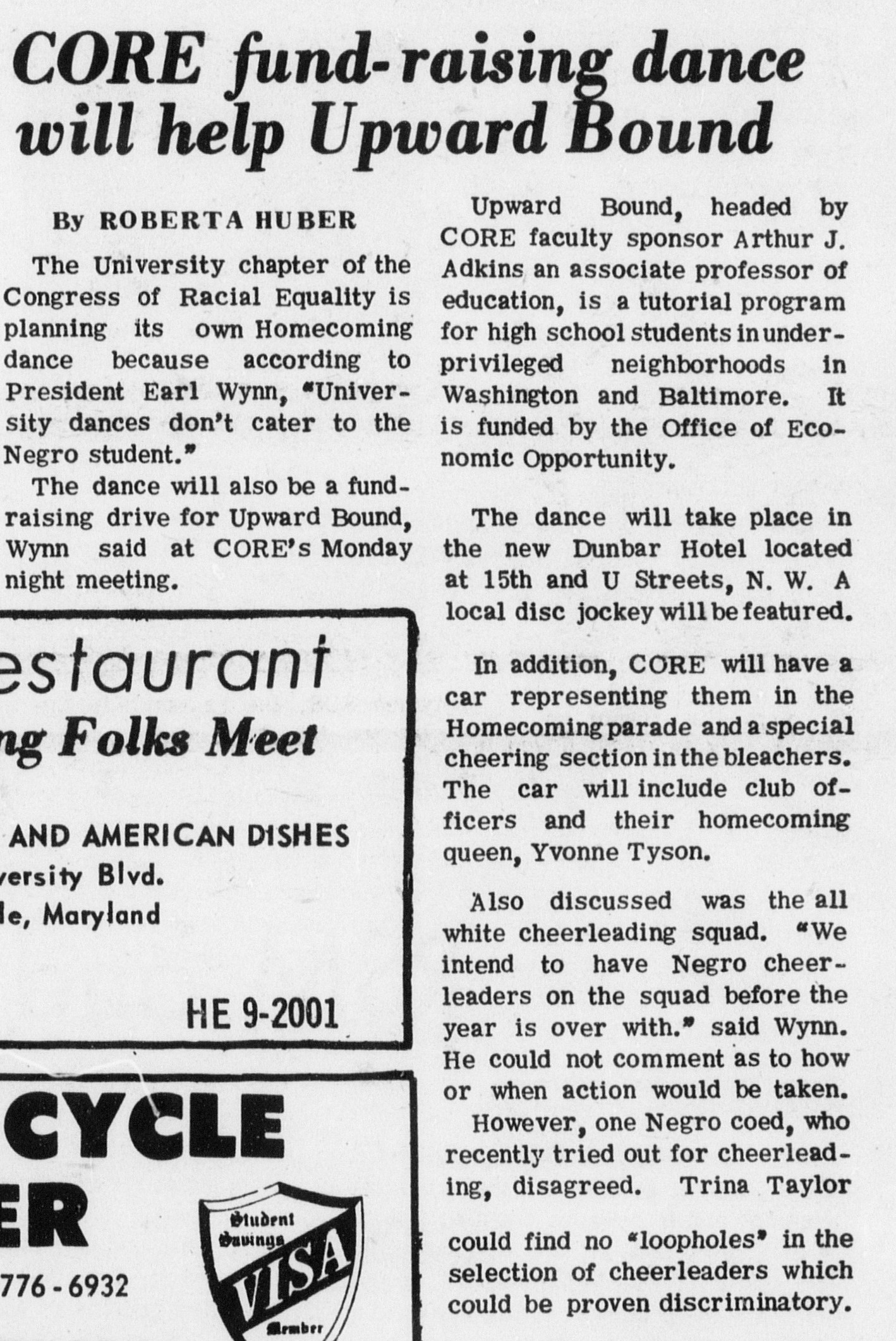
CORE recognized the importance of Upward Bound for the University's Black population, and so invested in support and mentorship for these high school students. The students of CORE recognized that for UMD's Black population to thrive, not only would programs like Upward Bound would have to continue to give Black students a chance, but Black students would have to support one another through the hostile environment that was the University of Maryland in the 1960s.
By the time of the protest, Black students and community members had been fighting racism from the University for nearly twenty years. This protest was part of a long legacy of Black students having the courage to challenge racist policies head-on, and to demand change from those who told them they didn't matter.
For Future Researchers
Due to the pandemic, Special Collections and University Archives in Hornbake Library closed during the discovery stage of this exhibit as we began compiling archival material. Considering this, we have included links and descriptions of the various collections within University Archives that we intended to explore for this exhibit. We implore those drawn to this exhibit to continue exploring these issues using the following archival collections.
The Board of Regents records contains correspondence; statements; proposals; reports; and files from specific committees, boards, and commissions. The University also holds a significant unprocessed addition to the records which includes correspondence, publications, audiotapes, minutes of meetings, budgets, and reports. Specifically, we would have examined the minutes of meetings between December 15, 1967, and June 20, 1969, available to be requested here.
Office of the Chancellor records
The Office of the Chancellor was created in 1970 in the course of the reorganization of the University of Maryland system. The Chancellor was the highest-ranking administrator for the College Park campus until the expansion of the University of Maryland in 1988, at which time the office was renamed Office of the President. The records consist of the administrative files of the Chancellor and include reports, financial and budget records, committee and task force files, publications, and working papers. These records likely contain correspondence surrounding many of the incidents highlighted in this exhibit.
History of the University of Maryland - Campus Unrest records
These records include photographs and documents from the Vietnam War protests at the University of Maryland between 1970 and 1972. Photographs capture demonstrations, police activity, arrests, and destruction, both on- and off-campus, caused by the protestors. Documents include posters, news clippings, and recollections of the protests by students. While the majority of the material in this collection is from 1970-1972, the collection provides context into the tension and turbulence on campus at the time.
Office of the President, University of Maryland records
These records include correspondence, publications, reports, minutes, invitations, legislation, legal and financial records, photographs, newspaper clippings, conference materials, class schedules, and committee files. University Archives also holds a large unprocessed addendum, consisting of one series documenting the administration of Wilson H. Elkins. These files primarily include correspondence, reports, budgetary materials, minutes, committee files, photographs, maps, and blueprints. The unprocessed papers contain a wealth of material relating to campus unrest, including official statements by Elkins and then-Governor Marvin Mandel. The unprocessed collection of President Elkin's papers also include extensive correspondence surrounding both the College of Home Economics and the Black Student Union.
Division of Student Affairs records
These records consist of administrative materials, committee and commission files, and budgetary records as well as files related to student organizations, housing, the Counseling Center, health services, and the dining hall. In 1970, the department was changed to the "Office of the Vice Chancellor for Student Affairs." The records also include a number of files related to the activities and publications of Students for a Democratic Society (SDS), a national organization largely focused on opposition to the Vietnam War. Also included are more general files dealing with on-campus demonstrations and protests. Specifically, series five likely contain material directly related to issues explored in this exhibit.
University Senate (1920-1970) records
These records consist of the minutes of the Senate as well as materials relating to its various committees and task forces. In series four, there are nine folders on disciplinary matters, containing such documentation as the university's policy towards demonstrations; minutes of the Committee on Student Discipline; a proposal to strengthen disciplinary procedures and
regulations and written comments about the proposal. It also includes newspaper clippings about the proposal and students in court because of protest activity.
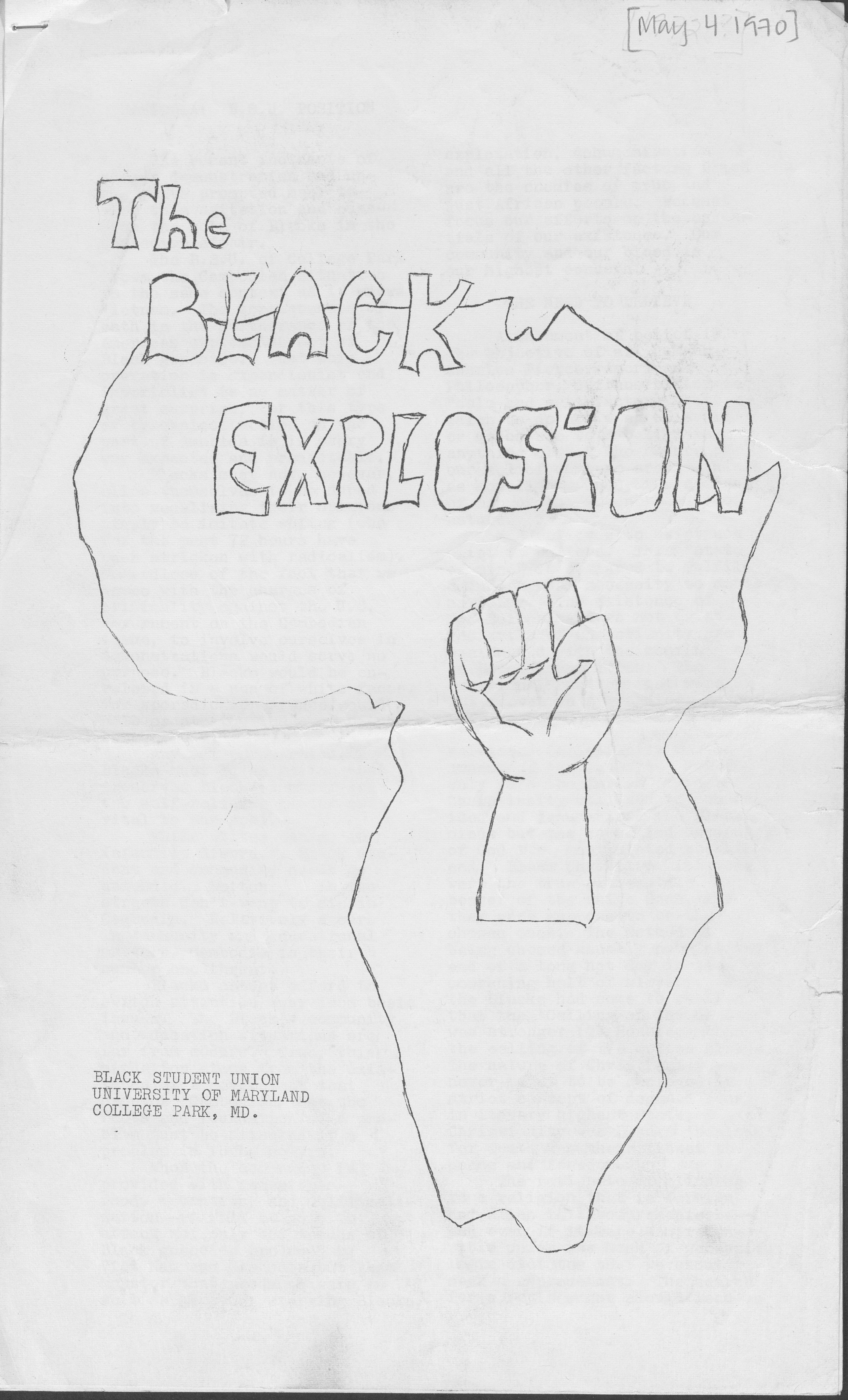
University Publications (UPUBs)
The collection of University Publications contains a wide variety of student publications, spanning much of the history of the university. Several publications contain extensive coverage of Campus Unrest and protests at the time, as well as the Black Student Union:
Increasingly radicalized student magazine published from 1966 to the early 1970s. Argus published a number of stories and photographs relating to student protests on campus, and the general campus climate.
Since 1968, the Black Explosion has offered information and updates about campus affairs and student life, especially pertaining to the Black community. Black Explosion began as the student publication of the Black Student Union, a central focus of this exhibit. Archival issues of Black Explosion are available online, beginning in May 1970. Current issues of Black Explosion can be found here.
The student newspaper of the University of Maryland, found online in the UMD student newspaper database, was the main resource for this exhibit. The Diamondback includes extensive coverage of events covered in this exhibit.
Radical Guide to the University of Maryland
This one-time publication was issued by the Democratic Radical Union of Maryland (D.R.U.M.)
in the fall of 1970 to provide guidance to the radical student and replace the M Book that had been censored by the administration. The graphic, relatively subversive guide provides context into the campus climate and tensions around campus unrest at the time.
University of Maryland Vertical File Collection
The University of Maryland Vertical File collection contains newspaper clippings (text and photographs) from the Washington Post, Baltimore Sun, Diamondback, and other papers grouped under subject headings. Specifically related to this exhibit, there are folders for the Black Student Union, and several folders on campus unrest. There is also a folder for the College of Home Economics, which could contain information about the Black Student Union protest, or the nutrition study students protested against.
Photo Credits
Photo 1: UMD Black Student Union, 1970. Courtesy UMD University Archives
Photo 2: 1971 Rally for a Black Studies Program at UMD. Source: Washington Spark
Photo 3: Raised fists at UMD 1969 convocation, directly referencing the 1968 Olympics Black power salute. Courtesy UMD University Archives
Photo 4: 1968 Black Student Union protest at UMD. Courtesy UMD University Archives
Photo 5: UMD Campus sits empty due to COVID-19. Source: Maryland Today
Photo 6: Black Explosion Now Available! 1970. Source: Terrapin Tales
Grand Challenges: Anti-Black Racism Initiative
The Anti-Black Racism Initiative seeks to build upon the state of Maryland’s legacy of racial equity and social justice and will position the University of Maryland as a leading institution standing in opposition to anti-Black racism through three strategic and institutional initiatives:
- Develop faculty-student cross departmental anti-Black racism focused research projects;
- Develop and execute anti-Black racism teach-in workshops for faculty, staff, students, and community members, and
- Present research findings to the wider campus and local community through an annual symposia and networking event.
These three interconnected and innovative projects will amplify the new anti-Black racism (ABR) minor (beginning Fall 2023) hosted by five colleges (College of Behavioral and Social Sciences, College of Arts and Humanities, College of Education, School of Public Health, and School of Public Policy).
We will produce multi-disciplinary and transformative scholarship that advances conversations on anti-Black racism, equip faculty to teach with an anti-Black racism lens to further diversify the academic curriculum at the University, and create a larger anti-racist ecosystem to ensure the University of Maryland is at the forefront of moving us towards an anti-Black racist future. Learn more about the team leading this initiative.
Anti-Black Racism Initiative
The College of Behavioral and Social Sciences (BSOS) at the University of Maryland announces an initiative to further coordinate, publicize and enhance our efforts to identify, disrupt and prevent anti-Black racism.
One primary goal of the Anti-Black Racism Initiative is to address racism on our campus and in our local community, produce scholarship that advances a national conversation and policy agenda on social justice, and empower students to envision and create a racially equitable future.
The Anti-Black Racism Initiative builds upon centers and programs including:
- The Critical Race Initiative in Sociology;
- The Baha’i Chair for World Peace in the college;
- The Department of African American Studies;
- The new Graduate Program in Public Safety Leadership Administration in the Departments of Sociology and Criminology and Criminal Justice in conjunction with the law school in Baltimore;
- The BSOS Summer Research Initiative, as well ass the Psychology Research Empowerment Program, which both to diversify the PhD pipeline.
The Baha’i Chair for World Peace has a speaking series on Systemic Racism and the Root Causes of Prejudice. Drs. Hoda Mahmoudi and Ray have a forthcoming book featuring articles from series speakers who are some of the most renown race scholars in the country.
The Department of African American Studies in collaboration with CRI, Baha’i, and the Judge Williams Center has a speaking series on reparations. It has featured Congresswoman Barbara Lee who has a Truth and Reconciliation Bill in Congress.
The Departments of Psychology and Economics have impactful programs for students that aim to help students matriculate and view research as a desirable career path.
Dean Kim Nickerson not only runs the BSOS Summer Research Initiative, but he started the Black History Tour on campus to tell the story of the role of African Americans in the founding of the university.
The Critical Race Initiative, currently led by Dawn Dow in sociology and students across campus, hold a symposium every year in honor of Congressman Parren Mitchell. Mitchell was the first Black student to obtain a graduate degree while taking courses on campus.
Minor in Anti-Black Racism Launched 2023
The Department of African American Studies collaborated with the College of Arts and Humanities, the College of Behavioral and Social Sciences, the College of Education, The School of Public Policy, and the School of Public Health are excited to introduce a Minor in Anti-Black Racism effective Fall 2023.
Anti-Black racism is conceptualized as policies and practices rooted in social institutions (i.e. education, health care, criminal justice system, housing) that reinforce prejudice and discrimination towards people of African descent. This minor will give students a deeper understanding of these policies, practices, beliefs, and behaviors as well as ways to work to ensure they can be inclusive leaders in line with what it means to be Terrapin Strong.
Students in the minor will choose one of five tracks by their 2nd semester in the minor. This will allow students to customize their experience in the minor based on their academic and professional interests. The key components are one common introductory course (ABRM330), three disciplinary courses, and a capstone course (ABRM450) that will feature an opportunity to participate in experiential learning that is mentored by a faculty member from one of the participating colleges/schools.
UMD to Debut Minor in Anti-Black Racism
 Photo by John T. Consoli
Frederick Douglass Square on Hornbake Plaza features inspirational quotes by the native Marylander and famed abolitionist on freedom, justice and equality, themes that will resonate in a new anti-Black racism minor.
April 28, 2023
Program to Prepare Students to Identify and Disrupt Individual, Structural and Cultural Racism
The University of Maryland this fall will launch one of the first academic minors in the country focused on identifying the causes and effects of anti-Black racism to create lasting societal change.
The new minor will expose students to scholarly research from different disciplines, help them develop new ways of processing and interpreting information, and set them apart in the job market with a credential that Rashawn Ray, a professor of sociology and co-creator of the minor, said employers should value in a diversifying nation increasingly attuned to value of a variety of perspectives.
It will be supported by the Anti-Black Racism Initiative, which received one of the university’s new Grand Challenges Grants and strengthens UMD commitment’s to stand against anti-Black racism. The initiative will also include workshops for faculty, staff, students and community members and research that will be presented through an annual symposia and networking event.
"The creation of an anti-Black racism minor is in response to our students who have advocated for ways to educate our community to foster a more inclusive environment,” said university President Darryll J. Pines.
The five-course anti-Black racism minor, housed in the College of Behavioral and Social Sciences’ Department of African American Studies, will be taught with faculty from the College of Arts and Humanities, College of Education, School of Public Health and School of Public Policy.
The new program debuts amid a renewed scrutiny of the role of race in the deep inequities that plague American life—from discriminatory policing that has resulted in high-profile killings of unarmed Black Americans to environmental injustices that put disadvantaged communities of color in harm’s way from industrial and agricultural pollution.
This fall, undergraduates can enroll in “Introduction to Anti-Black Racism,” which will define anti-Black racism, describe different ways in which it may manifest, and examine how it specifically appears in different facets of American life by having faculty from each collaborating college lead the class for approximately two weeks. Undergraduates pursuing the minor must take one disciplinary course of their choosing, plus two three-credit elective courses in alignment with their career pursuits. They must also complete a capstone course and research project, directed by Department of African American Studies Lecturer and Director of Undergraduate Studies Ashley Newby.
“We want to help folks gain an awareness of anti-Black racism and be able to enter into their respective fields and recognize when concerning things are being said, when concerning actions are being done, and when concerning policies and practices are put into place,” said Jeanette Snider, an assistant research professor of social justice and anti-Black racism. “We want to help them not just to accept these things as they are but be able to have an orientation to disrupt anti-Black racism and, of course, eradicate it at some point in our lives.”
Rhiley Jones, a sophomore government and politics major, is considering enrolling in the minor, which she called “progressive and really cool.”
“I think increasingly all across the world, people of all races are starting to fully understand the extent of racism and prejudice and discrimination that African American people are facing,” she said. “Students are realizing that conducting research on racism and using data to implement techniques to help African Americans and other minorities achieve their fullest potential, are useful skills for all majors, as there's a lot of intersectionality to it.”
African American History at the University of Maryland
A new online campus tour explores their role—including their struggles and achievements—and celebrates trailblazing African-Americans in the state and nation. The African-American History Tour, sponsored by the Office of Diversity and Inclusion, tells this story through 17 campus landmarks.
The full self-guided walking tour is available at umd.edu/blackhistorytour.
1. The Rossborough Inn: Memorial Bench

Charles Benedict Calvert, a slaveholding planter and politician, sold a portion of his 428-acre Rossburg Farm property, including the inn, to found the Maryland Agricultural College in 1856. The Greater College Park initiative brings together the university, the city, and state and federal partners to re-imagine the Baltimore Avenue corridor, along the tracks of the D.C. Metro system’s coming Purple light-rail line, and around the College Park Metro Station.
2. Thurgood Marshall Room, Shoemaker Hall


U.S. Supreme Court Justice Thurgood Marshall (1908–93) was a native Baltimorean, who as counsel for the NAACP Legal and Education Defense fund, led or participated in several cases that led to the Supreme Court’s landmark ruling in Brown vs. Board of Education of Topeka that racial segregation of public schools was unconstitutional.
3. Parren J. Mitchell Art-Sociology Building

Parren J. Mitchell M.A. ’52 sued UMD to become the first African-American graduate student to take all of his classes on campus and receive a degree. Mitchell went on to become a civil rights leader and Maryland’s first black congressman.
4. Stamp Student Union, Photos of Whittle and Johnson


Future U.S. Supreme Court Justice Thurgood Marshall and the NAACP successfully represented Hiram Whittle, who in 1951 became the first African-American undergraduate admitted to UMD; Whittle left after a year without graduating. Johnson enrolled in 1955 and four years later became the first African-American woman to graduate.
5. David C. Driskell Center


The David C. Driskell Center for the Study of the Visual Arts and Culture of African-Americans and the African Diaspora honors the legacy of an emeritus professor, painter, art collector and curator, and leading authority on African-American art.
6. Maryland Stadium

Maryland Stadium opened in 1950 and for 65 years was named for Harry Clifton “Curley” Byrd, a 1908 graduate who returned four years later as football coach and served as president from 1935–54. He is credited with strengthening the university’s athletic programs and increasing the university’s stature but actively opposed racial integration of the campus. In 2015, his name was removed from the stadium.
7. Frederick Douglass Square, Hornbake Plaza

One of the most important figures in Maryland history, Frederick Douglass (1818–95) is honored with an 8-foot-tall bronze statue unveiled in 2015. Born into slavery in Talbot County, Md., Douglass taught himself to read and write on the streets of Baltimore before escaping at age 20. Douglass went on to become a powerful voice against slavery and post-Civil War oppression against African-Americans.
Honoring Harriet Tubman, Acknowledging Slavery, and Building an Inclusive Community
September 04, 2020
Dear University of Maryland community,
In one of my first official duties as President, I outlined five initiatives and recommendations designed to create a more inclusive environment at the University of Maryland. Those announcements were just the beginning of our commitment to build a multicultural campus of excellence. Today, I am pleased to build further upon that commitment:
Announcing the Harriet Tubman Department of Women, Gender, and Sexuality Studies
It is my honor to announce a major milestone in our university's history: the first honorific naming of an academic department at UMD, the Harriet Tubman Department of Women, Gender, and Sexuality Studies. It is fitting that this heroic Marylander is now honored at the state's flagship university. The department is widely acclaimed for its unique concentration in Black feminist thought and intersectionality, and it is the only department in the nation that offers a Black women's studies minor, jointly with the Department of African American Studies. Historically, Black women have played a brave and critical role in social justice. Harriet Tubman's life and her dedication to freedom and equality speaks directly to the department's mission, now and in the years ahead.
The 1856 Project
The University of Maryland has recently created "The 1856 Project," which joins the Universities Studying Slavery (USS) consortium to facilitate collaborative research and academic scholarship. This initiative will help provide a narrative of the University of Maryland's history that grapples with its past, acknowledges the challenges and achievements of the present, and lays the groundwork for a future rooted in justice and equality. The institutional official of The 1856 Project is Provost Mary Ann Rankin, and the institutional co-leads are Lae'l Hughes-Watkins, University Archivist, and Joni Floyd, Libraries Curator for Maryland and Historical Collections.
New Program Coordinator for Immigrant and Undocumented Student Life
I am pleased to share that the Division of Student Affairs has hired a new Program Coordinator for Immigrant and Undocumented Student Life, who will officially start at the end of this month. The new coordinator has experience working with undocumented students in higher education and has done tremendous work building community among students. This position is integral to the support of our undocumented and immigrant students and will carry on the great work of previous coordinators. Additional details about the new coordinator, including opportunities for virtual meet and greets, will be shared with students in the coming weeks.
TerrapinSTRONG
TerrapinSTRONG is an initiative focused on one of my main priorities as your president: ensuring that students, faculty and staff feel welcome, a sense of community, and that they matter and belong at UMD. More than 100 faculty, staff and students on campus from every college, school and division are serving on TerrapinSTRONG committees to bring this initiative to fruition. Thanks to their hard work, dozens of TerrapinSTRONG programs will take place this fall virtually and around campus. We plan to find ways to share and acknowledge all aspects of our history and show how we're working toward a deeper sense of inclusion across campus.
Task Force on Community Policing
As part of my first-day announcements, I stated that I wanted to enhance community policing. Toward that goal, today I am announcing the University of Maryland Task Force on Community Policing. The Task Force will provide recommendations to enhance public safety and community policing that help the UMD campus move toward more collaborative and trusting partnerships between our public safety officials and the university community. This task force will be co-chaired by Deans Bonnie Thornton-Dill (ARHU), and Greg Ball (BSOS). We have invited a diverse group of individuals, including faculty, staff, and student leaders; as well as city and county officials, state legislators, a retired judge, alumni and members of law enforcement, to serve on this task force. I am hopeful that the task force will deliver a report to me by the end of the fall semester with findings and recommendations to improve our campus public safety activities while also building partnerships.
Common Application
I am passionate about accessibility to our great institution. Last month, the university officially joined the Common Application, which currently serves more than three million applicants, teachers, counselors and advisors across all 50 states and around the world each year. Our participation in the Common App will help increase access and equity for prospective students, reduce barriers to the college application process, and provide support in key areas like financial aid and scholarships.
Grand Challenges of Our Time
This fall, I am looking forward to teaching a course for new students that will focus on the grand challenges of our time, such as COVID-19, Black Lives Matter, climate change and voter access. As a class, we will hear each other's stories, investigate these issues together, examine our shared humanity and how history is recorded, and explore implications for the future. In addition, the course will feature guest lectures, some of which will be open to our broader campus community, and will feature national and campus experts working on these pressing problems.
Each initiative is important and noteworthy on its own. Together, with previous actions announced on July 1, they mark meaningful progress toward realizing our vision of a truly inclusive campus. Our work is not done. In the words of Dr. Martin Luther King Jr.: "No, no, we are not satisfied, and we will not be satisfied until 'justice rolls down like waters, and righteousness like a mighty stream.'"
Sincerely,

Darryll J. Pines
President, University of Maryland
He/Him/His
University Makes Progress on Antiracism Initiatives
Onboarding Program, History Project, Athletics Effort Part of Strengthened Commitment
By Maryland Today Staff / October 28, 2020
Since the first day of his tenure on July 1, UMD President Darryll J. Pines has spoken of the urgency of addressing two simultaneous and intertwined pandemics: the public health challenge of COVID-19; and the ongoing pain and suffering caused by a racially unequal society.
Neither, of course, can be solved in a few months, but several initiatives are under way at the university to come closer to fulfilling its mission of fostering a “diverse, united, proud and empowered community of people from every background who work positively to impact our globally connected society.”
Some projects acknowledge how, like many of our country’s institutions and organizations, the University of Maryland has not always met those standards; other efforts will give students, faculty and staff who may have not felt seen or heard more support and opportunity. And as part of the new TerrapinSTRONG onboarding program, all members of the Terp community will learn how diversity is one of our strengths and essential to a healthy campus climate.
Next up: A new university-produced “End Racism” PSA video will make its broadcast debut during Maryland’s Homecoming football game against Minnesota on Friday night on ESPN. Here’s where other new antiracism efforts stand today:
Expanded opportunities to build a supportive, respectful and inclusive environment: The Office of Diversity and Inclusion is leading efforts on campus to recognize and stop inequities and disrupt the cycle of racism. It launched #UMDSolidarity to centralize a robust schedule of panel discussions, lectures, seminars and performances to learn about antiracist practices and for solidarity and reflection. It also is working with diversity officers across campus to design diversity scorecards for schools and colleges, and will unveil an equity officer training module.
Launched racial justice initiative in Athletics: Maryland football student-athletes debuted new nameplates on their jerseys, helmet stickers and warm-up shirts to make personal statements about the fight for racial justice before their season opener against Northwestern on Saturday night. The expressions, including “Equality,” “Unity, “Justice,” “I Got Your Back” and “Speak Up” were created by Maryland student-athletes and reflect the department’s commitment to social justice.
Renamed the women’s studies department: Thanks to years of effort by College of Arts and Humanities faculty, the Harriet Tubman Department of Women, Gender, and Sexuality Studies now honors the Dorchester County, Md., native best known as an Underground Railroad conductor and advocate for freedom and justice. It draws inspiration from her efforts to promote women’s rights, while reflecting the department’s scholarly and institutional identity.
Created the 1856 Project: As UMD's chapter of the national consortium of Universities Studying Slavery, the 1856 Project seeks to enhance our collective understanding of the Black experience at UMD. It will investigate the history of that experience on campus and in the surrounding community, analyze documentation on the university's historical connections to U.S. slavery and its legacies, then share its findings and recommendations with campus stakeholders and the public.
Hired a program coordinator for immigrant and undocumented student life: Rocío Fregoso-Mota began in the permanent position on Oct. 12. A first-generation Mexican American with a mixed-status family, she advocated for DACA-friendly admission policies and scholarship opportunities while working in undergraduate admissions at Alvernia University, then was a senior admissions counselor for DACA and Latinx students at Catholic University. Fregoso-Mota most recently worked in UMD’s School of Public Policy as a student affairs coordinator and was active in a committee there leading anti-racist initiatives.
Developed the TerrapinSTRONG onboarding program: Staff led by Carlton E. Green, director of diversity training and education in the Office of Diversity and Inclusion, and Ramsey Jabaji, acting director of the Office of Global Engineering Leadership in the A. James Clark School of Engineering, are creating a program for students, faculty and staff featuring an introduction to our history and traditions as well as training on important issues such as diversity, equity and inclusion; anti-racism; and sexual harassment. KerryAnn O’Meara, the new special assistant to the president for strategic initiatives, will assist with several TerrapinSTRONG initiatives, including advancing faculty diversity and enhancing inclusive climates.
Proposed naming two residence halls: Pines submitted a request to name two residence halls under construction on North Campus in honor of courageous, trailblazing Terps who helped integrate the campus and enrich its diversity: Hiram Whittle, the first African American to be admitted, in 1951; Elaine Johnson-Coates ’59, the first African American woman to earn an undergraduate degree; Pyon Su, the first Korean student to receive a degree from any American college or university, in 1891; and Chunjen Constant Chen, who in 1915 became the first Chinese student to enroll at the Maryland Agricultural College.
Partnered with Bowie State to form the Social Justice Alliance: The two institutions are collaborating to honor the memory of 1st Lt. Richard Collins III, who was killed on the College Park campus in 2017, by creating new opportunities to learn about and foster social justice. Top faculty and staff with relevant research experience will work to integrate social justice principles and concepts on and between campuses. UMD has also created a scholarship in Collins’ name, with special consideration for ROTC students. Plans for a memorial are expected to be unveiled soon.
Formed the Task Force on Community Policing: This new group will make recommendations to enhance public safety and community policing that helps UMD move toward more collaborative and trusting partnerships between public safety officials and the university community. It will examine community attitudes, experiences and values along with policing structures, resources, practices and policies. Led by College of Arts and Humanities Dean Thornton Dill and College of Behavioral and Social Sciences Dean Greg Ball, the task force includes a diverse group of faculty, staff and student leaders; as well as city and county officials, state legislators, a retired judge, alumni and members of law enforcement.
Introduced the Common Application into the admission process: This new option to apply for undergraduate admission joins the existing MyCoalition platform to reduce barriers to the college application process. It makes the fee waiver process more efficient for students in need; connects students and those who support them to additional tools and services, such as financial aid and scholarship information; and offers round-the-clock technical support.
The 1856 Project
Libraries faculty to lead The 1856 Project
The University of Maryland has recently created “The 1856 Project,” which joins the Universities Studying Slavery Consortium (USS) to facilitate collaborative research and academic scholarship. USS, which is housed at the University of Virginia, is dedicated to organizing multi-institutional collaboration as part of an effort to facilitate mutual support in the pursuit of common goals around the core theme of “Universities Studying Slavery.” USS additionally allows participating institutions to work together as they address both historical and contemporary issues dealing with race and inequality in higher education and in university communities as well as the complicated legacies of slavery in modern American society.
The 1856 Project will strengthen the university’s commitment to its values for diverse and inclusive spaces and provide a narrative of the University of Maryland's history that embraces its past, stands firm in the challenges and achievements of its present, and lays the groundwork for a liberated future. The institutional official of The 1856 Project is Provost Mary Ann Rankin, and the institutional co-leads are Libraries faculty members, Lae’l Hughes-Watkins, University Archivist, and Joni Floyd, Libraries Curator for Maryland and Historical Collections. Douglas McElrath, Director of the Libraries' Special Collections & University Archives is also a member of the project team. Other project members include: Richard Bell, Christopher Bonner, Georgina Dodge, Traci Dula, Mark Loene, Kim Nickerson, Barnet Pavao-Zuckerman, and Philip Soergel.
Related articles:
Black Terps Matter
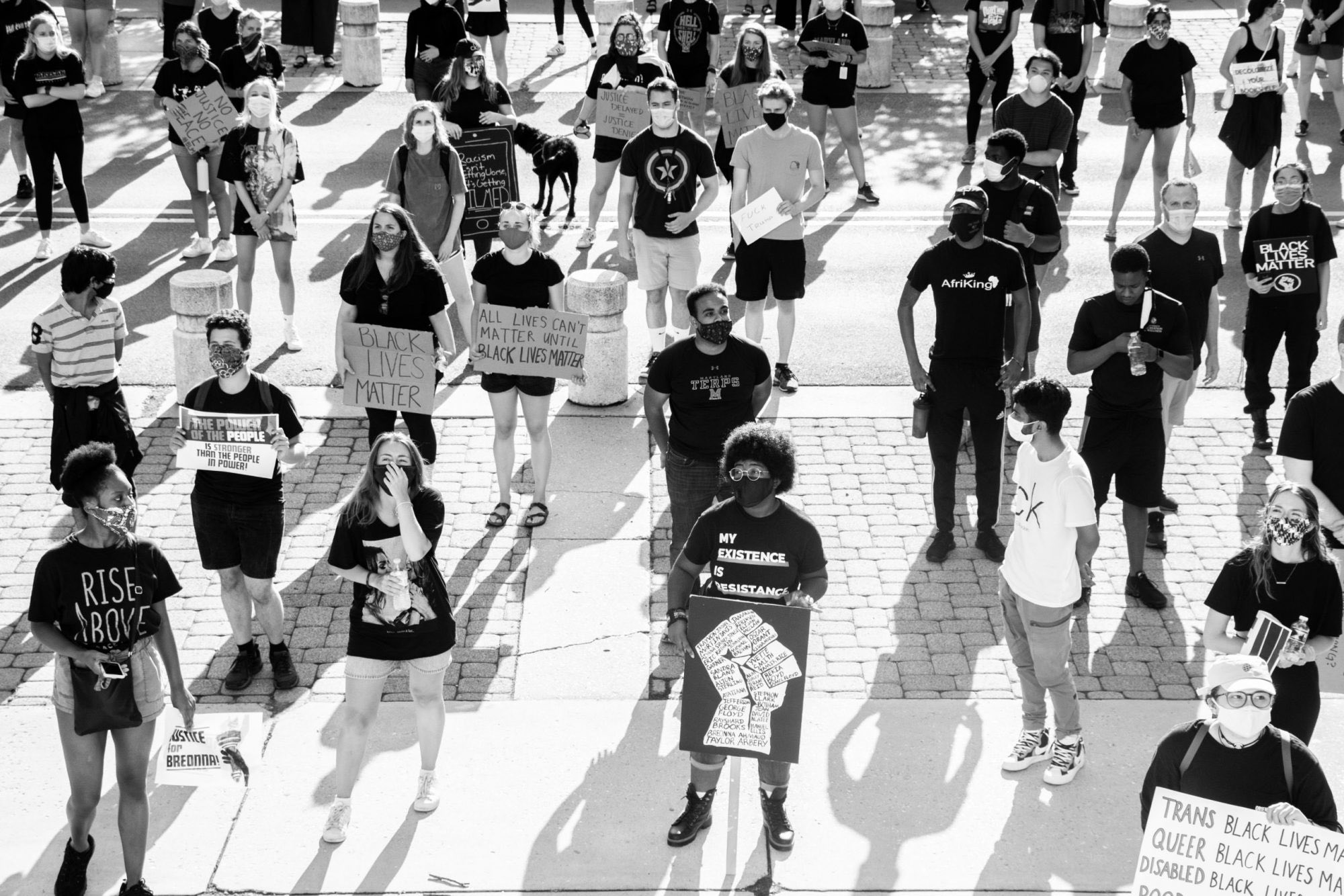
Black Terps Matter
Mission Statement - 8/09/2020
Black Terps Matter is a grassroots anti-racist communal coalition that aims to dismantle all forms and constructs of systemic racism and oppression at the University of Maryland. We employ transparency and intersectionality to support any and all forms of anti-racist idealism. We promote diverse experiences and perspectives substantiated by facts and data to educate expeditious activists whom we align ourselves with. We intend to hold all entities pertaining to the University accountable for every one of their actions, assertions, propensities, and implications.
Black Terps Matter organizes to:
- call attention to the urgent (though often invisible) problem to law enforcement violence against women of color and trans people of color
- collect stories from women and men of color and transgender people of color about their experiences with law enforcement violence to use as further evidence of how gender- and race-based oppression are used to target us
- build strong networks among other Black-led organizations at the University of Maryland to strengthen our ongoing work addressing violence
- advocate for and develop community-based alternative responses to addressing domestic and sexual violence so that survivors are not forced to rely on police and prisons
- make critical partnerships with groups organizing against police brutality and prisons to support a critical gender analysis when considering what police and prison violence looks like and how to end it; and with groups addressing “violence against women,” such as anti-domestic violence and anti-rape organizations, to use a critical race analysis and expand our notion of “violence against women” to include state-sponsored violence such as law enforcement violence
- make connections between all kinds of law enforcement (including local and state police; immigration enforcement such as ICE, Border Patrol, and Customs; Drug Enforcement Agents; the FBI; private security agents; and military forces) so that we better understand - how local police collaborate with immigration police, how local police are often trained by military forces, how U.S. neighborhoods are actually occupied by military forces (such as in post-Katrina New Orleans), how military violence abroad is connected to police and military violence in the U.S., how private security contractors play a critical role in the function and violence of law enforcement
- make connections between gender-policing and gender violence targeting transgender people of color and non-trans women of color
Related Content:
Smart Terps
Terps!
We created this website in hopes of providing a space for UMD student-athletes to learn, listen, and support one another in the midst of the anti-black violence that has once again sparked an outcry for justice. As community members and leaders, we must recognize and acknowledge that the issues of police brutality, white supremacy, and systemic racism have been ingrained in our society for hundreds of years.
It is our responsibility to do the work in dismantling such systems as they continue to plague our culture and harm our Black and Brown friends. We believe that in order to be actively anti-racist individuals within an actively anti-racist institution, we must educate ourselves and help educate one-another about our country's history of Black oppression. We must also be allies in amplifying Black voices, in order to cultivate change on the interpersonal and institutional level.
We stand with our Black friends and student-athletes and commit to doing the work in ensuring that they have the opportunity to not just 'matter,' but to thrive.
The compiled resources are of various content and form, and we encourage feedback and critiques for making this site as useful as possible. Within each section of information, we have included comment boxes that are meant to facilitate discussion, suggestions, and the sharing of experiences. This resource is solely for UMD athletes, so we welcome any thoughts or ideas about the ways in which our school and athletic program can take part in anti-racist initiatives and change.
Project STAND (Student Activism Now Documented)
Project STAND brings together information about student activism archives from colleges and universities.
Project STAND Podcast: Blueprint Episode 2 - Speaking with Saba Tshibaka
- Illumination Fall 2020 - Archiving Activism
Resources for Black College Students
Black college students can access resources designed to rectify historical imbalances, including scholarships, financial aid, career development opportunities, and student groups.
Black undergraduate enrollment increased significantly from 2000-2010, but declined over the last decade. For schools, encouraging Black enrollment means providing additional resources to combat systemic disadvantages Black students face. These include social clubs, organizations, and career-oriented assistance programs. Black students can also network with alumni, explore opportunities for employment, and find funding to further their education.
Find out more at The Best Schools Resources for Black College Students Page
Do Good Institute
Want to be an ally but not sure where to start? Members on the Do Good team have been using this working list of resources that meet you where you are.
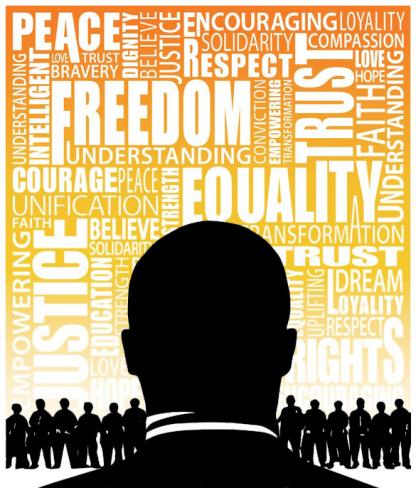
School of Architecture, Planning and Preservation (MAPP)
Take a look through this list of news articles, how-to guides, podcasts, videos, action steps and more on topics related to anti-racism and how race and racism intersect with the built environment. This is a living document and is updated regularly.
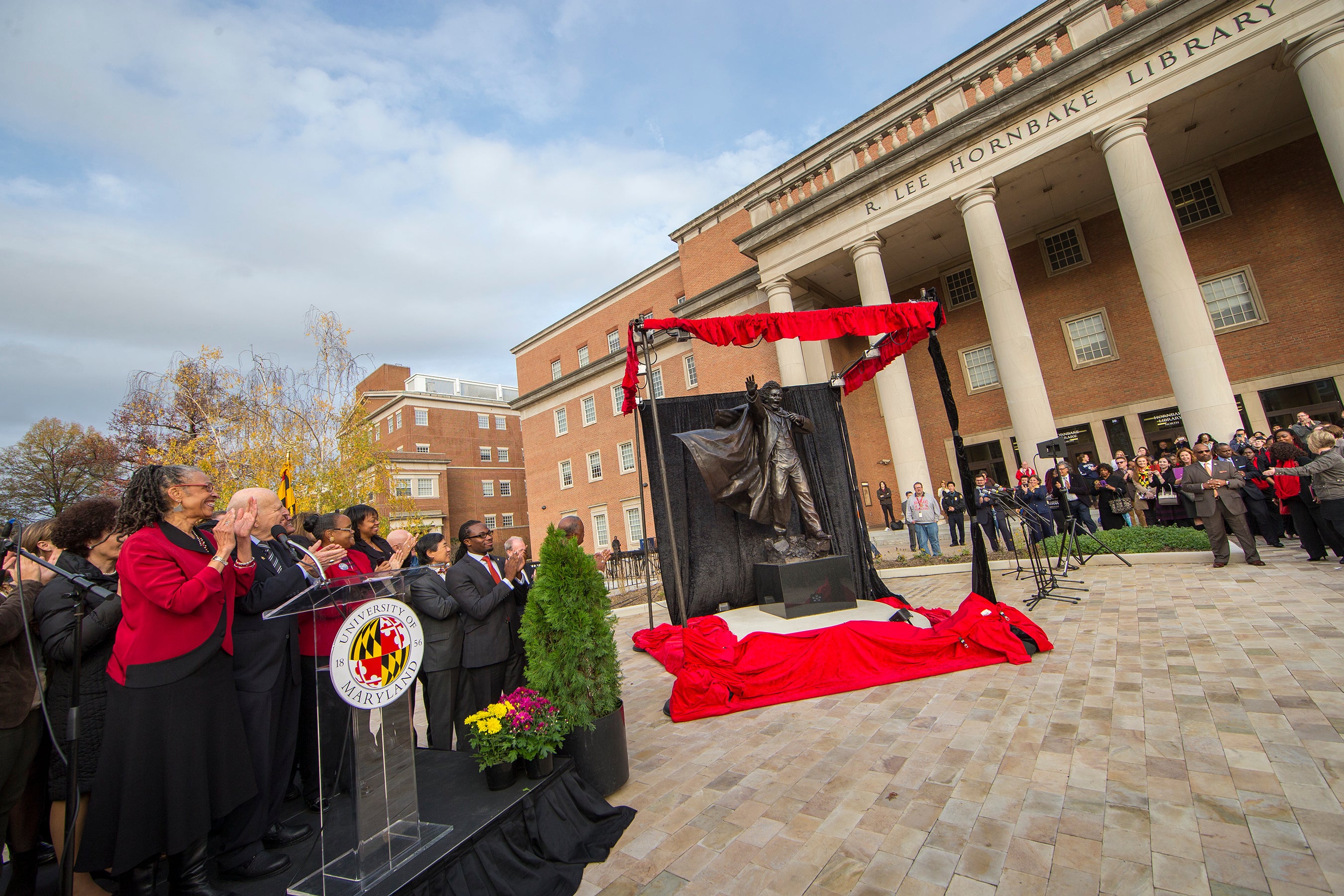
University of Maryland Dedicates Frederick Douglass Square to Honor Maryland’s Native Son
7 1/2-foot-tall bronze Douglass statue to be unveiled, memorializing Douglass as an enduring role model for social justice.
November 18, 2015
COLLEGE PARK, Md. – The University of Maryland today dedicated a memorial on campus to honor abolitionist Frederick Douglass, a son of Maryland who has come to represent America’s quest for freedom, liberty and the rights of all people in a democracy.
The square is a commemorative public space centered on UMD’s Hornbake Plaza, a prominent campus location and hub of student activity. The square features stone pavers and a vertical corten wall, both engraved to highlight Douglass’ words. The wall is built in planters filled with native Irish and Maryland plants to represent Douglass’ roots in Maryland and Irish supporters abroad. In the center, an 71/2-foot-tall bronze statue portrays an urgent and youthful Douglass in Ireland, created by renowned sculptor Andrew Edwards and inspired by the Frederick Douglass Ireland Project.
At a formal dedication and unveiling ceremony held today, UMD officials commemorated Douglass’ life and legacy, including University President Wallace D. Loh; Dean of the College of Arts and Humanities Bonnie Thornton Dill; and Distinguished University Professor and internationally recognized expert on slavery, Ira Berlin. In addition, special guests from Douglass’ family, Nettie Washington Douglass, who is Douglass' great-great-granddaughter, and Kenneth B. Morris Jr., his great-great-great-grandson, paid tribute to Douglass.
“Frederick Douglass’ soaring words on racial justice and the transformative power of education resonate as fully today as they did in his lifetime,” said University of Maryland President Wallace D. Loh.
For more than five years, a group of campus leaders called the North Stars worked to secure funding and approve architectural and landscape designs for the square. The total cost of the square amounted to $575,000, which included funding from UMD, private donations, the Maryland Commission on African American History and Culture, and the Maryland Historical Trust, which is part of the Maryland Department of Planning.
“Frederick Douglass Square was created to teach what Douglass has advocated, as well as what he continues to inspire us to do,” said Distinguished University Professor Ira Berlin, who spearheaded the North Stars group. “We memorialize Frederick Douglass in the center of campus in a space that is both classroom and monument. It is a place to contemplate and celebrate the ideals that Douglass exemplified.”
In addition to the square, the work of Frederick Douglass is intertwined into the research and curriculum of the university in many ways. UMD Libraries houses an interpretive exhibition featuring the images and works of Frederick Douglass. The exhibition, “Frederick Douglas: Scholarship and Legacy,” provides insight into Frederick Douglass’ life and legacy, and is organized by three themes that exemplify Douglass scholarship at UMD, including Mark Leone’s archaeological investigations into Douglass and other enslaved people in Maryland; Ira Berlin’s scholarship on the history of slavery that helps one see Douglass as an international human rights leader; and Robert Levine’s cultural and historical scholarship on 19th-century American literature that illuminates Douglass’ role as a dynamic orator and brilliant writer. The exhibition includes a digital installation featuring Douglass portraits and quotes, as well as archaeological artifacts from the early 19th-century plantation landscape that he remembered as a child.
Frederick Augustus Washington Bailey was born a slave in Talbot County, Maryland in 1818. He was later sent to a family in Baltimore, where he secretly taught himself to read and write. After a failed escape attempt in 1836, he eventually fled to New York two years later, changed his name to Frederick Douglass, and joined the abolitionist movement to end slavery.
In 1845, Douglass traveled to Ireland focused on the abolition of slavery in the American south, however left with a much broader perspective. After meeting Irish Catholics who were also born into servitude and the “Great Emancipator” of Irish Catholics, Daniel O’Connell, Douglass became an advocate for the liberty and equality of all, whatever their race, sex, religion or nationality. Douglass became an internationally famous advocate for human rights. He lectured throughout the North and Europe, wrote a series of autobiographies and published a weekly newspaper.
Four decades after he escaped slavery, Douglass returned to Talbot County. He met with his former owners’ family, visited his birthplace, addressed crowds at the courthouse, and in 1877, dedicated the new Asbury Methodist Episcopal and Bethel African Methodist Episcopal church buildings in Easton, Maryland. Still, he continued the fight for equality and the rights of black people, women, Native Americans, immigrants and working peoples. He died in 1895.
https://arhu.umd.edu/news/university-maryland-dedicates-frederick-douglass-square-honor-marylands-native-son
Frederick Douglass Square Unveiled on Hornbake Plaza
Monument to a Hero
Frederick Douglass Square Unveiled on Hornbake Plaza
- November 20, 2015
- By Lauren Brown
A new memorial on campus dedicated to abolitionist and statesman Frederick Douglass depicts one of the most important figures in state history as he was: a man of words who was bigger than life.
Construction wrapped up this fall on a 4,500-square-foot area on Hornbake Plaza featuring inspiring quotes from Douglass carved into pavers and a new wall, plant beds, lighting and benches. An 8-foot-tall bronze statue (below) was revealed to the university community, state leaders and Douglass’ descendants at a ceremony Nov. 18, with him posed as a young agitator in mid-speech, flinging his hands in the air, his cape and coat flapping behind him.
Distinguished University Professor Ira Berlin, a historian and authority on American slavery, organized the effort among a small group of faculty and administrators to commemorate him on Maryland’s flagship campus.
“Douglass spoke to or embodied all of the things that we believe in: equality, education, self-improvement and women’s rights,” Berlin says.
Douglass was born a slave on an Eastern Shore plantation around 1818, and was sent to serve his owner’s relatives in Baltimore around age 10. He defied rules forbidding slaves from learning to read or write, and began speaking out against slavery as a teen. He later escaped, and settled in Massachusetts.
During the 1840s, when fears ran high that Southerners would capture Douglass and return him to slavery, he fled to Ireland, then Britain. Finding conditions for the Irish poor as wretched as for slaves back home, he began refining his positions on freedom and civil rights—and his oratory.
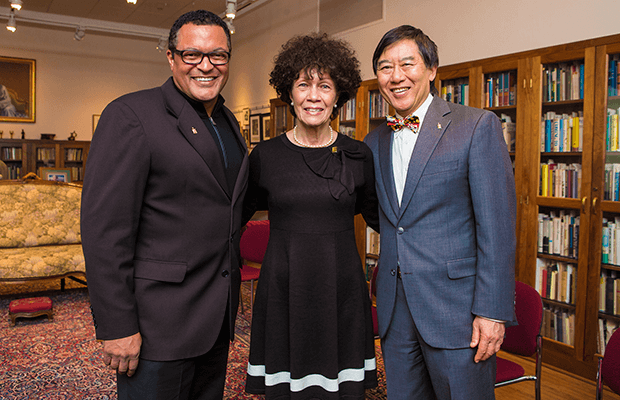
Vice President for Research Patrick O’Shea, a native of Cork and avid historian, helped dedicate a plaque to Douglass in 2012 at the site of his last speech in that city. There O’Shea heard about a Welsh sculptor’s plans for a new statue, and he helped connect UMD with sculptor Andrew Edwards.
The statue’s construction and delivery were funded in part with money raised by UMD’s group pushing the project, known as the North Stars (named after the guiding direction to freedom and one of Douglass’ newspapers).
Douglass’ importance is already reflected on campus in varied ways: anthropology Professor Mark Leone is researching the Wye Plantation, where Douglass was enslaved; English Professor Robert Levine is editing two of Douglass’ autobiographies and writing a book on him; and doctoral students have a yearlong project with University College Cork on Douglass’ impact.
Frederick Douglass: A Journey from Maryland to Ireland, and Back.
Frederick Douglass: A Journey from Maryland to Ireland, and Back.
Frederick Douglass, a former slave from Talbot County, Maryland, inspired the abolitionist movement in Britain, Ireland, and the U.S. He spoke passionately about his fight for freedom and eventual escape from slavery during his 1845 visit to Cork, Ireland. The Frederick Douglass Statue on Hornbake Plaza at the University of Maryland stands as a memorial to honor his contributions. Created by Andrew Edwards, the sculpture depicts the young Douglass in the full flow of an oration, as he would have appeared during his visit to Ireland in 1845. He is shown with one arm outstretched and a copy of his autobiography tucked under the other, standing astride water that represents the Atlantic Ocean, with Irish wildflowers at his feet. The installation includes benches, lighting, plant beds, and many of Douglass's quotes carved into pavers and a steel wall. The statue's presence is unique in UMD’s history, as it is the first statue on campus of a person not affiliated with the University.
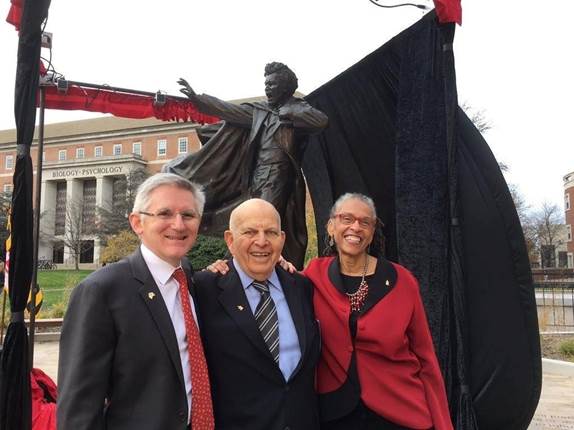
The original dedication ceremony for the Frederick Douglass statue took place on November 18, 2015, marking the end of an extensive journey that began in 2011 to honor the famous human rights activist, orator, and writer. Through his connections in Ireland, Vice President and Chief Research Officer Patrick O’Shea helped the university acquire the piece after learning of Dr. Ira Berlin and the North Star committee’s intent to recognize Douglass. Work on the design began in Ireland around 2011, aligning with the committee's initial planning. Dr. O'Shea commemorated the 10th anniversary of the statue on November 18, 2025, alongside members of the TerrapinStrong Committee. Also, as part of the 10th anniversary of the installation of the statue, a team from the College of Information developed an interactive game, The Frederick Douglass Square Adventure. More information is available below:
Frederick Douglass Square
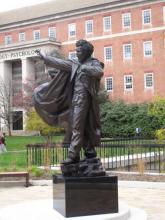
Dedicated in 2015, this garden prominently honors one of Maryland’s greatest native sons, Frederick Douglass, on Hornbake Plaza. Born into slavery on the Eastern Shore of Maryland, Douglass taught himself how to read and write, teaching others as well. He escaped from slavery and went on to become a powerful orator, a counselor to presidents, and a leader in the fight to end slavery and for equal rights among all men and women. This garden area pays homage to his legacy with a bronze statue of Douglass mid-speech and his words etched in stone pavers and cut into a steel wall. As Dr. Loh notes, we honor Douglass “as an enduring role model for social justice and the transformative power of education—values that are at the core of our institution's mission.”
The garden beds are filled with native Maryland plants. Funding came from private gifts, UMD Foundation funds, and grants from the Maryland Commission on African American History and Culture and the Maryland Historical Trust.
In 2016, Floura Teeter Landscape Architects won the Merit Award for their design from the Maryland chapter of the American Society of Landscape Architects.
This site was renovated with new plant material in summer 2021, following the COVID-19 pandemic.
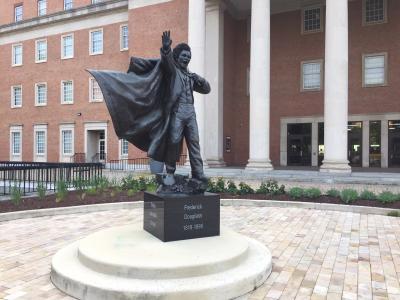
https://arboretum.umd.edu/frederick-douglass-square
UMD Black History Month tour honors Frederick Douglass, Thurgood Marshall
UMD Black History Month tour honors Frederick Douglass, Thurgood Marshall
February 22, 2019

The statue of Frederick Douglass in Hornbake Plaza. (Fatemeh Paryavi/For The Diamondback)
By Fatemeh Paryavi
For The Diamondback
University of Maryland students who stream past the statue of Frederick Douglass in Hornbake Plaza each day might think it’s a simple homage to the famous abolitionist and Maryland native.
But the statue holds far more meaning, said Kim Nickerson, the assistant dean of diversity and inclusion of the behavioral and social sciences college.
“The university hasn’t gotten around [to] creating a plaque to describe the features to the public, but I’ll do it for you,” Nickerson said during the tour.
The artist replicated Douglass’ outstretched arm from a photo of former President Barack Obama, Nickerson said. The long coat represents a similar one worn by former President Abraham Lincoln.
The abolitionist’s coat billows out behind him and his mouth is wide as if he is shouting into the winds of oppression, Nickerson added.
The statue was the final stop on one of the Office of Multicultural Involvement and Community Advocacy’s four Black History Month tours throughout February. It touched on notable black history landmarks across this campus.
Senior criminal justice major Marlon Taffe said the tour was eye-opening to some parts of this university’s history that aren’t well known.
Taffe was one of about 10 students, faculty and staff who trekked around campus Feb. 15. The tour began on the steps of the Rossborough Inn, the oldest landmark at this university, which Nickerson said was thought to have housed slaves at one time. They may have helped build the university when it was called Maryland Agricultural College.
Plantation owner and Maryland politician Charles Benedict Calvert used to own the Rossborough Inn, which was built at the turn of the 18th century, Nickerson said.
“History is not the past, it is the present,” he said, quoting the civil rights activist James Baldwin. “We carry our history with us. We are our history.”
Over the last six years, MICA has expanded its celebration of Black History Month to include art exhibits and expert panels on race. Last year, this university’s Office of Diversity and Inclusion commissioned a virtual tour of all the landmarks related to black history on campus.
The tour group stopped at a bench in the Memorial Chapel garden that faces southeast — toward Africa. They later stopped at the Shoemaker Building, which features a room dedicated to Thurgood Marshall, the first African-American justice to serve on the Supreme Court of the United States.
According to the story, Marshall was upset when Donald Gaines Murray — who would go on to become the first African-American to be admitted to the University of Maryland law school — was rejected from this university. Marshall walked up the steps of the Shoemaker Building demanding to know why the man was rejected, and a room was later dedicated to him.
Nickerson said the landmarks were chosen to “inspire and motivate” students, helping them realize they can achieve great things in college by seeing the accomplishments of those who have come before them.
Taffe said he initially attended the tour to earn class credit but left feeling inspired by Nickerson’s words and the various landmarks they visited.
“Like [Nickerson] was saying before, anyone can kind of make it here,” he said. “You should feel proud to be here and that you can make it.”
Derrick Peoples, a compensation analyst in the university’s human resources department, said that he was “excited to see some of the footprints where our forefathers walked and made on campus.”
I didn’t know we had such an impact on this campus,” said Peoples.
The tour was much needed “to honor the contribution and legacy [black] Americans had and still have on this campus and the country,” he said.
Derek Bowe, an academic adviser in the business school, said the tour inspired him and made him realize there is still work to be done in advocating for equality.
“That’s where the inspiration comes in — to continue to advocate,” he said.
Bowe and Taffe said more people should know about the campus tour.
“We were walking through and we were saying a lot of these things people just walk by and don’t really notice,” Taffe said of the landmarks. “I feel like we should really know what’s behind the makeup of our university.”
https://dbknews.com/2019/02/22/umd-campus-tour-black-history-month-landmarks-frederick-douglass/
Frederick Douglass Statue Preservation
October 01, 2022
Who Was Frederick Douglass?
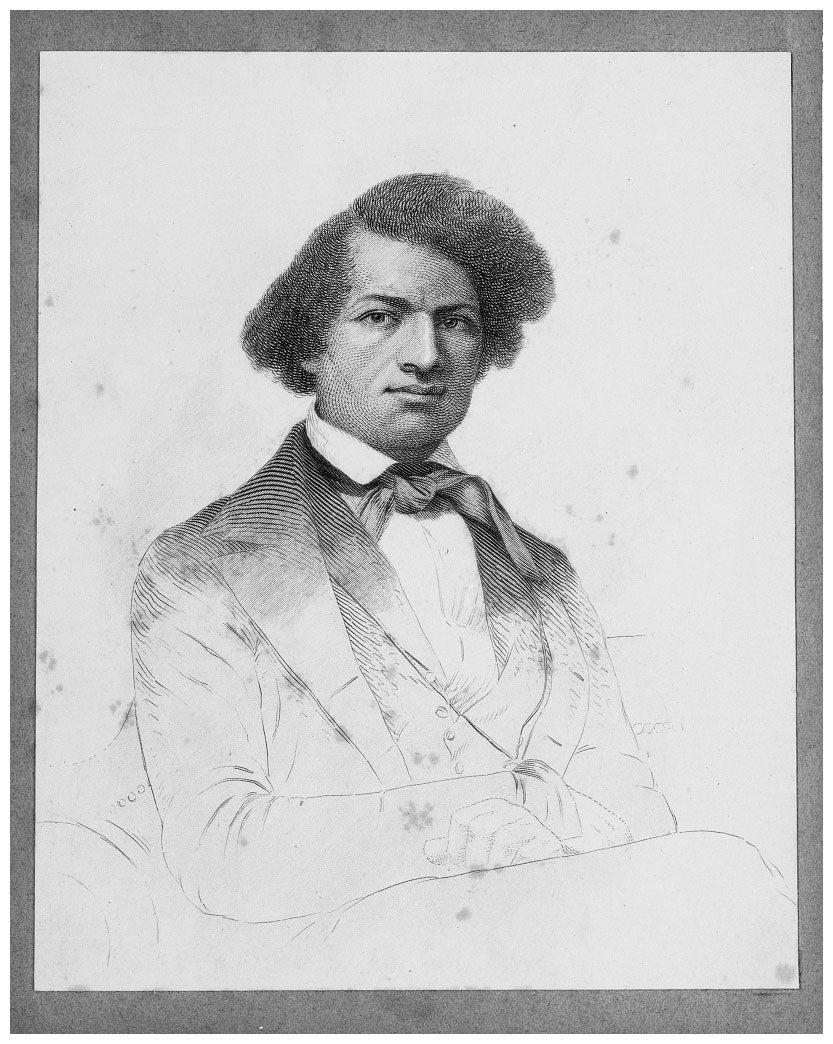
Frederick Douglass in an 1845 image that was
used in his first autobiography, which is the book
he holds in the statue at UMD.
Born a slave on Maryland’s Eastern Shore in 1818, Frederick Douglass rose to heights unimaginable for an African American in the mid-1800s. After his escape to freedom in 1838, he began to attend abolitionist meetings. He became a newspaper writer and publisher, orator and ambassador for African American civil rights. He also embraced and argued for women's rights, especially the right to vote. He would write and publish three autobiographies - the first in 1845 to dispel rumors that such an articulate and powerful orator could not possibly have been born an illiterate slave. At this time, he traveled to the British Isles to escape possible capture and a return to slavery. While there, he continued to speak against slavery. He especially felt a kinship with the Irish people, relating to them as another group repressed by authority. Abolitionists in the region took up a collection to purchase his freedom so Douglass could return to America with no fear of a return to slavery.
After the Civil War, Douglass soared even higher, holding government positions that included U.S. Marshall for the District of Columbia, D.C Recorder of Deeds and Consul General to Haiti. Douglass died on February 20, 1895 at his home in the Anacostia neighborhood of Washington D.C.
About the Statue
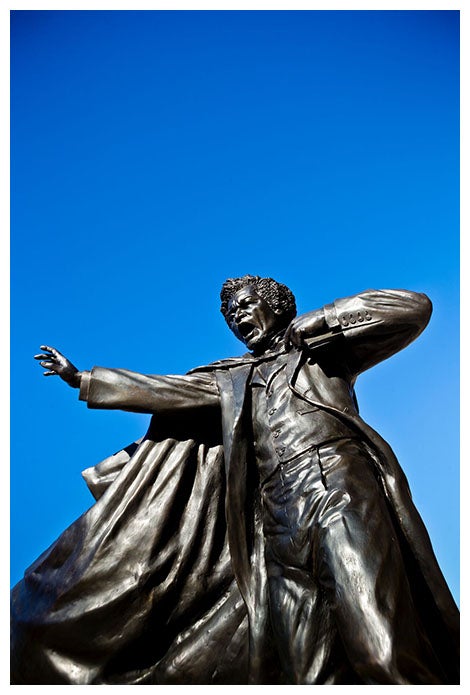
The Fredrick Douglass statue was created by British sculptor Andrew Edwards. The bronze statue portrays a youthful Douglass in Ireland, where he visited, traveling extensively and delivering his anti-slavery message. It stands on a 3-foot-tall base and weighs nearly half a ton.
The statue captures Douglas delivering his words with the passion and ferocity he was known to exude – mouth open wide, hand outstretched, autobiography tucked under his arm. His cape billows in the wind as he stands, proud, determined, and fearless. Edwards described the sculpture as “a symphony of inspirations” - everything from a pose in an ancient Greek statue of Demosthenes and photos of modern President Barack Obama, the long coat of Abraham Lincoln and the cape of Irish liberator Daniel O’Connor.
The statue was brought to the University as a result of years of effort on the part of campus leaders to honor this important Marylander and to reaffirm the University's commitment to social justice. It was installed and dedicated at its current location in November 2015.
Preserving an Icon
After 7 years in the often harsh and ever-changing College Park weather, UMD Facilities Management is restoring the bronze to its original glory – cleaning and treating the sculpture with care, repairing its stately granite base, and creating a long-term stewardship model to ensure this important testament to history serves future generations of Terps as a place for education and reflection. This effort is the first of several phased improvements and restorative efforts to the Square and is expected to be completed by late October 2022.
Historic Documentation
To help mitigate risk associated with movement and repair of the statue, 3-D scans are used to capture an accurate representation of the sculpture in its current state and environment. UMD historic preservationists use two different technologies to create a photo realistic, scaled, digital image.
The LIDAR (light detection and ranging) laser scanner sits on a tripod and slowly spins around the sculpture gathering millions of measurements from different positions. Multiple scans are stitched together to create a single comprehensive scan that includes both the statue and its environment. Laser scanning provides scale measurements and 3-D coordinates, but the final appearance of the model isn’t lifelike. While this type of scanning captures color, it is not photo realistic.
Photogrammetry uses two-dimensional photography to create precise measurements of three-dimensional objects. About 5000 photos will be used for the Fredrick Douglass sculpture. This technology can also help fill in any gaps in the laser scan data. Photogrammetry renders a photo realistic model and calculates the geometry of the object, but doesn’t provide scale. It shows the shape of an object, but not its size.
The best of both worlds – By combining these two technologies, preservationists can create a final model that includes the accuracy of the laser scanner with the photo realism of photogrammetry and provide spatial context.
The Conservation Process
A small crane will be used to lift and relocate the statue, but most work will be performed by hand. The statue will be carefully removed from its base and stabilized before moving it to a new on-site location for conservation. Dirt and corrosion will be removed and patina will be applied to even the color. The final touch is a coating with microcrystalline wax and a buff to create an even sheen and protect the bronze from the weathering effects of the outdoor environment. Once work is complete, the sculpture will be put back in place. The project conservator will also provide a written conservation report with a long-term care plan and photos capturing the sculpture before, during, and after cleaning and repair.
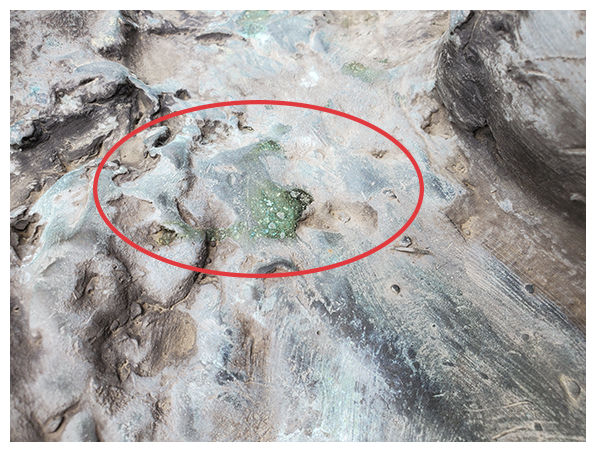
Damage like this appears in many locations on the statue.
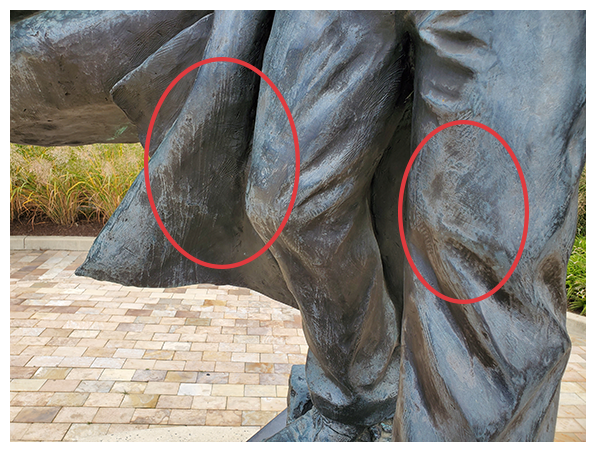
Areas like this will be repaired and sealed to prevent future damage.
https://facilities.umd.edu/frederick-douglass-statue-preservation
A New Look for a Maryland Icon
A New Look for a Maryland Icon
Frederick Douglass Statue to Undergo Conservation
 Photos by Stephanie S. Cordle
A conservation crew will remove rust and stains and repair cracks in the bronze Frederick Douglass statue following its removal from its base. The work will be done on site over the next three to four weeks.
October 11, 2022
The 7.5-foot-tall bronze likeness of Frederick Douglass is about to move from his perch overlooking Hornbake Plaza. But he won't go far: just about 15 feet from his usual spot. And it won’t be for long: three to four weeks while he and his granite base get spruced up.
Following a painstaking effort that began yesterday to carefully separate the statue from its pedestal, the University of Maryland’s monument to the Maryland-born abolitionist, orator and statesman is undergoing a short conservation process.
A team from Stromberg Conservation will strip its microcrystalline wax, a coating that sculptors often use on outdoor sculptures to protect them from the elements. After cleaning off rust spots and the green patina that naturally forms on bronze, the team will restore the wax coating and place the statue back on its granite pedestal, said Kristy Long, executive director of operations, maintenance and utilities in Facilities Management, which is handling the project.
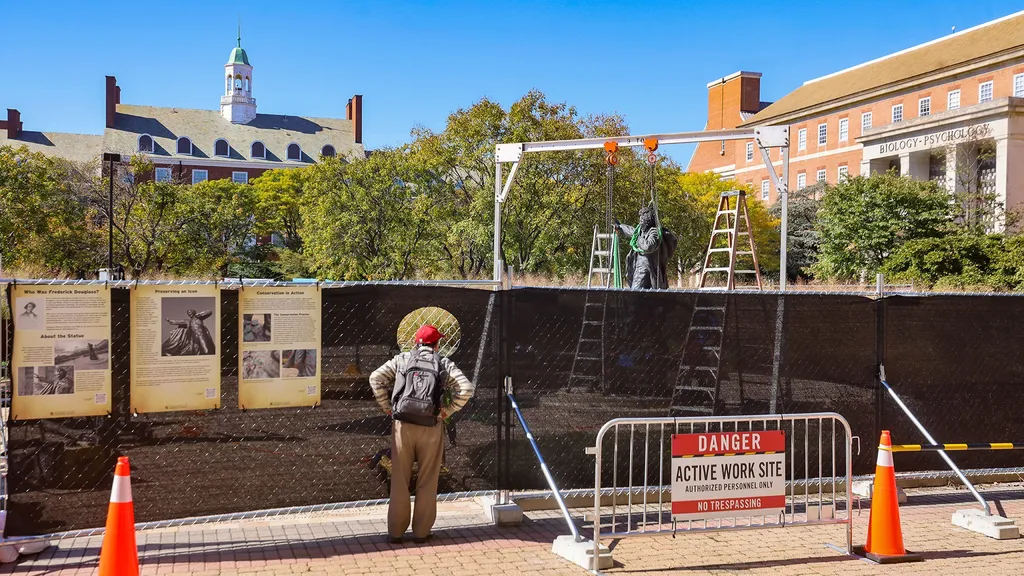
On Friday, Stefan Woehlke, postdoctoral associate in historic preservation, and graduate student Janet Adesina used laser scanning and 2D imaging to create a reference for the conservationists: “the most accurate real-world representation of Frederick Douglass Square,” he said.
He wasn’t kidding. Woehlke and Adesin stood their device in a tripod that rotated very slowly as it took 45 million measurements from just one scan over the course of 10 minutes. In total, the pair planned to gather 18 to 20 scans.
The statue by British sculptor Andrew Edwards and the surrounding Frederick Douglass Square were dedicated in 2015, honoring his role in advocating for social justice, his place in Maryland history and his ties to Ireland, where he spent time in 1845 and 1887. He was born in Talbot County, Md., then was sent as a teen to Baltimore, where he learned to read and write and eventually escaped bondage and headed to New York City.
The statue depicts Douglass as a young man, in mid-speech with one arm raised dramatically, while the plaza features some of his memorable quotes as well as Maryland and Irish plantings.
“Frederick Douglass Square was created to teach what Douglass has advocated, as well as what he continues to inspire us to do,” said the late Distinguished University Professor Ira Berlin, who led the faculty group that fundraised for its construction, at its dedication. “We memorialize Frederick Douglass in the center of campus in a space that is both classroom and monument. It is a place to contemplate and celebrate the ideals that Douglass exemplified.”
https://today.umd.edu/a-new-look-for-a-maryland-icon
Legendary Poet, Activist and Educator Nikki Giovanni to Help Inaugurate New Frederick Douglass Center
Legendary Poet, Activist and Educator Nikki Giovanni to Help Inaugurate New Frederick Douglass Center
April 08, 2024
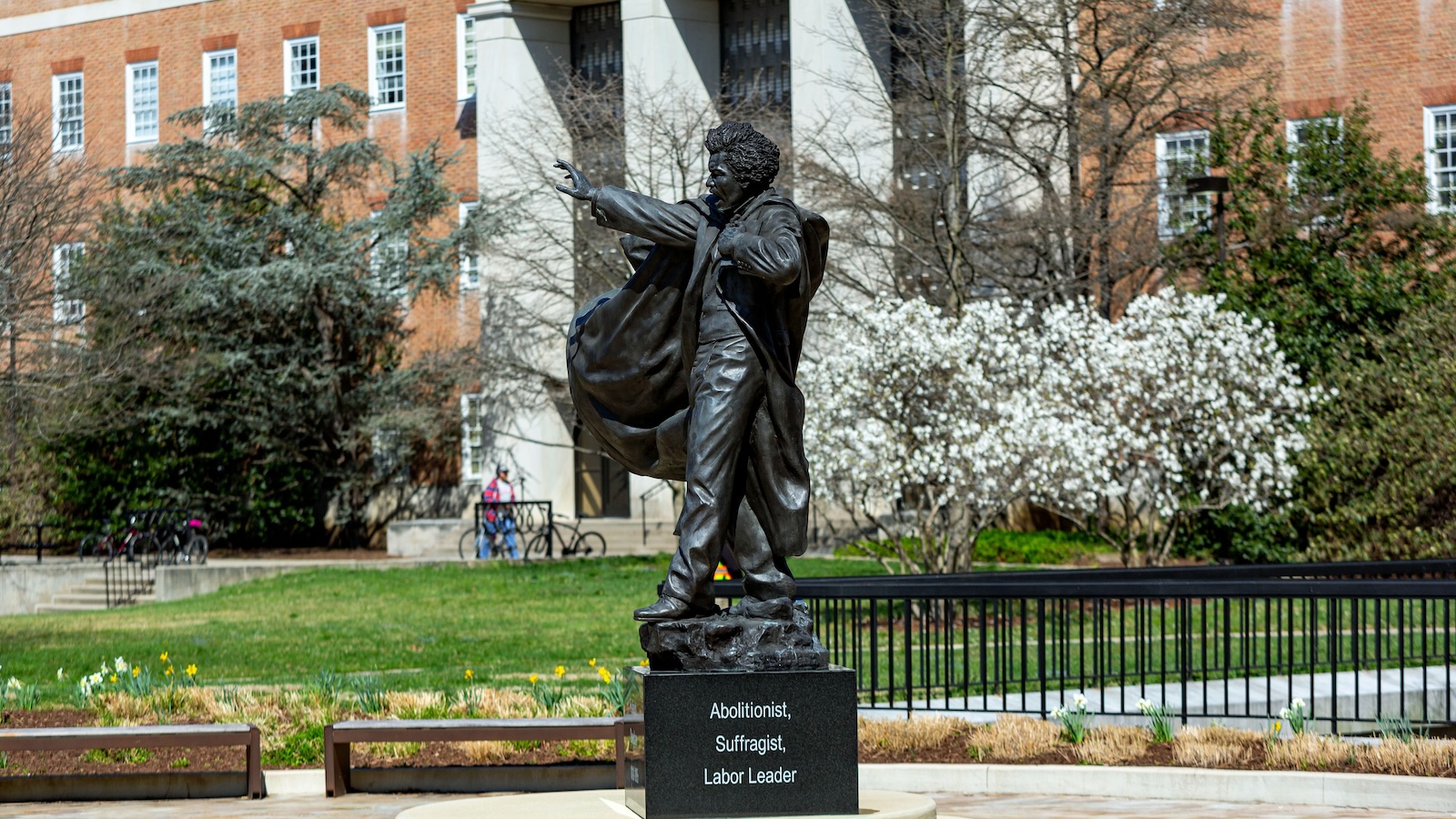
The center is dedicated to engaging diverse communities—both at the university and well beyond—around issues of social justice and equity.
By Jessica Weiss ’05
The author of two dozen books and a revered voice on issues at the core of American consciousness, like race, gender, love and family, Nikki Giovanni will visit the University of Maryland on April 24 to discuss her work and lifelong commitment to the arts and humanities in an intimate conversation.
It marks the official launch of the College of Arts and Humanities’ (ARHU’s) new Frederick Douglass Center for Leadership Through the Humanities, dedicated to engaging diverse communities—both at the university and well beyond—around issues of social justice and equity and creating leaders with values rooted in the humanities. The center’s activities, which include varied learning and funding opportunities, public events and more, seek to embody the core values of abolitionist Frederick Douglass, who was born into slavery in Maryland and went on to become a prominent writer, orator, publisher, civil rights leader and government official.
Giovanni, too, paved her own path. After self-publishing her first poetry collection in 1968, she published numerous volumes of poetry, nonfiction works, illustrated children’s books, collections of essays and multiple recordings. Her poetry seeks to uplift the Black experience. She is the recipient of countless honors and awards including the Langston Hughes Medal and several NAACP Image Awards, and has also taught and lectured at universities all over the world.
At UMD, she’ll be in conversation with ARHU Associate Dean and Douglass Center Director GerShun Avilez, professor of English, and ARHU Dean Stephanie Shonekan, professor of ethnomusicology, followed by a Q&A with the audience.
“Giovanni is an artist, an activist, an educator—she captures everything that we think that Douglass’ legacy embodies,” said Avilez. “We couldn’t think of a better person to help us celebrate the launch of the center.”
Shonekan said the center stems from her persistent, lifelong belief that society would be far more “literate, empathetic, knowledgeable and communicative” with leaders who are humanists. She arrived at the university in 2022 eager to put that into practice, and came up with the idea while walking on campus one day.
“As my wonderful dean team was thinking about this shared belief, I happened to walk by the statue of Frederick Douglass outside Hornbake, and the idea to create a leadership program based on the humanities crystallized,” she said. “There is no other Marylander that exemplifies leadership through the humanities—the power of reading, writing, thinking, communicating, ethics, language and culture—more than Douglass.”
Rather than focusing on humanities scholarship alone, Shonekan and her team envisioned a center that would have a life both on and off campus, helping the university community and the public to think about leadership and activism in the 21st century and how the humanities can help address social issues.
The center has an “expansive understanding of leadership,” Avilez said, and seeks to reach teachers, community activists, artists and many others who may not necessarily consider themselves as such.
It has held programming since last summer, when it ran an online “Humanities Institute” for middle and high school teachers from across the region. Led by UMD faculty, participants learned about a range of topics—like cheating and morality in the context of chat GPT; teaching Frederick Douglass’ narrative; and how to integrate hip-hop and pop culture into the classroom—as a way to bring critical perspectives rooted in the humanities into their teaching. The institute will be held in person this summer.
And last month, the center presented a screening of “Lowndes County and the Road to Black Power,” a documentary that tells the story of citizens and activists who faced violence and oppression in the struggle for the right to vote in Lowndes County, Alabama, a rural, impoverished town with a vicious history of racist terrorism. The event included a Q&A with three veteran organizers from the Student Nonviolent Coordinating Committee, who reflected on their activism in the 1960s. It was attended by over 100 people, most of whom were area teachers and community activists.
The center is also running two grant programs to support faculty and graduate students’ publicly-engaged research. And more opportunities will be announced soon for undergraduates.
“We want everyone on campus to understand the value of the humanities,” Avilez said. “Whether history, ethics or equity, the humanities have always helped us understand complex social problems; they've always given us a way of imagining new and better futures.”
The Frederick Douglass Center Launch With Poet Nikki Giovanni, which is co-sponsored by the College of Arts and Humanities, the Division of Student Affairs and Arts for All, will be held Wednesday, April 24, from 5:30-7:00 p.m. in the Brendan Iribe Center’s Michael Antonov Auditorium.
https://arhu.umd.edu/news/legendary-poet-activist-and-educator-nikki-giovanni-help-inaugurate-new-frederick-douglass
5 Frederick Douglass Artifacts You Never Knew Were at UMD
5 Frederick Douglass Artifacts You Never Knew Were at UMD
Libraries’ Special Collections Holds Early Editions of Abolitionist’s Books, Handwritten Poem, Pamphlet
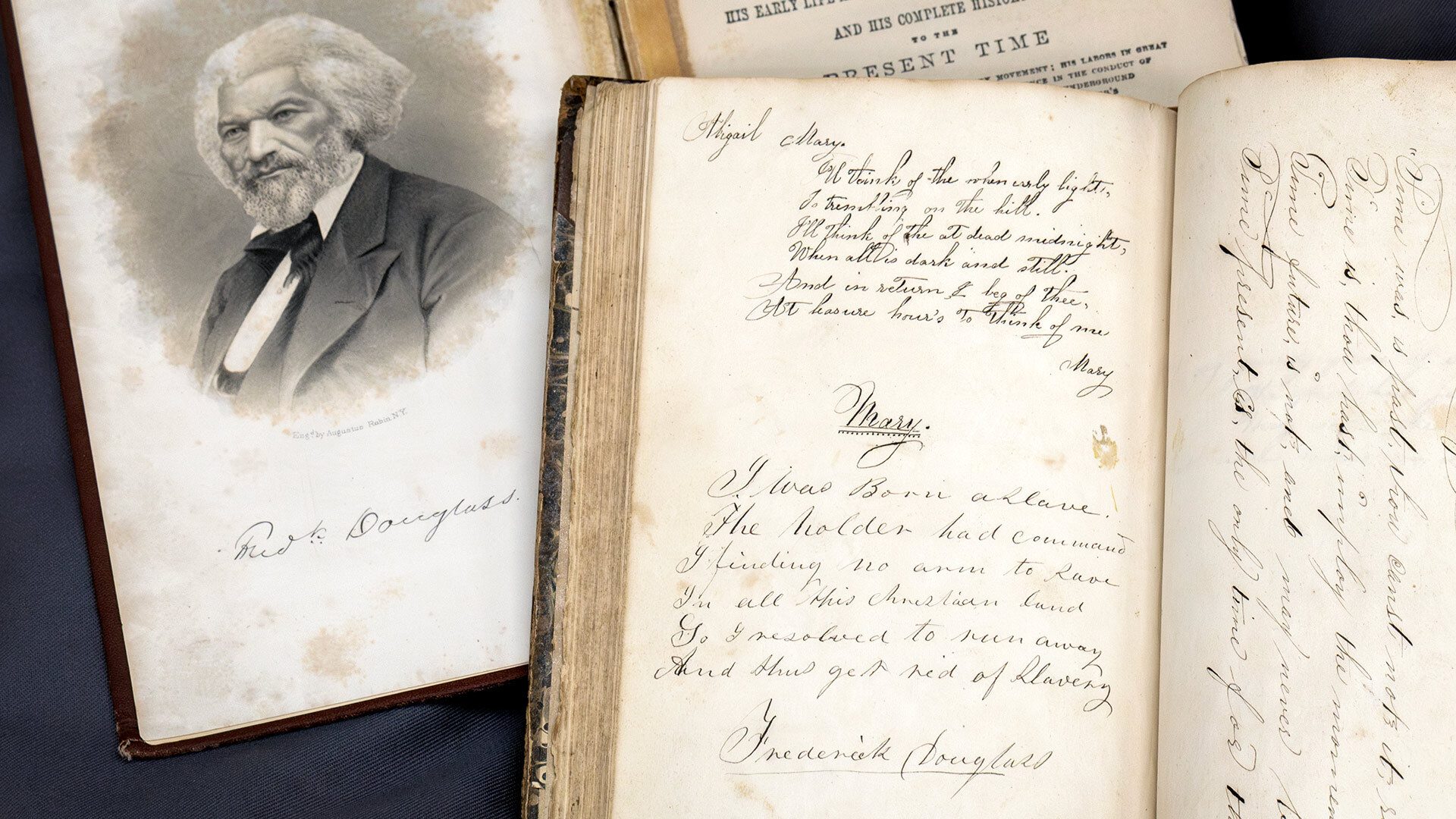
Among the Frederick Douglass works in Special Collections and University Archives at UMD Libraries are an early edition of “Life and Times of Frederick Douglass," left, and a handwritten poem and signature in a Marylander's memory book, right. (Photos by Stephanie S. Cordle)
- February 11, 2026
- By Karen Shih ’09
You’ve probably walked past the statue of a striking young Frederick Douglass in mid-speech overlooking Hornbake Plaza dozens of times. But if you take just a few more steps into the library behind it, you can read elegant script penned by the orator, abolitionist and statesman himself—and get a firsthand look at how the famed Marylander spread the word about the cruelties of enslavement and advocated for freedom in the 19th century.
The University of Maryland Libraries’ Special Collections and University Archives, housed primarily at Hornbake Library, features a treasure trove of materials by advocates of emancipation, including numerous works by Douglass.
Through primary sources at UMD, people can trace Douglass’ “life story, and his movements across the country as he continued to speak at organizations and spread the message of abolition and anti-slavery” said Jeannette Schollaert, outreach and engagement librarian. “It's really interesting to see how this one man helped to power a movement … and how he contributed to national and international history.”
These materials are accessible to UMD researchers and students, such as those who visit Hornbake for instruction sessions like those in the College Park Scholars’ Justice and Legal Thought program, as well as external community members interested in genealogy. Anyone can make an account with Special Collections and request a time to view the items, which are usually stored in climate-controlled areas.
“It might seem like Special Collections appointments are only open to folks with a set research question or that you need to be writing a dissertation to justify your appointment, but no,” said Schollaert. “If you are curious and want to hold these materials in your hands, get in touch. We’re happy to help you.”
In honor of Douglass’ birthday, celebrated on Feb. 14, here are five items he wrote that you can see at UMD.
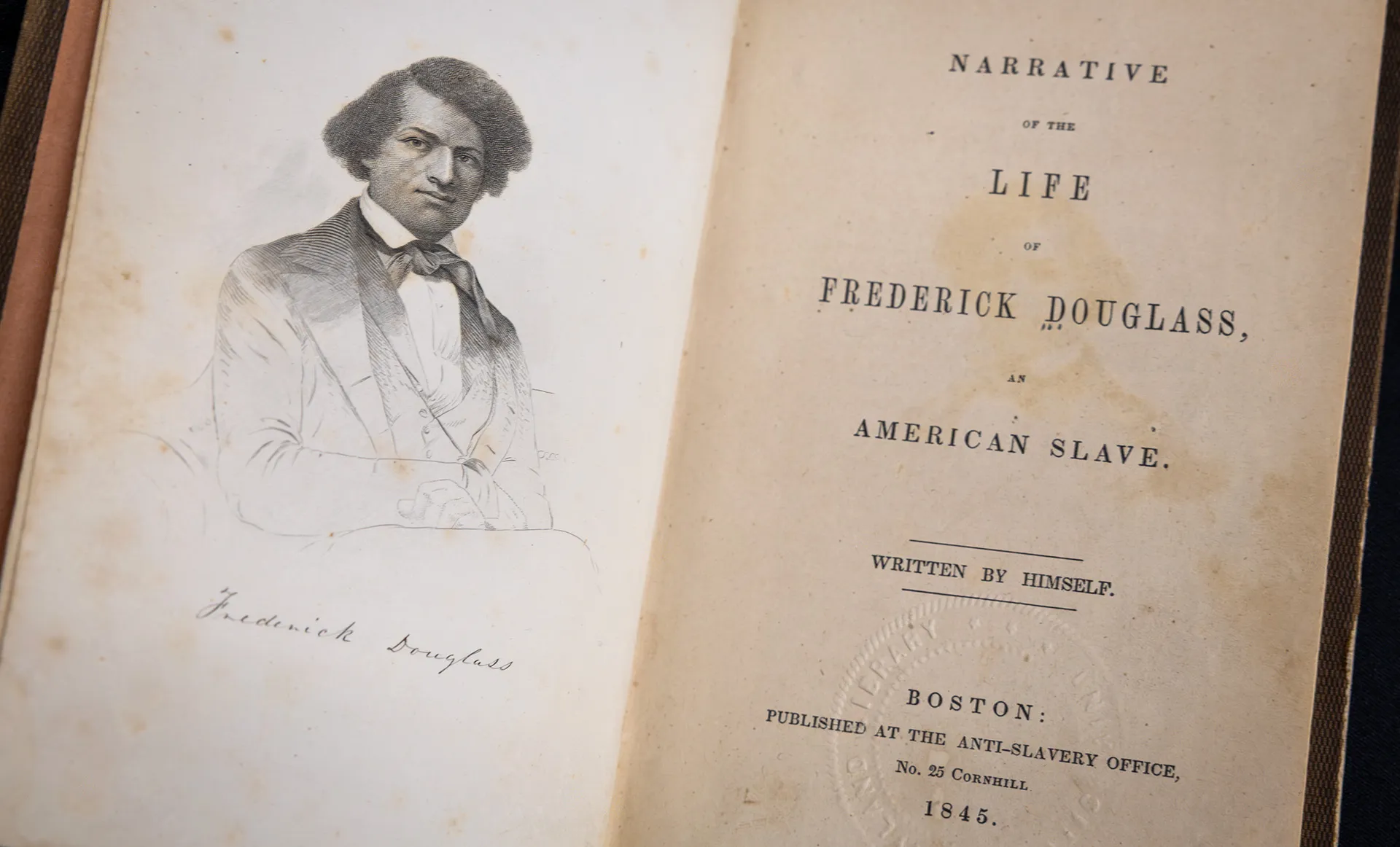
“Narrative of the Life of Frederick Douglass”: This first edition of his initial autobiography from 1845, detailing his early life as an enslaved person on the Eastern Shore and Baltimore and eventual escape in 1838, became one of the most influential pieces of the abolition movement. “Whenever I bring students in to look at rare books, they think they're copies,” said Amber Kohl, curator of literature and rare books collections. But “this is what, if you lived in Frederick Douglass’ time, you would have purchased if you went to the bookstore.”
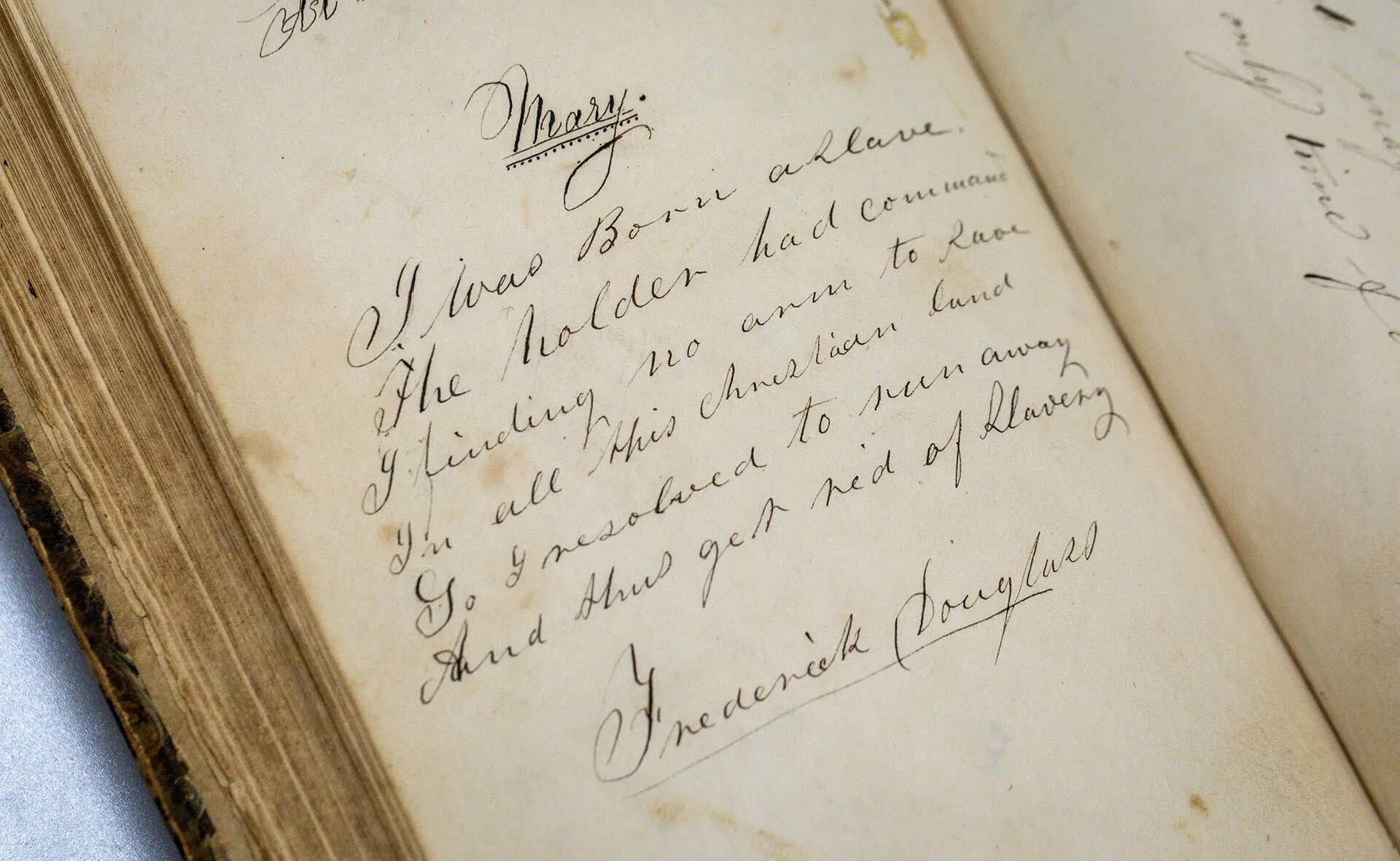
Abigail Fisher’s memory book: This notebook of a Maryland resident, dated to between 1825 and 1847, features a poem handwritten by Douglass as well as his autograph. The poem reads: “I was born a slave / The holder had command / I finding no arm to save / In all this christian land / So I resolved to run away / And thus get rid of slavery.” He wrote versions of this poem in other guestbooks as he championed liberty for African Americans across the country. Knowing that he wrote those words by hand, “you get chills and a sense of wonder,” said Schollaert.
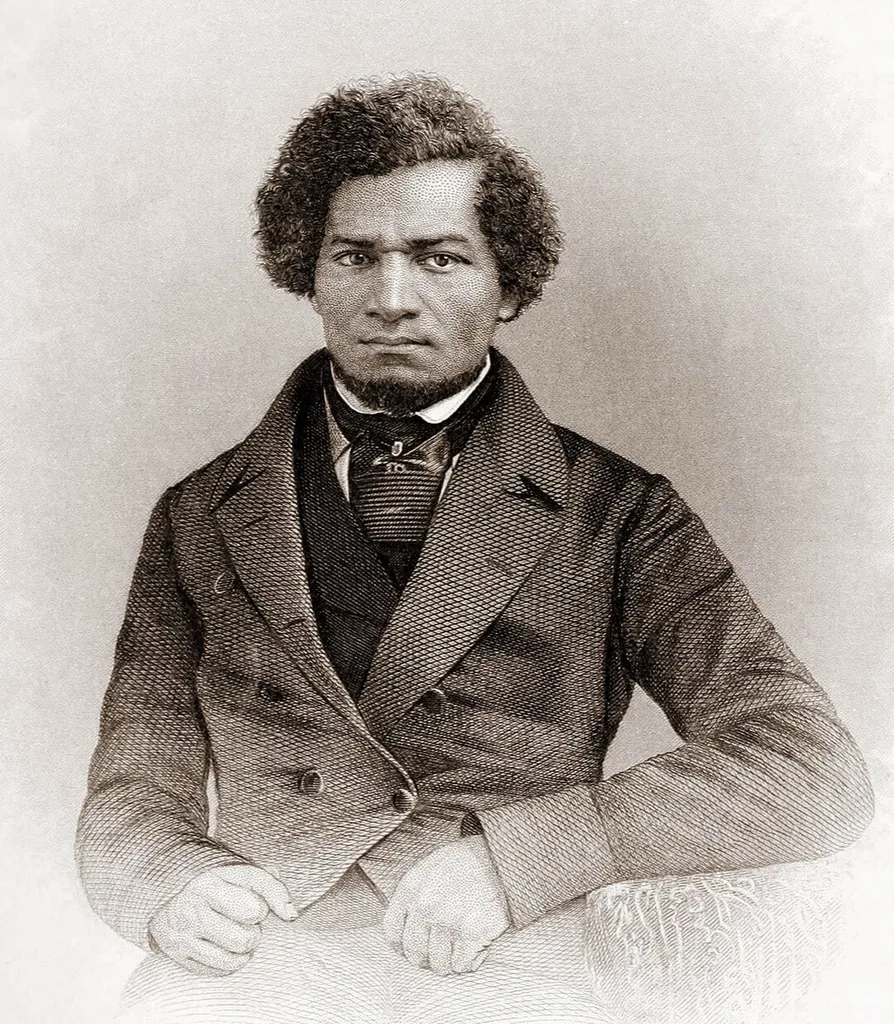
“My Bondage and My Freedom”: The 1855 autobiography, another first edition, expands on his journey to freedom and explores his advocacy for not only abolition, but also women’s rights, and his work as a speaker and newspaper publisher. In addition to the Douglass biographies, Special Collections also has early editions of “12 Years a Slave,” written in 1853 by Solomon Northrup, a free man kidnapped and sold to the South, and “Slavery in the United States,” by Charles Ball in 1837, a fugitive enslaved man who was born in Calvert County, Md. “With these narratives, there's always the question who's writing it? Whose perspective is this? Is this a white person writing on behalf of someone else? Has it been significantly edited? When the narrative is a first hand account of a genuine lived experience, it lends more power and authenticity to the historical resource,” said Kohl.
“Equality of all Men before the Law”: Pamphlets were inexpensive to print and distribute in the mid-19th century, said Kohl. “The purpose is to get the word out about abolition, spread awareness and education about, and rouse public support for the cause.” This one published in Boston in 1865 features speeches by William D. Kelley, Wendell Phillips and Douglass, including his famous quote, “What I ask for the negro is not benevolence, not pity, not sympathy, but simply justice.”

“Life and Times of Frederick Douglass”: Written after the Civil War in 1881, the book reveals new details about his life as an enslaved person that would have previously put him in danger, as well as chronicles his encounters with Presidents Abraham Lincoln and James Garfield. A later edition with a striking embossed red cover, depicting Douglass as an older man, is currently on display on the first floor of Hornbake Library as part of its “Unboxing Innovation” exhibition.
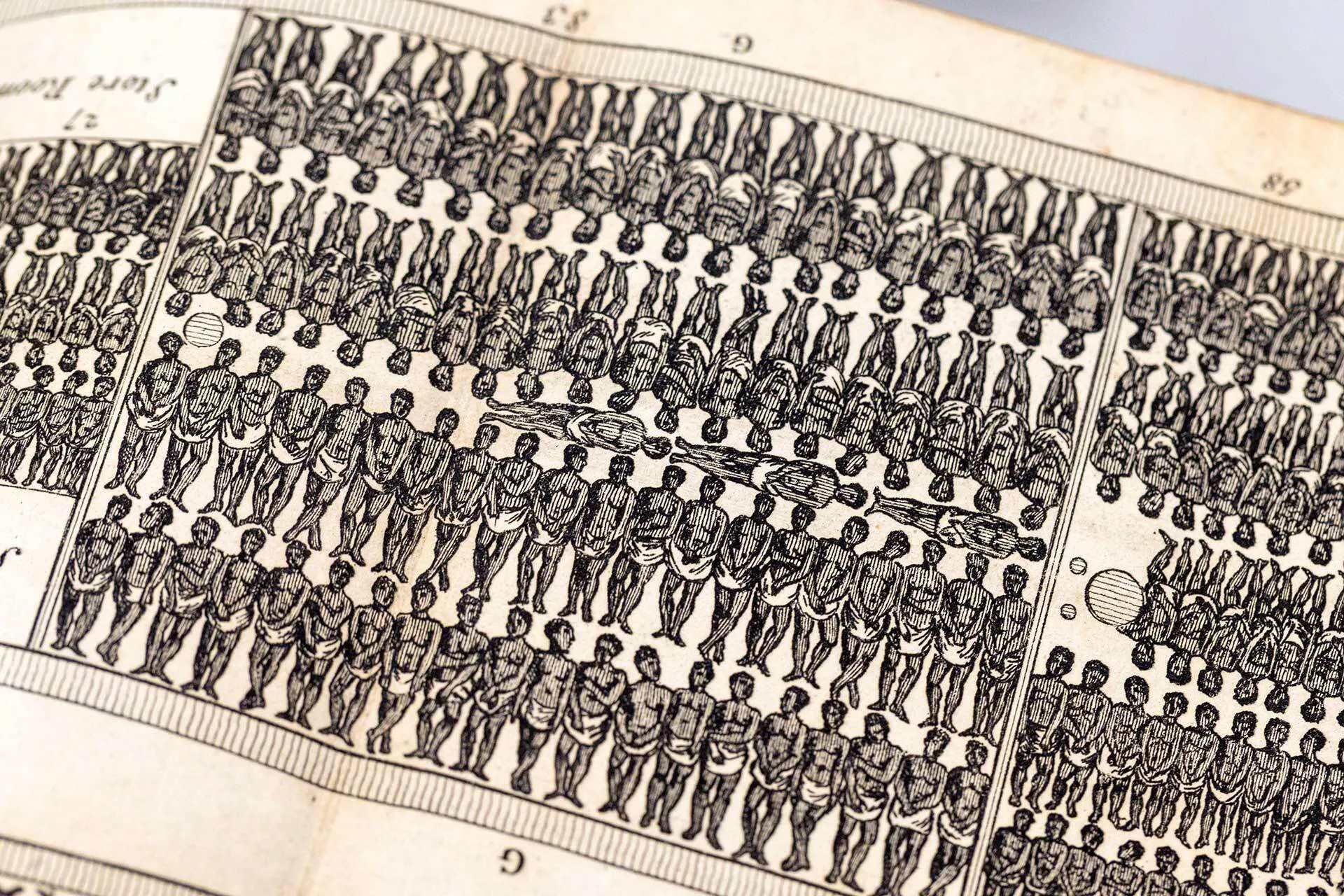
Bonus: “The History of the Rise, Progress and Accomplishment of the Abolition of the African Slave-Trade by the British Parliament” by Thomas Clarkson: Though not a work by Douglass, this 1808 book contains a fold-out diagram depicting the inhumane transportation of enslaved people arriving in ships from Africa. “It becomes a lightning rod for the abolitionist movement. The imagery is so striking, it becomes a symbol for people rallying against slavery,” said Kohl, noting that it was reprinted in broadside posters and pamphlets to further the cause. “When you think about images in history that provoke real change, the impact of this illustration was massive.”
https://today.umd.edu/5-frederick-douglass-artifacts-you-never-knew-were-at-umd
This struggle may be a moral one, or it may be a physical one and it may be both moral and physical, but [it] must be a struggle. Power concedes nothing without a demand. It never did and never will.
Frederick Douglass

Take a look at the Office of Belonging & Community dedicated Events page and the Instagram account for updates on events and opportunities for solidarity and reflection.